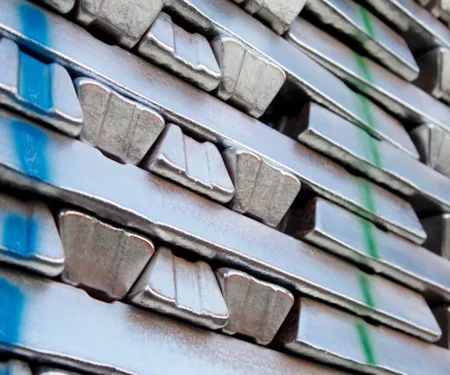
Aluminium Bahrain B.S.C. (Alba), the world's largest smelter ex-China, has announced its fourth quarter and full-year results for 2024, reporting an impressive growth in financial output, coincided with its new high of net finished production at 1,622,261 tonnes.
Image source: Aluminium Bahrain B.S.C.
In the fourth quarter of the year, the company yielded a profit of BD37.1 million (US$98.6 million), which was 58.5 per cent higher than a profit of BD23.4 million (US$62.2 million) earned in Q4 2023. For the full year, Alba reported a profit of BD184.5 million (US$490.8 million), up by 56.4 per cent from BD118 million ($313.9 million).
Alba's comprehensive income in Q4 2024 was BD38.1 million (US$101.3 million) against BD16.3 million (US$43.2 million) a year ago – up by 134.4 per cent Y-o-Y. For the full year, the income was BD183.4 million (US$487.8 million) compared to BD106.7 million ($283.8 million) in 2023. Basic and Diluted Earnings per Share was fils 130 in 2024 versus fils 83 in the previous year.
Total equity as of December 31, 2024, was BD1923.9 million (US$5,116.9 million), up by 7.5 per cent Y-o-Y from BD1789.2 million (US$4,758.6 million). Total assets were BD2673.4 million (US$7,110 million) versus BD2553.6 million (US$6,791.4 million) in 2023.
Increased production and sales volume and boosted aluminium prices on the London Metal Exchange (LME) were the two primary factors that drove Alba's strong financial results. As per the report, Alba's primary aluminium sales volume stood at 1,611,638 tonnes for the entire year, up 1 per cent Y-o-Y despite market challenges. Value-added sales emerged at 1,157,328 tonnes after growing by 5.6 per cent Y-o-Y, accounting for 72 per cent of the total shipments.
On the one hand, the global aluminium price on LME averaging US$2,419 per tonne in 2024, up by 7 per cent Y-o-Y, backed Alba's financial growth; higher alumina prices, on the other hand, partially offset its gains.
Alba attributed its sales growth to a 3 per cent increase in global aluminium demand. As an ambitious aluminium producer, the company is committed to expanding its production and supply to meet worldwide demand. In November 2024, Alba's CEO, Ali Al Baqali, affirmed the company's goal of becoming one of the world's leading aluminium smelters and producers. To achieve this, Alba is forming strategic partnerships with global companies. With sustainability at the core of its growth strategy, Alba has collaborated with Daiki Aluminium to establish a sustainable aluminium dross processing facility in Bahrain, designed to produce 25,000 tonnes annually.
Al Baqali said: "The local market accounts for approximately 25 per cent of Alba's sales, while we target global markets in Asia, the US, and Europe with a range between 18 per cent and 22 per cent. However, the latest geopolitical challenges like the war between Ukraine and Russia in addition to the tensions in the Red Sea area have added pressure on shipping costs and guarantees, which made the company change its strategy swiftly."
To enhance its global competitiveness while further reinforcing its commitment to sustainability and innovation, Alba has collaborated with Saudi Arabian Mining Company (Ma'aden), allowing Ma'aden to acquire a 20.62 per cent stake for $1 billion. This strategic transaction positions Ma'aden as a key shareholder in Alba, which views the partnership as an opportunity for both operational excellence and overall growth.
Alba's macroeconomic outlook
Alba anticipates continued market volatility in 2025, driven by the potential revival of trade tensions, including the possible reinstatement of paused tariffs on Canada and Mexico. Additionally, renewed discussions on EU sanctions against Russian aluminium further contribute to the uncertain market outlook.
On the demand front, Alba expects a gradual recovery in the second half of the year, following a period of sluggish global demand persisting through the first half. Meanwhile, supply growth is expected to remain limited as China approaches its 45 million-tonne capacity cap.












_md.webp)
_md.webp)
_md.webp)