20 tonnes of aluminium, one Veyron: Why Alonso chose Bugatti chassis 8.100
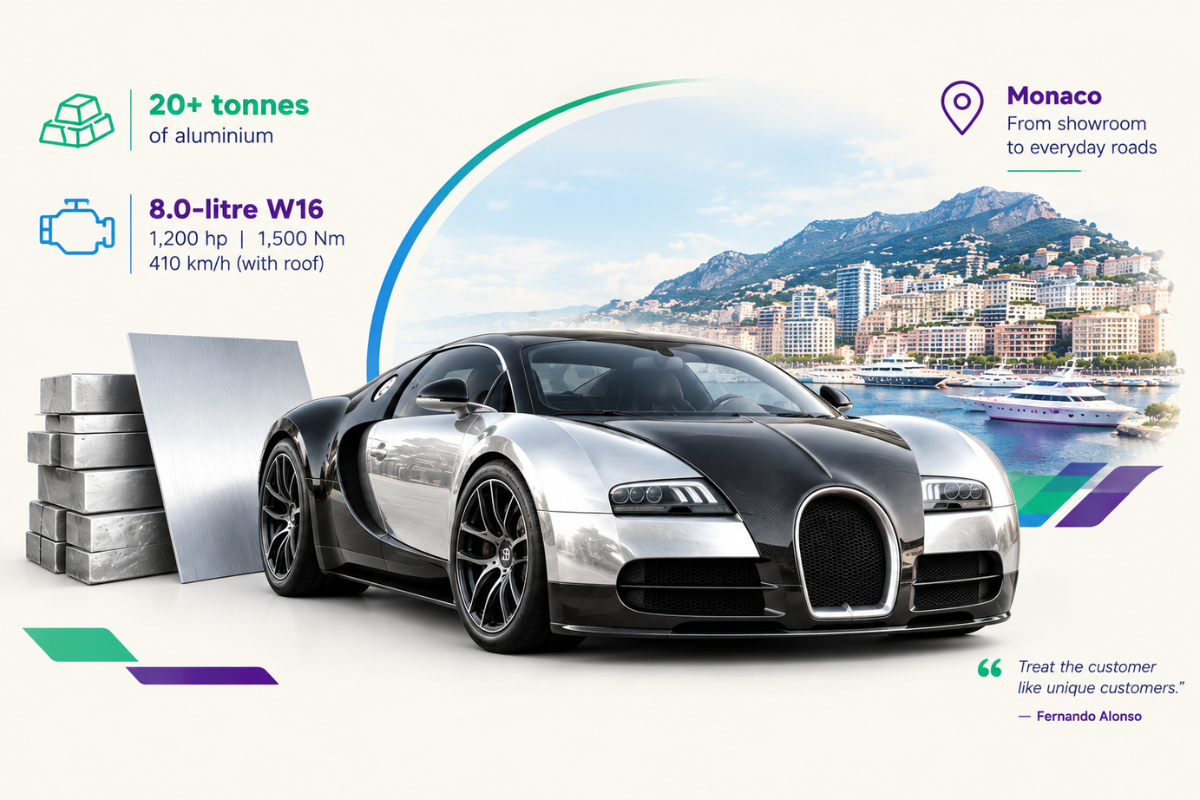
The image used in this article is generated with an AI tool and does not depict any real-time moment
Spanish racing driverFernando Alonso has added a one-off Bugatti Veyron Grand Sport Vitesse to his growing collection of rare cars. Known as chassis 8.100, the car is distinguished by bespoke aluminium bodywork that required more than 20 tonnes of aluminium to produce, along with dedicated CAD programmes developed by Bugatti. Its history is equally distinctive, being produced after an original customer pushed Bugatti to create something it had initially considered too expensive.
For Alonso, the automobile fits closely with an approach to luxury he outlined in 2024 about choosing manufacturers that treat individual customers differently rather than simply producing cars in larger numbers.
To know the aluminium casting demand forecast in the transportation sector, explore our report "Global Aluminium Casting Market 2026-2032: Plant Economics, Alloy Segmentation, Pricing Intelligence, Supply Chain Analysis & Strategic Recommendations"
A Veyron built around one customer
Chassis 8.100 was ordered from Molsheim in 2014 and delivered in 2015. Its front bumper and seamless side panels were milled from solid aluminium blocks and polished, contrasting with the otherwise exposed carbon-fibre body.
Underneath the bespoke bodywork sits the standard Grand Sport Vitesse specification: an 8.0-litre W16 engine with four turbochargers, producing 1,200 horsepower and 1,500 Nm of torque. With the roof in place, the car can reach 410 kilometres per hour. Its options bill alone exceeded the Vitesse's approximately EUR 1.69 million (USD 1.94 million) pre-tax list price.
According to Mechatronik, the first owner already possessed a Veyron Pur Sang and had ordered all six Grand Sport Vitesse Legends editions, comprising three cars each from the 2013 and 2014 series, along with several Super Sports.
The resulting car covered only 750 kilometres in nine years before being consigned to a showroom near Stuttgart. Bugatti produced 450 Veyrons between 2005 and 2015, while the five-car 2007 Pur Sang had already explored the combination of aluminium and carbon fibre.
Explore aluminium products and connect with suppliers on the AL Circle B2B marketplace.
Why the one-off appeals to Alonso
The timing of the purchase is significant. In July 2024, at the Goodwood Festival of Speed, Alonso spoke about “looking forward to having a small collection.” Some luxury brands he had driven for “went into a different direction: bigger numbers,” while he preferred manufacturers that “treat the customer like unique customers.”
At the time, his planned purchases included an Aston Martin Valkyrie, one of the 38 Valiants he commissioned with a manual gearbox, and a DB5 he was pursuing through the heritage department.
The cars that have since arrived, however, have taken a somewhat different route. Alonso bought a one-off Pagani Zonda Roadster Diamante Verde and this one-off Bugatti. Both were bought from Mechatronik and delivered in Monaco.
Chassis 8.100 therefore closely matches the customised approach described by Alonso. It was created specifically around one customer's specifications and was never replicated in the same form.
Bugatti produced 450 Veyrons between 2005 and 2015. The company had already explored the combination of bare aluminium and carbon fibre with the 2007 Veyron Pur Sang, limited to five cars. Chassis 8.100 nevertheless represents a different level of individualisation, with its aluminium panels developed specifically for one customer.
Unlock key insights from industry experts on aluminium’s applications in end-use with our magazine End-user Revolution: Aluminium’s Impact on Modern Living
From nine years of storage to Monaco roads
The contrast between the first owner's use of the car and Alonso's is notable. The Veyron accumulated just 750 kilometres over nine years, averaging fewer than 100 kilometres a year during its first nine years. Alonso, by contrast, has described himself as someone who drives every day in Monaco.
The aluminium-bodied Veyron has now been seen performing that kind of everyday duty in Monaco traffic rather than remaining in showroom conditions. Its purchase price has not been disclosed, and Mechatronik has not published one.
Chassis 8.100 is a highly individual Veyron whose bespoke specifications and individuality aligned with Alonso's preference for manufacturers that treat customers as unique.
The DB5 he was pursuing in 2024 has still not surfaced, while two one-off cars bought through a German dealer have arrived within four months.
For now, that suggests his collection may be evolving around exceptional cars that become available rather than following the original shopping list exactly. The DB5 remains the missing piece in the story, while the one-off Bugatti Veyron gives Alonso a car whose unusual history and construction closely match the individualised approach he once described.
Ducati Desmo450 SM pairs aluminium frame with 63.5hp racing performance
Next articleUS aluminum tariffs push Canadian beer can costs up nearly 13%
Grow with
AL Circle