








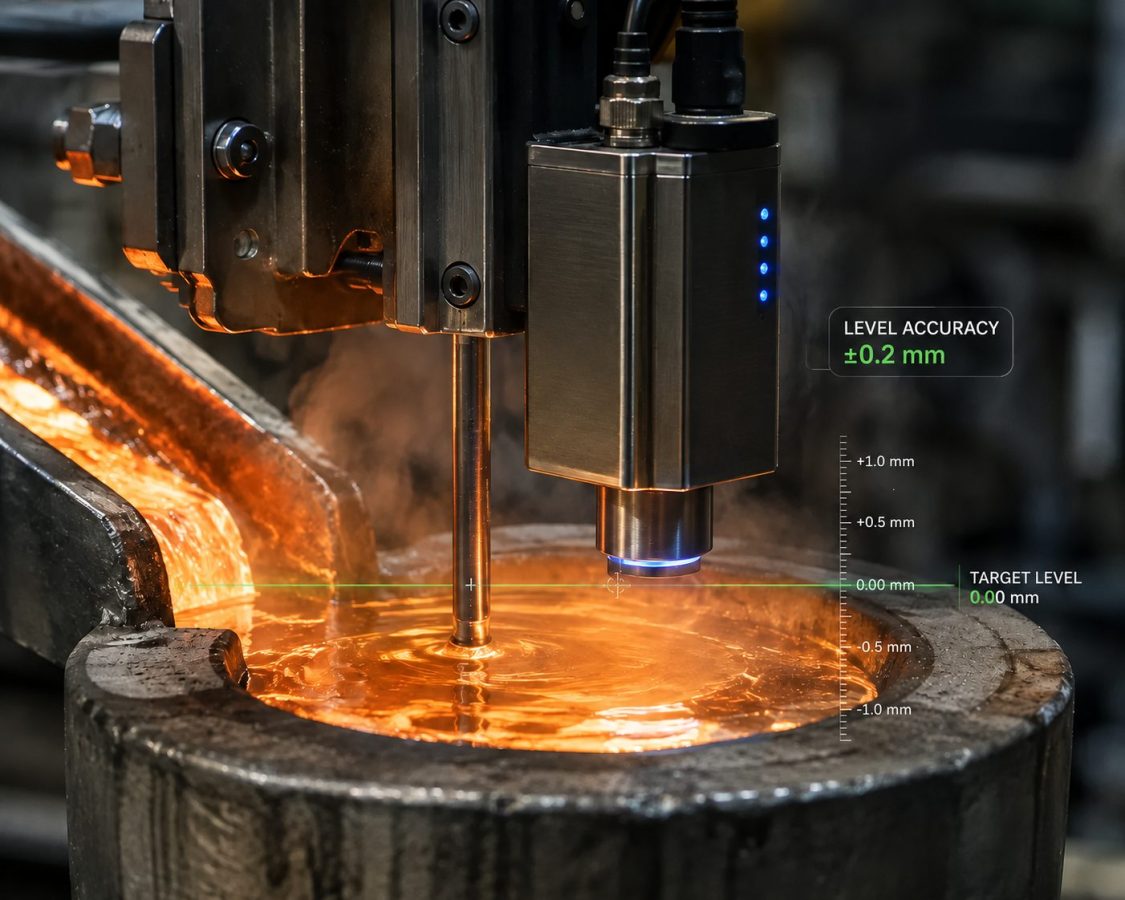
In aluminium direct chill (DC) casting, mould level is one of the process variables that operators cannot afford to ignore.
The level of molten aluminium in the mould affects how the meniscus behaves, how metal enters the mould and how the solidifying shell develops. If that level moves too far from its target, the casting process can become unstable.
The result may be surface defects, poor casting starts, process variation or, in severe cases, a safety-critical casting event.
This makes DC casting process control more than a matter of automation convenience. Accurate measurement and reliable flow control are part of the basic process.
The control principle is simple:
Measure the metal level → compare it with the target → adjust metal flow → measure again.
The difficult part is keeping that loop reliable in a hot environment with steam, smoke, flames, water and continuous mechanical movement.
This is where mould level sensors, level actuators and closed-loop casting control come in.
Why mould level matters in DC casting
During DC casting, molten aluminium enters the mould while the emerging casting is cooled and withdrawn from below.
The mould level determines where the molten metal surface sits relative to the mould. This affects the meniscus and the conditions under which the shell forms.
Several process variables interact with mould level:
- Metal temperature
- Casting speed
- Metal flow rate
- Cooling-water conditions
- Mould design
- Lubrication
- Alloy chemistry
- Solidification behaviour
- Metal cleanliness
This is why molten metal level control should not be treated as an isolated measurement task.
A change in metal flow changes the mould level. A change in casting speed can also affect the required flow. The control system has to keep these changes within a workable range.
During mould filling, the challenge is even greater. The level needs to be controlled while the moulds are being brought into operation.
GAP Engineering notes that mould filling can be difficult because flames and smoke may disturb metal-level measurement. Its MMLC system uses an inductive measurement approach and combines the GLS sensor with the GLA actuator to regulate the molten metal level during filling and steady-state casting.
That leads to an important point: Mould level accuracy is not only about getting an accurate reading. It is about getting a reliable reading early enough for the control system to act on it.
What happens when mould level is unstable?
An unstable mould level creates changing conditions at the meniscus.
A small deviation may be corrected without any visible problem. But repeated or larger changes can affect the casting process.
Potential consequences include:
- Meniscus instability
- Premature freezing at the metal surface
- Laps or folds
- Uneven surface conditions
- Unstable casting starts
- Excessive actuator movement
- Poor process repeatability
- Increased operator intervention
- Greater risk during abnormal casting conditions
The exact cause of a casting defect is rarely one variable. Cooling, casting speed, metal temperature, mould condition and alloy behaviour also matter.
But level instability can be an important contributor.
What causes surface defects in aluminium DC casting?
Surface defects in aluminium DC casting can be caused by unstable mould level, incorrect casting speed, cooling conditions, metal temperature, mould design, lubrication, alloy behaviour and metal quality.
A low or unstable metal level can allow the meniscus to freeze prematurely. Fresh liquid metal can then move over a partially solidified area, contributing to laps or folds.
This is why process engineers often look at the mould-level trend when investigating a casting defect.
The trend can show whether the level was stable, slowly drifting or repeatedly oscillating before the defect appeared.
What is a mould level sensor in DC casting?
A mould level sensor measures the position of molten aluminium inside the mould.
The measurement is sent to the casting control system. The controller compares the actual level with the required setpoint and determines whether metal flow needs to change.
A useful aluminium casting sensor needs to work in conditions that are very different from normal liquid-level measurement.
The sensor may have to deal with:
- High temperatures
- Steam
- Smoke
- Flames
- Bright metal surfaces
- Water
- Vibration
- Electrical interference
- Restricted maintenance access
This is why the measurement principle matters.
A sensor may perform well in a clean laboratory environment but behave differently when installed above a working aluminium casting mould.
Eddy-current and inductive level measurement
One approach used for molten metal level measurement is inductive sensing.
The principle uses the electrical properties of conductive molten metal to determine its position. Because the measurement does not depend on seeing the metal surface, it can be useful in environments where optical measurement is difficult.
This is one reason inductive and eddy-current technologies are relevant to DC casting level measurement.
GAP Engineering’s GLS (GAP Level Sensor) uses an inductive sensor mounted on a mechanical system that moves vertically. The company says this arrangement allows the system to extend the measurement range beyond the relatively small range of the sensor head itself.
The current AL Biz listing for the GAP Level Sensor – GLS gives a 240 mm measuring range, ±0.2 mm accuracy and 24 VDC power supply. It also specifies dry, oil-free cooling air and states that the system is designed to avoid disturbance from smoke, steam, flames and bright surfaces.
Eddy-current vs laser level sensors
A laser level sensor works differently. It measures distance by sending light towards the target and analysing the reflected signal.
Laser systems can be effective where the target surface is clearly visible.
But DC casting can present difficult optical conditions.
Steam, smoke, flames and reflections can interfere with an optical measurement. The installation position also matters.
That does not mean a laser system is unsuitable for every caster. It means the technology needs to be matched to the actual operating environment.
| Factor | Inductive / eddy-current | Laser |
| Needs clear optical view | No | Yes |
| Suitable for conductive molten metal | Yes | Yes, through optical measurement |
| Effect of smoke and steam | Generally less dependent on visibility | Can be affected |
| Bright surface reflections | Less relevant | Can matter |
| Installation requirements | Sensor and mechanical arrangement | Clear optical path required |
| Best selection method | Match to caster conditions | Match to caster conditions |
The right choice is not simply “eddy current vs laser”.
The better question is: Which measurement technology will remain reliable under the actual casting conditions?
The actuator’s role in molten metal flow control
A level sensor tells the control system what is happening.
It does not change the metal flow.
That is the role of the level actuator.
In a DC casting system, an actuator can control the position of a pin in the casting spout. Moving the pin changes the flow of molten aluminium into the mould.
The basic relationship is:
Sensor = measurement
Controller = decision
Actuator = correction
This distinction is important.
A highly accurate sensor cannot deliver stable metal flow control if the actuator is slow, inconsistent or mechanically unstable.
And a good actuator cannot compensate for poor level measurement.
How does a casting spout actuator work?
A casting spout actuator changes the position of a flow-control pin to regulate the amount of molten aluminium entering the mould.
If the mould level falls below the target, the control system can command the actuator to increase flow.
If the level rises above the target, it can reduce flow.
The actuator therefore provides the physical response to the sensor’s measurement.
The movement must be controlled and repeatable. Small corrections matter during steady-state casting.
The current specification for the GAP Level Actuator – GLA lists a 0–48 mm movement range, ±0.5 mm accuracy, 24 VDC power supply and an automatic test feature. The product is designed to position the pin in the casting spout and regulate aluminium flow into the mould.
GAP Engineering states that the GLA and GLS work together to regulate the required metal level in the mould.
Closed-loop mould level control
The basic closed-loop casting control system looks like this:
Target level → controller → actuator → metal flow → mould level → sensor → controller
The controller continuously checks the difference between the target and measured level.
If the difference is small, it makes a small correction.
If the difference increases, the controller responds accordingly.
But there is a delay in the process. The actuator moves first. The metal flow then changes. The mould level responds after that.
If the control system reacts too aggressively, it can overshoot the target.
The controller may then correct in the opposite direction.
That can create a cycle of:
High level → correction → low level → correction → high level
This is why automatic mould level control needs suitable tuning.
The aim is not to make the actuator move constantly. The aim is to keep the level within the required operating window with controlled corrections.
GAP Engineering describes its GLS/GLA system as being integrated with casting-machine PLC, PC or real-time control systems, with PID regulation used for the filling curve and actuator set values.
Why casting starts need accurate level control
Casting starts are different from steady-state casting.
The mould is being filled. The metal level is changing. The control system needs to respond as the process moves towards its operating condition.
If different moulds fill at different rates, the time between the first and last mould reaching the required level can become important.
GAP Engineering has described this filling stage as a challenge for automatic casting because conventional inductive measurement can have a relatively limited measurement range. Its MMLC approach extends the GLS measurement range and allows level regulation during mould filling.
This is where automatic casting start can be useful.
Rather than waiting until the mould is already close to its target level before regulation begins, the system can measure and control the level earlier in the filling sequence.
That can make the transition into steady-state operation more predictable.
Sensor and actuator integration
For a plant automation manager, the sensor and actuator should be viewed as parts of one control loop.
A useful system should provide:
- Stable level measurement
- Predictable actuator movement
- Suitable response time
- Position feedback
- PLC compatibility
- Fault indication
- Manual control where required
- Start-up control
- Easy maintenance
- Useful process data
The integration also needs to suit the existing casting machine.
GAP Engineering says its GLS and GLA are independent units connected to the machine through input and output signals, allowing integration into existing automation systems.
This matters in retrofit projects.
A plant does not always want to replace its entire control architecture just to improve mould-level regulation.
A modular sensor and actuator arrangement can make an upgrade easier to assess.
GLS 4.0: moving from measurement to equipment data
Modern DC casting automation is not only about controlling the process.
It is also about knowing the condition of the equipment.
This is where GLS 4.0 adds another layer.
The updated system has a digital interface alongside its existing outputs. According to GAP Engineering’s published information, the interface can connect to a computer or PLC and provides additional calibration and status-monitoring functions.
The system also monitors the temperature of the sensor head and electronic compartment.
It records information such as:
- Number of movements
- Device serial number
- Equipment status
- Temperature information
- Calibration-related information
That data can support maintenance and traceability.
GAP Engineering says the newer GLS design was developed with durability and maintenance in mind and can be retrofitted with compatible components rather than requiring the complete product to be discarded.
This is relevant to plants looking at predictive maintenance in aluminium casting.
The idea is simple.
Instead of waiting for equipment to fail, monitor its condition and investigate changes before they become production problems.
What is GLS 4.0 in aluminium casting process control?
GLS 4.0 is an updated molten metal level measurement system from GAP Engineering that adds digital communication, equipment-status monitoring, temperature monitoring and maintenance-related data to its level-sensing system.
It is not a replacement for good process control.
It provides more information to the people responsible for process control and maintenance.
The role of data in casting troubleshooting
When mould level becomes unstable, the first reaction is often to suspect the sensor.
That is not always correct.
The problem could be:
- Sensor positioning
- Sensor calibration
- Actuator movement
- Mechanical backlash
- Metal flow
- Control-loop tuning
- Casting speed
- Metal temperature
- Cooling conditions
- Mould condition
Trend data can help separate these possibilities.
For example, if the sensor shows repeated level oscillations while the actuator is moving back and forth, the problem may be related to control-loop tuning or actuator response.
If the sensor signal changes sharply while the process remains stable, the measurement system deserves closer attention.
This is why real-time metal level measurement is most useful when the data can be reviewed alongside other casting parameters.
Dross and metal cleanliness
Mould level control cannot compensate for poor metal quality.
This is particularly important when looking at the role of dross management in aluminium casting.
Dross contains aluminium and non-metallic material formed during melting and handling. Poor skimming, unnecessary turbulence and poor melt handling can increase the amount of oxide material entering the downstream process.
Filtration and degassing also play important roles in melt quality.
So a stable casting process needs more than a good level sensor.
It needs control of the complete chain:
Melt handling → dross management → metal treatment → filtration → temperature → flow → mould level → cooling → casting
Each stage affects the next.
The point of automation is to reduce avoidable variation, not to replace basic process discipline.
How to choose a mould level sensor and actuator
When buying a DC casting level sensor, do not compare suppliers on accuracy alone.
Look at the complete application.
| Parameter | What to ask |
| Measurement range | Does it cover the required filling and casting range? |
| Accuracy | Is it suitable for the required control window? |
| Response time | How quickly does it detect level changes? |
| Environment | Can it handle heat, steam and smoke? |
| Technology | Inductive, eddy-current, laser or another method? |
| Calibration | How is calibration performed? |
| Installation | How quickly can it be installed or replaced? |
| Actuator movement | Is the range suitable for the casting spout? |
| Actuator accuracy | Can it make repeatable small corrections? |
| Feedback | Can actual actuator position be monitored? |
| PLC integration | Can it connect to the existing control system? |
| Diagnostics | What equipment-health data is available? |
| Maintenance | How easy is servicing and replacement? |
| Traceability | Can equipment information be recorded? |
| Safety | What happens during signal or power loss? |
The current GLS listing gives a 240 mm measuring range and ±0.2 mm accuracy, while the GLA listing gives a 0–48 mm movement range and ±0.5 mm accuracy. These figures provide useful reference points, but buyers should always compare them with the requirements of their own caster.
Where can aluminium casting sensors and actuators be sourced?
For casthouse engineering and procurement teams, choosing a mould-level system means looking at the complete control loop.
The sensor must suit the casting environment.
The actuator must provide repeatable flow control.
And both need to work with the plant’s automation system.
GAP Engineering SA on AL Biz lists the company’s GAP Level Sensor – GLS, GAP Level Actuator – GLA and GLS 4.0 Reliability solutions. GAP Engineering specialises in industrial automation and equipment for Direct Chill and Electromagnetic casting applications.
For industry buyers, AL Biz provides a marketplace where aluminium producers can find equipment and technology suppliers and send enquiries directly. Buyers can post their requirements directly to reach 4,500+ aluminium suppliers and technology providers.
Conclusion
Good DC casting process control starts with reliable information about what is happening in the mould.
The level sensor measures the molten metal.
The controller decides what correction is needed.
The actuator changes the metal flow.
The process then provides new level information.
That closed loop has to work reliably.
Mould level is only one part of aluminium casting. Metal temperature, cooling, casting speed, mould condition and metal cleanliness still matter. Dross management and melt treatment also remain important upstream controls.
But when the level measurement is unreliable, the control system is working with poor information. And when the actuator cannot respond consistently, even a good measurement may not produce stable control.
That is why mould level accuracy, sensor reliability and actuator response deserve close attention when improving DC casting automation.
For plants reviewing mould level sensors, aluminium casting sensors, casting spout actuators, automatic metal flow control or predictive maintenance systems, relevant suppliers can be found through AL Biz.
Frequently asked questions
What is a mould level sensor in DC casting?
A mould level sensor measures the position of molten aluminium inside the casting mould. The measurement is used by the control system to regulate metal flow and maintain the required level.
How does a casting spout actuator work?
A casting spout actuator changes the position of a pin or other flow-control mechanism to regulate molten aluminium entering the mould. The controller uses the level-sensor signal to determine the required adjustment.
What is a level actuator?
A level actuator is the mechanical device that changes metal flow in response to the mould-level control signal. In a DC casting system, it can position the casting-spout pin to increase or reduce flow.
What causes unstable mould level in DC casting?
Possible causes include sensor problems, actuator movement, control-loop tuning, inconsistent metal flow, casting-speed changes, metal-temperature changes and other process conditions.
What causes surface defects in aluminium DC casting?
Surface defects can result from several factors, including mould level, casting speed, cooling, metal temperature, mould condition, lubrication and metal quality. Mould level should be investigated as part of the wider process rather than as the only possible cause.
What is the difference between an eddy-current and laser level sensor?
An eddy-current or inductive system measures conductive metal using electromagnetic principles and does not require a clear optical view. A laser sensor measures distance optically and therefore depends more on the quality of the optical path.
Why is automatic mould level control important?
It allows the casting machine to respond to changes in metal level without relying entirely on manual adjustment. This can improve process repeatability during mould filling and steady-state casting.
What is GLS 4.0 in aluminium casting process control?
GLS 4.0 is GAP Engineering’s updated molten metal level measurement system. It adds digital communication and equipment-monitoring features, including temperature and status information that can support maintenance and traceability.


 Voyagerman Technology


