








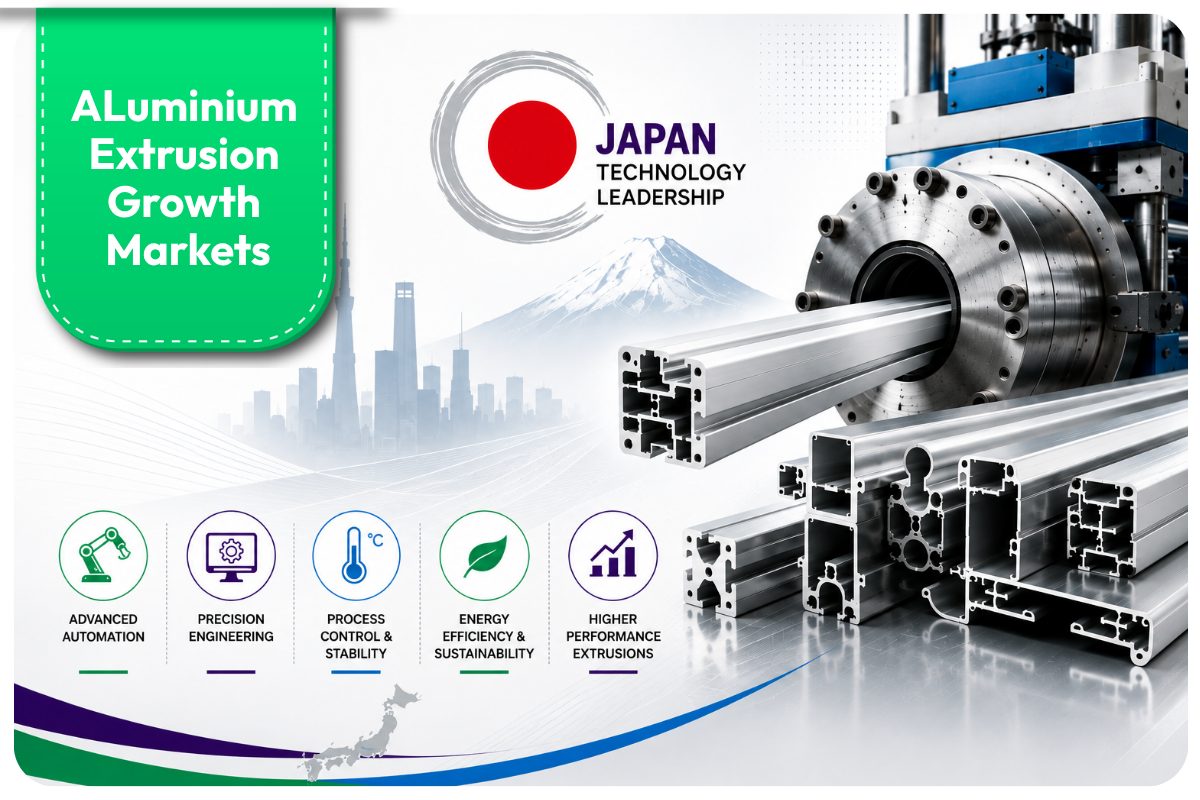
Aluminium extrusion is becoming an increasingly technology-driven manufacturing process, with automation, precision machining, robotics, process control, energy efficiency and intelligent manufacturing playing increasingly important roles across the production line.
Japanese companies are contributing to this evolution from different points in the value chain, from the control systems and robots embedded in extrusion presses to the CNC machines used for die-making and secondary machining, and finally to dedicated extrusion press technology.
Here is a closer look at the technologies offered by nine Japanese companies supporting the aluminium extrusion industry.
Mitsubishi Electric: Putting intelligence inside the extrusion press
Mitsubishi Electric’s Factory Automation division provides the industrial control technologies that can become the operating core of third-party aluminium extrusion presses and production lines. Its technologies span PLC control, CNC systems, inverters, motion control and robotics, allowing extrusion equipment manufacturers to build increasingly automated press lines.
Technology spotlight
- MELSEC PLC systems — Used for billet loading, container and ram sequencing, and puller synchronisation.
- PLC and HMI integration — Supports precise control of ram speeds and pressure regulation on extrusion presses and handling lines.
- MELSEC MX Controller — Combines sequence, motion and network control for high-speed machine operation. It can bring billet loaders, stretchers and saws into one synchronised system.
- FR-D800 inverters — Provide energy-efficient motor control for extrusion-line drives and pullers.
- Freeform bending technology — CNC spatial controls enable aluminium tubes and profiles to be dynamically pressed and bent while maintaining consistent wall thickness.
- Robotics — Articulated robots can automate downstream handling, picking and sorting of delicate extruded profiles.
Explore the trends, technologies and growth opportunities in our report, The World of Aluminium Extrusions – Industry Forecast to 2035.
Omron Global: Bringing sensing and safety into the extrusion line
Omron approaches aluminium extrusion from the broader industrial automation side, combining PLCs, sensors, safety systems, HMIs, robotics and measurement technologies. Its Sysmac platform brings several of these functions together, while specialised sensors and safety equipment address the demanding operating environment around extrusion presses and profile-handling equipment.
Technology spotlight
- Sysmac Automation Platform — The platform combines logic, motion, safety, robotics and vision. This architecture can control high-speed pullers, cut-off saws and press synchronisation through NJ/NX series controllers and Sysmac Studio.
- NX-Series I/O — High-speed modular remote I/O systems are designed to improve response times and throughput while helping reduce machine-building costs.
- E2EY aluminium-detecting sensors
- These specialised non-ferrous sensors identify aluminium billets and profiles while ignoring surrounding steel or iron components.
- Measurement and displacement sensors — Laser and LED-based instruments measure profile dimensions thickness and straightness. The measurements can be taken in real time.
- F3SG-SR safety light curtains — These configurable light curtains protect wide areas around heavy equipment such as runout tables and profile stackers.
- AMRs and automation — Robotic arms and autonomous mobile robots move raw accessories and finished aluminium profiles around the factory without human intervention.
Stay updated on AL Circle’s aluminium extrusion campaign and follow our Aluminium Extrusion Growth Markets page.
Yaskawa: Robots take on the heavy lifting
Yaskawa’s contribution is centred on motors, servo systems, drives and Motoman robotics. In aluminium processing, its robots can take on material transport, machine tending and part handling.
Technology spotlight
- Press tending and press-to-press automation — Motoman robots can load and unload presses, making the technology applicable to billet loading and profile handling around extrusion equipment.
- Sigma-7 servo motors — High-speed, high-precision servo motors and drives provide responsive synchronisation for automated manufacturing systems.
- Die-cast handling robots —Dedicated robots handle material and die lubrication in aluminium die-casting operations.
- MOTOMAN NEXT — The AI-driven robot uses NVIDIA Jetson Orin and Wind River Linux to provide greater autonomous adaptability and judgment in unstructured handling environments.
- Heavy-payload robotics — The GP215L, GP400L and GP700 expand Yaskawa’s ability to handle heavy materials, including applications involving hot billets or long extruded profiles.
Yamazaki Mazak: Where precision begins with the die
Before an aluminium profile reaches the extrusion press, one of the most important pieces of equipment has already been made, i.e., the extrusion die. Yamazaki Mazak’s CNC machine tools support the manufacture and maintenance of precision dies and tooling, as well as secondary machining of extruded and cast aluminium components.
The machining toolbox
- Five-axis machining — The VARIAXIS and HCR series supports the production of complex aluminium parts, automotive components, industrial structures and aerospace-related components requiring multi-surface access and high dimensional accuracy.
- Die and mould machining — Mazak’s FJV double-column machining centres are designed for high-accuracy die and mould work and can be used to manufacture extrusion dies and related tooling.
- MAZATROL CNC — Mazak’s CNC turning and milling capabilities are used for machining extruded and cast aluminium stock.
- INTEGREX i-V — Vertical five-axis, multi-tasking platform combine turning, milling, multi-face and simultaneous five-axis machining in a single setup, reducing handling and setup requirements for complex aluminium components.
- Automation and process integration —Mazak supplies automation and integrated production solutions that can support pallet handling, workpiece transfer and continuous machining of aluminium components.
Connect with verified aluminium extrusion buyers and suppliers through the AL Biz marketplace.
Makino: Faster, cleaner and more precise die machining
Makino focuses heavily on high-speed CNC machining, particularly for aluminium structural components and dies and moulds. Its approach centres on reducing machining time while maintaining the precision demanded by complex extrusion tooling.
Key technologies
- Horizontal machining for dies — Makino advocates horizontal machining centres for die production. Pallet changers and a B-axis rotary table allow multi-sided machining and continuous operation.
- High-speed, high-power spindles — High-RPM spindles designed for PCD tooling support rapid material removal and high surface finishes when machining aluminium and harder tool steels.
- ROI and Active Inertia Control — These motion-control technologies reduce non-cutting time and improve acceleration and deceleration during complex milling operations.
- SGI — Super Geometric Intelligence — Servo-control software maintains precise cornering geometry at high feed rates, helping reduce the need for manual die polishing.
Okuma: Keeping dimensions stable when temperatures move
Aluminium’s tendency to expand and contract with temperature creates a particular challenge during long machining cycles. Okuma addresses this through a combination of CNC control, automation and thermal management.
Technology spotlight
- OSP-P500 CNC control —Dual-core processing supports faster and more accurate machining, alongside tamper protection and anomaly detection.
- Robot Loader —Automates loading and unloading operations.
- Autonomous Mobile Robot —Supports material movement within machining environments.
- ARMROID —Extends automation into machining operations.
- smarTwinCELL —Supports unattended machining cells.
- Thermo-Friendly Concept —Maintains dimensional accuracy during long production runs despite temperature-related changes.
- Machining Navi —Detects and suppresses chatter during high-speed cutting to improve surface finishes on complex aluminium shapes.
Brother Industries: Compact CNC technology for aluminium parts
Brother Industries brings another angle to the aluminium processing chain through its SPEEDIO drilling, tapping and machining centres. Its machines are particularly suited to precision machining where productivity, compact equipment and process integration matter.
Key technologies
- SPEEDIO S500Xd1-5AX — A simultaneous 5-axis vertical machining centre designed for high-productivity, high-accuracy machining of complex aluminium parts such as impellers.
- CNC-D00 control — Brother’s proprietary control is designed for lean operation and reduced wasted movement. The S300Xd1, S500Xd1 and S700Xd1 models use it to support larger tool magazines and greater process integration.
- Compact pallet-changing systems —R-series rotary table arrangements allow long aluminium profile sections to be loaded and unloaded continuously without stopping the spindle.
- Energy-saving functions — The machines incorporate features designed to reduce power consumption during idle and low-load conditions.
FANUC: Connecting robotics with machining
FANUC sits at the intersection of robotics, CNC and factory automation, with applications extending from material handling to direct machining.
From handling to machining
- Flexible robotic wet machining — High-precision industrial robots can mill and drill aluminium stock directly.
- ROBODRILL — High-speed machining centres perform milling, drilling and tapping for extruded profile end features, automotive structural components and aluminium heat sinks.
- Laser cutting and trimming — Specialised laser heads, e.g., SPA NEWTON, combined with FANUC manipulators like the M-800/60-20B and M-20 series for high-speed cutting of moving or complex aluminium extrusions.
- Hot-press and extrusion T-Cell integration — Heavy-duty robots, including high-capacity M-series systems such as the M-950iA and R-2000, can automate: billet loading → induction oven transfer → hot press unloading
- R-50iA controller — Provides a more flexible and programmable control environment for aluminium handling and machining cells.
Be part of Aluminium’s Frontline: OEM Edition 2026, our exclusive magazine, and showcase your innovations to the global aluminium industry.
UBE Machinery: the specialist at the heart of extrusion
While several of the companies above provide technologies that support aluminium extrusion, UBE Machinery directly manufactures extrusion presses. The company, part of the UBE Group and formerly Ube Industries, has been building heavy machinery including die-casting machines, injection moulding machines and extrusion presses since 1964.
The core technology
- Indirect double-action extrusion presses —These presses allow the container and stem to move simultaneously. The result is reduced friction and more consistent metal flow.
- A complete extrusion ecosystem —UBE also provides
- Automated billet handling
- Fully automatic lift-type die cassette changers
- Automated handling of free dies
- Shell and discard handling
- Extrusion press auxiliaries
- Installation and maintenance support
The company maintains dedicated sales and technical support for its extrusion press business. The Japanese technology landscape around aluminium extrusion is therefore far from a single story about extrusion presses. Rather than relying on one piece of equipment to transform the process, different technologies are gradually connecting the entire production chain.


 Voyagerman Technology


