Calculate Embedded Emissions for Unwrought Aluminium (HS7601)
Enter your input
Notes:
There may be a difference when calculating the price with respect to
import volume, carbon price, and benchmark emissions, as the embedded
formula may result in minor variations due to decimal rounding.
Therefore, the actual value may vary.
CBAM is applicable to trade volumes starting from 50 metric tonnes. For trade volumes below 50 metric tonnes, CBAM does not apply.
Usage Procedure – How to use the CBAM Calculator Sheet
Enter or update values only in the
INPUT PARAMETERS section (Highlighted in blue) ,
including the carbon price, benchmark emissions, CBAM chargeable
percentage (as per the phase-in year), and imported quantity.
The system will automatically calculate the
payable emissions and the total CBAM cost (€)
based on the inputs provided.
Notes:
• Change any input value to automatically update CBAM cost.
• Formula used: Carbon price × payable emissions × quantity.
• Model aligned with CBAM supplier-side illustrative methodology.
Login now to unlock Calculate Embedded Emissions for Unwrought Aluminium
World Recycled ALuminium Market Analysis Industry forecast to 2032
The updated version of our report, “World Recycled Aluminium Market Analysis – Industry Forecast to 2032”, delivers an in-depth, data-driven outlook on one of the fastest-growing segments of the global metals industry. This updated report offers exclusive intelligence on market trends, regional demand patterns, trade dynamics, policy shifts, technological advancements, and the competitive landscape shaping the recycled aluminium or secondary aluminium market. With sustainability taking centre stage in global manufacturing,
recycled aluminium is poised to play a pivotal role in decarbonising supply chains—making this report a must-have for manufacturers, investors, policymakers, and analysts looking to stay ahead of the curve.
World Recycled Aluminium Market Analysis: What’s driving the USD 160 billion opportunity?
Discover the trends, transformations, and opportunities shaping the global recycled (secondary) aluminium economy
As the world pivots toward decarbonisation, sustainability, and circular economy solutions, recycled aluminium is no longer a niche—it’s a global imperative. This comprehensive market report from AL Circle provides authoritative, data-backed insights into the future of secondary aluminium, enabling you to navigate this fast-evolving industry with confidence and clarity.
What this report delivers
Market Forecast to 2032
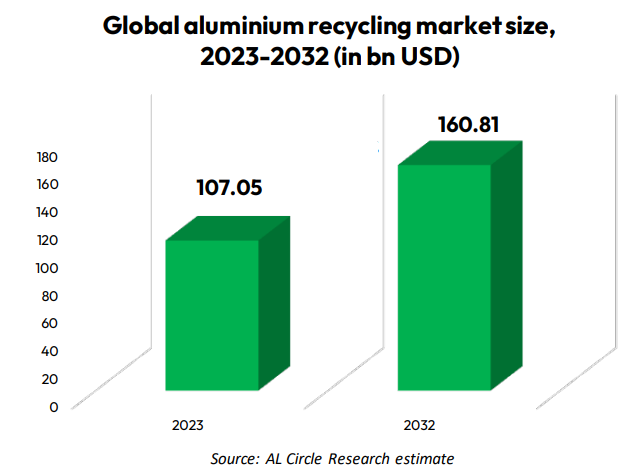
Track the global recycled aluminium market as it grows from USD 107.05 billion in 2023 to a projected USD 160.81 billion by 2032, driven by demand across construction, automotive, packaging, and electronics.
Region-wise analysis
Deep-dive into production, usage, policy impact, and growth potential across China, Europe, North & South America, Asia-Pacific, Middle East & Africa.
Circular economy & ESG integration
Explore how recycled aluminium is transforming value chains, lowering emissions by up to 95% versus primary production, and enabling net-zero commitments globally.
Technology, trade & regulation insights
Understand the impact of CBAM, US tariffs, the EU Green Deal, China’s Five-Year Plan, and innovations like AI-driven scrap sorting and blockchain for traceability.
Strategic outlook on scrap supply & demand
Analyse scrap availability by type—UBCs, extrusion, castings, zorba—and how supply constraints are reshaping market dynamics and investment priorities.
What’s new in the report
The report will now forecast to 2032
Analysis of the Impact of US Tariffs on the Aluminium Recycling and Scrap Market
Impact of trade policies on global aluminium scrap flows, pricing, and industry competitiveness
Scrap Demand and Trade: Top Importers/Exporters
Global low carbon aluminium production: Secondary Aluminium Vs Primary Aluminium
Recycled aluminium: Market share by product form: Ingot-Billet-Slab
Major country-wise market analysis other than region-wise
Analysis of key market players based on shipping volumes of secondary aluminium ingot, price and quantity (selected participants)
Old & New scraps recycling market shares by volume & regions, 2013-2024
Key advancements and innovations in aluminium recycling techniques
List of Scrap Suppliers, Their Products, and Countries
Methodology
1) Scope
This report essentially covers – (1) Recycled aluminium usage and forecast across regions (2019 - 2032), (2) Recycled aluminium usage by end-user sectors (2019 - 2032), 3) Applications of recycled aluminium, (4) Overview of aluminium recycling and pollution control, 5) Aluminium recycling - technological developments (including case study), (5) Investment & expansions in recycled aluminium sector, (6) Global trends in aluminium scrap collection and recycling, (7) Scrap demand & trade (pre & post consumption scrap).
2) Data collection
Advanced Internet research: In-depth research has been performed for data collection. The primary sources include the International Aluminium Institute (IAI), International Trade Council, International Organization of Motor Vehicle Manufacturers (OICA), AL Circle recycling e-Magazine, published articles, company reports and publications, ASI certificates, journals, and white papers.
Review of the database - The curated database, with the input of subject matter experts, includes facts and figures from AL Circle (www.alcircle.com) news, blogs, interviews, and press releases.
3) Research & analysis
The facts and figures in this report are derived from comprehensive market research analysis, which includes collecting and examining historical data, reviewing research reports, and calculating compound annual growth rates.
By evaluating reports & trade data sourced from the International Aluminium Institute (IAI), International Trade Council, European Circular Economy Stakeholder Platform, publications of European Aluminium, and sustainability reports from various companies around the world.
Who should read this report?
This report is designed for decision-makers, innovators, and professionals across the global aluminium value chain who need actionable intelligence on recycled aluminium markets, policy impacts, and sustainability-driven growth.
Aluminium recyclers & secondary producers
Stay ahead of demand trends, technology advancements, and scrap sourcing challenges. Benchmark your capacity, product mix, and regional positioning against industry leaders.
Primary aluminium producers
Gain insights into secondary market disruptions that may impact their cost structure, ESG goals, and downstream client preferences. Explore opportunities for integration, green product development, or scrap acquisition.
Automotive, packaging & construction manufacturers
Understand how recycled aluminium is reshaping material sourcing, cost competitiveness, and compliance with net-zero and circular economy targets.
Metal traders, scrap dealers & procurement heads
Track shifts in global scrap trade flows, regional imbalances, pricing volatility, and opportunities in underserved markets.
Investors, private equity & strategic consultants
Identify regions and companies primed for growth, M&A, or expansion, especially in high-potential segments like billets, slabs, and dross recovery.
Government bodies & policy think tanks
Use this report as a framework to design or evaluate recycling-friendly industrial policies, CBAM-readiness, and low-carbon infrastructure planning.
Quantify recycled content impact, traceability challenges, and energy savings across sectors. Track decarbonisation pathways and Scope 3 emission reductions.
Technology providers & equipment manufacturers
Find market-entry insights into regions investing in sorting, melting, dross recovery, and AI-enhanced scrap processing technologies.
Academics & research institutions
Access detailed data, case studies, and forecasts for further study into decarbonisation, resource efficiency, and industrial sustainability transitions.
Looking for the latest updates on Europe’s aluminium recycling industry? Click here
TOC
Sector: Market overview
01Global aluminium recycling market size
0 topics
02Recycled aluminium: Production across regions, 2010-2024
4 topics
16Aluminium recycling: Challenges Vs Potential
0 topics
17Aluminium recycling and pollution control – an overview
0 topics
18Government legislation on waste in European Union
0 topics
19Applications of recycled aluminium
2 topics
19.1
Case study
19.2
Case study
20Major ASI certificates in the recycled aluminium industry
0 topics
21Energy Consumption: Primary aluminium production Vs Secondary aluminium production
0 topics
Sector: Recycled aluminium usage and forecast across regions
22North America: Usage and forecast by end-use sectors
1 topic
22.1
Case study
23South America: Usage and forecast by end-use sectors
1 topic
23.1
Case study
24Western Europe: Usage and forecast by end-use sectors
1 topic
24.1
Case study
25Eastern Europe: Usage and forecast by end-use sectors
1 topic
25.1
Case study
26China: Usage and forecast by end-use sectors
1 topic
26.1
Case study
27Rest of Asia Pacific (excluding China) : Usage and forecast by end-use sectors
1 topic
27.1
Case study
28Middle east And Africa : Usage and forecast by end-use sectors
1 topic
28.1
Case study
29Recycled aluminium production & key players
0 topics
30Recycling Advocates and NGOs
0 topics
Sector: Investment and Expansions
31Greenfield
0 topics
32Brownfield
0 topics
Sector: Scrap Demand and Trade
33Old & New scraps recycling market shares by volume & regions, 2013-2024
8 topics
33.1
China
33.2
Europe
33.3
Japan
33.4
Middle East
33.5
North America
33.6
Oceania
33.7
Other
33.8
South America
34Top importers and exporters of aluminium scraps
0 topics
Sector: Key advancements and innovations in aluminium recycling techniques
Sector: Expansions of secondary aluminium capacity underway
Sector: Conclusion
35Appendix 1
1 topic
35.1
Directory of Scrap Suppliers and Secondary Aluminium Market Participants
This appendix presents a comprehensive list of global scrap suppliers, detailing the
types of aluminium scrap they trade and their respective countries of operation. The
product categories include:
• Tense Scrap
• Extrusion Scrap
• Foil Scrap
• Sheet Scrap
• Turning/Twitch Scrap
• UBC (Used Beverage Cans) Scrap
• Wire and Cable Scrap
• Zorba/Zurik Scrap
In addition to the scrap supplier directory, the appendix also includes:
• An extended list of suppliers involved in the secondary aluminium sector
• A list t of secondary aluminium producers, along with their estimated production
capacities
Sector: “This information has been compiled in a separate Excel spreadsheet and is provided as a reference for understanding supply chain dynamics and assessing potential sourcing or partnership opportunities in the secondary aluminium market.”
Frequently asked questions
This report stands out with its comprehensive global scope, in-depth regional analysis, and integration of trade data, technology trends, and sustainability insights. It includes exclusive case studies, forecasts, ASI certification updates, and a detailed appendix with import-export data, making it a one-stop reference for industry stakeholders, policymakers, and investors.
Aluminium recycling plays a critical role in reducing energy consumption, lowering greenhouse gas emissions, and conserving natural resources. Unlike primary production, secondary (recycled) aluminium requires only about 5% of the energy. With growing regulatory pressures and climate goals, industries are shifting focus to recycling as a viable route for sustainable growth.
Regions such as China, Europe, and North America dominate aluminium recycling volumes. However, emerging markets like India and the Middle East are rapidly investing in infrastructure. Global trends indicate a rising shift toward automation, advanced sorting technologies, and increased regulatory support, especially in Europe and Japan.
Key end-use sectors include automotive, construction, packaging, electrical, and consumer durables. Automotive and packaging, in particular, benefit from aluminium's light weight and recyclability, aligning with sustainability goals and circular economy initiatives.
Trade policies, especially US tariffs on aluminium imports, have disrupted traditional trade flows, affecting scrap prices as no tariffs have been added and resulting to availability. These shifts have encouraged some countries to become more self-reliant in scrap sourcing and prompted investments in domestic recycling capacity.
Primary aluminium producers are embracing recycling through brownfield projects and scrap integration to reduce energy costs and carbon emissions. Recycling uses only ~5% of the energy required for primary production, aligning with global sustainability goals. Increasing customer demand for low-carbon aluminium, especially in sectors like automotive and packaging, is driving this shift. Regulatory pressures and ESG commitments further compel producers to diversify their operations. Brownfield expansions offer a faster, cost-effective route to scale recycling capacity and meet market expectations.
The report offers actionable intelligence on market dynamics, regional usage patterns, scrap supply-demand, key players, and upcoming investments. This enables users to identify growth opportunities, benchmark against competitors, plan supply chain strategies, and align with evolving environmental and trade regulations.
We use cookies from our users to operate this website and to improve its usability.
You can find details of what cookies are, why we use them and how you can manage them in our
Cookies page. Please note that by using this site you are consenting to the use of cookies.
Necessary cookies help make a website usable by enabling basic functions like page
navigation and access to secure areas of the website. The website cannot
function properly without these cookies.
Preference cookies enable a website to remember information that changes the way
the website behaves or looks, like your preferred language or the region that you
are in.
Statistic cookies help website owners to understand how visitors interact with
websites by collecting and reporting information anonymously.
Marketing cookies are used to track visitors across websites. The intention
is to display ads that are relevant and engaging for the individual user and
thereby more valuable for publishers and third party advertisers.
Cookies are small text files that can be used by websites to make a user's experience more efficient.
The law states that we can store cookies on your device if they are strictly necessary for the
operation of this site. For all other types of cookies we need your permission.
This site uses different types of cookies. Some cookies are placed by third party services that
appear on our pages.
Your consent applies to the following domains:
google.com,
youtube.com,
doubleclick.net,
zopim.com