您想继续阅读英文文章还
是切换到中文?
是切换到中文?

THINK ALUMINIUM THINK AL CIRCLE

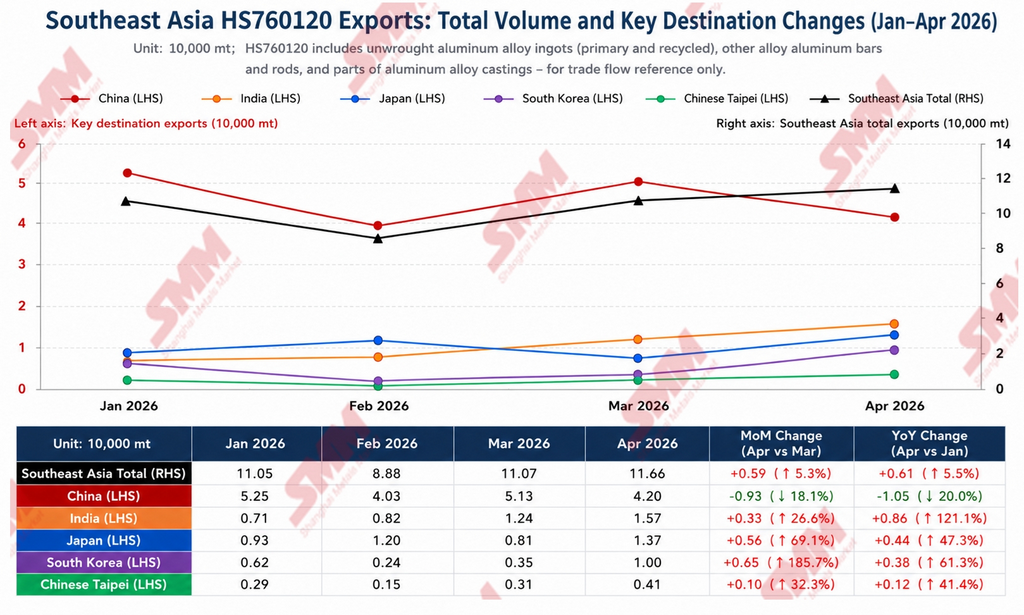
This image has been sourced from https://news.metal.com/newscontent/103974632
With the continued expansion of aluminium processing and downstream industries in Southeast Asia, regional aluminium billet production, consumption and trade markets have attracted growing attention. Malaysia, Thailand and Vietnam are not only important aluminium billet production and consumption hubs in Southeast Asia, but also play a key role in regional aluminium billet trade flows. Markets such as Indonesia, the Philippines and Cambodia, meanwhile, are still at a stage where local processing capacity development and demand for imported aluminium billet are growing simultaneously.
{alcircleadd}Since March 2026, the escalation of geopolitical conflicts in the Middle East has caused significant disruption to the global aluminium supply chain. On the one hand, uncertainty over the supply of primary aluminium and aluminium processed products from the Middle East has increased, pushing up procurement interest in primary aluminium, aluminium billet and secondary aluminium resources across Asian markets outside China. On the other hand, fluctuations in crude oil prices and ocean freight costs have further lifted regional aluminium processing and trading costs. Against this backdrop, LME aluminium prices, Asian regional premiums and Southeast Asian local aluminium billet processing fees have all fluctuated to varying degrees.
At the same time, changes in the SHFE/LME price ratio have periodically affected the export arbitrage window for Chinese aluminium processed products. When overseas aluminium prices are stronger than domestic prices and export margins improve, Chinese aluminium processed products and some processing-trade resources show greater willingness to flow into the Southeast Asian market, creating certain disruptions to local billet supply-demand dynamics and quotations. When the price spread narrows, however, regional pricing returns to a framework driven jointly by local supply, imports from the Middle East and other overseas resources.
Trade flows
From the perspective of export destinations, the flow of Southeast Asian products under HS760120 is relatively concentrated. In 2025, the top ten export destinations for Southeast Asian HS760120 products totalled around 1.2695 million tonnes, accounting for approximately 93.3 per cent of total Southeast Asian exports. China was the largest destination, with full-year exports of around 602,100 tonnes, accounting for approximately 44.3 per cent.
Japan, Vietnam and India followed, with around 149,300 tonnes, 143,500 tonnes and 111,700 tonnes respectively, accounting for approximately 11.0 per cent, 10.5 per cent and 8.2 per cent.
It should be noted that HS760120 includes primary aluminium alloy ingots, secondary aluminium alloy ingots, other aluminium alloy billets and some cast aluminium alloy products. Therefore, this data mainly serves as a reference for observing trade flows of unwrought aluminium alloys and aluminium alloy billets in Southeast Asia, and cannot be directly equated with 6063 aluminium billet export volumes.
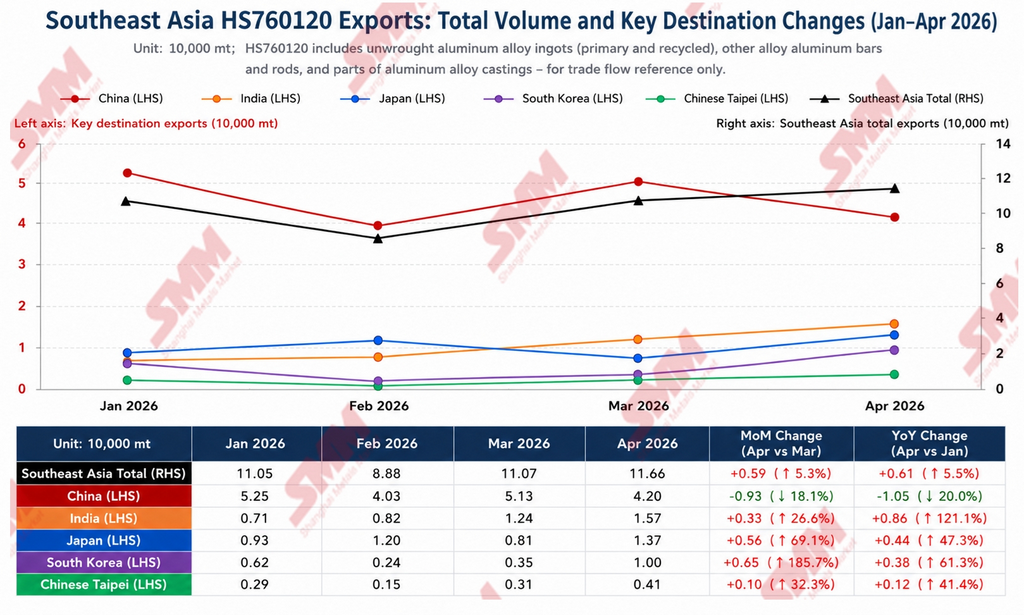
Entering 2026, affected by the escalation of the Middle East conflict, uncertainty in the global supply chain for primary aluminium and aluminium processed products increased, and trade flows of aluminium raw materials and aluminium billets in Asia saw certain adjustments. Data shows that total Southeast Asian HS760120 exports fell to around 88,800 tonnes in February 2026, before rebounding to around 110,700 tonnes in March and further increasing to around 116,600 tonnes in April. From February to April, cumulative growth reached approximately 31.2 per cent.
In terms of destination changes, China remained the largest export destination, although exports to China declined in April compared with March. India, South Korea, Taiwan, China and Japan showed more obvious increases from March to April.
Among them, exports to India rose from around 8,200 tonnes in February to around 15,700 tonnes in April; exports to South Korea increased from around 2,400 tonnes in February to around 10,000 tonnes in April; exports to Taiwan, China, climbed from around 1,500 tonnes in February to around 4,100 tonnes in April; while exports to Japan recovered to around 13,700 tonnes in April.
Overall, the rebound in Southeast Asian HS760120 exports from February to April 2026 reflected, on the one hand, the gradual recovery of regional trade after the Chinese New Year holiday. On the other hand, it may also have been related to Asian buyers increasing procurement of Southeast Asian regional resources and supplementing alternative supply sources after the Middle East conflict raised supply risks for overseas primary aluminium, aluminium billet and secondary aluminium.
Considering that China, India, Japan, South Korea and Taiwan, China are all important aluminium processing and consumption markets in Asia, the increase in Southeast Asian product flows to these markets indicates that regional unwrought aluminium alloys and aluminium alloy billets have played a certain supplementary and balancing role in trade during periods of supply chain disruption. For the 6063 aluminium billet market, this trend cannot be directly equated with changes in 6063 aluminium billet exports, but it can serve as an important reference for assessing the circulation activity of aluminium billets and aluminium alloy raw materials in Southeast Asia, regional substitution demand and fluctuations in processing fees.
Market and price analysis
With the continued expansion of aluminium processing and downstream enterprises in Southeast Asia, the situation of 6063 aluminium billet differs across countries due to variations in processing levels and downstream demand. Overall, Malaysia and Thailand are the main aluminium billet producing countries in the region and also have certain local consumption capacity. Vietnam’s aluminium processing capacity is growing rapidly, but some local quotations are still mainly for non-homogenised cast billets. Markets such as Cambodia and the Philippines remain at a stage where local processing capacity development coexists with demand for imported aluminium billet.
In terms of homogenisation status, mainstream 6063 aluminium billet quotations in Malaysia and Thailand usually already include homogenisation treatment, and the relevant homogenisation cost is mostly included in the aluminium billet processing fee quoted by producers. A small number of non-homogenised 6063 aluminium billet quotations also exist in the Thai market, which can be used to observe the basic processing cost of cast billets. The situation in Vietnam is different. As some enterprises mainly quote non-homogenised cast billets, the apparent processing fee for 6063 aluminium billet is usually around USD 50-100 per tonne lower than homogenised quotations in Malaysia and Thailand.
Aluminium billet homogenisation is an important heat-treatment process in the production of 6063 aluminium billets. It usually refers to placing cast aluminium billets into a homogenising furnace for heating, holding and cooling treatment, so that the internal composition distribution of the billet becomes more uniform and microstructural segregation formed during casting is improved. For 6063 aluminium billet, homogenisation helps improve stability in the subsequent extrusion process, reduce extrusion cracking, surface defects and performance fluctuations, and improve the surface quality and yield of extruded profiles. Therefore, in the aluminium extrusion value chain, homogenised aluminium billet generally has higher use value than non-homogenised cast billet.
According to SMM market research, since March 2026, under the influence of factors such as the escalation of Middle East geopolitical conflicts, tighter supply of overseas primary aluminium and aluminium billet resources, and fluctuations in energy and ocean freight costs, 6063 aluminium billet processing fees in major Southeast Asian countries rose to varying degrees. Among them, processing fees for homogenised 6063 aluminium billet in Malaysia and Thailand once increased from the previous USD 200-250 per tonne to USD 250-300 per tonne, with some high-end quotations even exceeding USD 300 per tonne during the peak period.
As the Middle East situation eased periodically in mid-June, 6063 aluminium billet processing fees in Malaysia and Thailand declined. At present, mainstream 6063 aluminium billet processing fees in Malaysia have stabilised at around USD 250 per tonne, and mainstream processing fees for homogenised aluminium billet in Thailand have also stabilised at around USD 250 per tonne. However, due to differences in raw material structure, product status and quotation basis among enterprises, processing fees still show a wide range. In Thailand, some 6063 aluminium billet processing fees have fallen to as low as around USD 100-150 per tonne. In Vietnam, from March to June, 6063 aluminium billet processing fees rose from the previous USD 150-200 per tonne to USD 200-250 per tonne, before falling back to around USD 200 per tonne in mid-June.
In addition, from the perspective of the imported aluminium billet arrival market, from May to June, SMM learned that CIF Thailand and Malaysia 6063 aluminium billet premiums/discounts were mostly around a premium of USD 100 per tonne, while some low-priced resources even fell to a discount of around USD 100 per tonne. These resources were mainly 6063 aluminium billets processed in China under processing trade and then re-exported to the Southeast Asian market. Amid cost advantages and an increase in cargo inflows at certain stages, these resources exerted some impact on the local aluminium billet market in Southeast Asia.
From March to April, affected by Middle East geopolitical conflicts, uncertainty over some Middle Eastern aluminium supply increased. Asian buyers in India, Japan, South Korea and Taiwan, China showed higher interest in Southeast Asian aluminium billets and related aluminium alloy resources, driving some Southeast Asian aluminium billet resources to flow out of the region and supporting stronger regional quotations. However, entering May and June, as Chinese aluminium billets flowed into markets such as Thailand and Malaysia through processing trade and re-export channels, competition pressure faced by local Southeast Asian aluminium billet plants increased. SMM research shows that sales pressure for some 6063 aluminium billet producers in Malaysia and Thailand has increased compared with earlier levels, and low-priced imported arrival resources have put certain downward pressure on local ex-works processing fees and the transaction price centre.
Outlook for Southeast Asian aluminium processing
Looking ahead, the Southeast Asian 6063 aluminium billet market will continue to evolve around regional processing capacity expansion, import substitution, changes in raw material structure and overseas low-carbon requirements. In the short term, Malaysia, Thailand and Vietnam will remain the core markets for 6063 aluminium billet production and consumption in Southeast Asia. Malaysia and Thailand have relatively mature local billet casting and homogenisation capacity, and their pricing systems are closer to a quotation logic based on “LME + regional premium + homogenised processing fee.” Vietnam, meanwhile, still has room for growth in aluminium billet demand as aluminium extrusion and downstream processing capacity improve, but the quotation basis for homogenised and non-homogenised products still needs to be further differentiated.
Although local sample coverage in markets such as Indonesia, the Philippines and Cambodia remains limited at present, with the advancement of local aluminium processing projects, future demand for imported aluminium billet, secondary aluminium billet and intra-regional trade flows will remain worth monitoring.
In the medium to long term, CBAM and overseas customers’ low-carbon procurement requirements may further drive segmentation in the price system of the Southeast Asian aluminium value chain. For the Southeast Asian aluminium billet market, the impact of CBAM may not necessarily be directly reflected through large-scale exports of aluminium billet itself to Europe, but may instead be transmitted through the export value chain of aluminium profiles, window and door profiles, industrial profiles and other deep-processed products.
In the future, when European customers procure aluminium processed products from Southeast Asia, they may pay greater attention to raw material sources, the ratio of primary aluminium, in-house new scrap and aluminium scrap, carbon emission data during production, supply chain traceability and third-party verification capability. Against this backdrop, enterprises with stable homogenisation capacity, clear raw material structures, the ability to provide emissions data and low-carbon material options may gain stronger advantages in securing export orders and price negotiations.
From the perspective of the price system, CBAM may not immediately drive a one-sided increase in Southeast Asian 6063 aluminium billet processing fees, but it will raise market requirements for differentiating “product status” and “raw material attributes.” In the future, price spreads between liquid aluminium direct-cast billets, remelted aluminium ingot billets, and remelted aluminium scrap billets, price spreads between homogenised and non-homogenised aluminium billets, and differences between CIF imported aluminium billet premiums and local ex-works processing fees are all expected to become key areas of market attention.
As the aluminium processing industry in Southeast Asia continues to expand, the 6063 aluminium billet market may gradually develop from relatively broad trade quotations in the past toward a more segmented price system differentiated by country, alloy grade, homogenisation status, raw material attribute and trade term.
SMM Price Points
Against the backdrop of regional processing expansion and low-carbon trends, Southeast Asian 6063 aluminium billet processing fees have gradually become one of the key price indicators followed by the market. To help enterprises better track price changes in the Southeast Asian 6063 aluminium billet market, SMM, after market research and improvement of its pricing methodology, will add a series of Southeast Asian 6063 aluminium billet processing fee, calculated reference price and CIF premium/discount price points starting from 3rd July 2026 (Friday) onward for market reference.
The Southeast Asian 6063 Aluminium Billet Premium price points will be updated on a weekly basis every Friday at 12:00 noon Kuala Lumpur time, Malaysia, which is the same as Beijing time, GMT+8. Due to differences in settlement methods among enterprises, the full aluminium billet price may vary. For reference, it can be estimated using the following formula: 【LME Official Cash Settlement Price + Quarterly MJP + 6063 Aluminium Billet Processing Fee】. Details of the relevant price points are as follows:
The SMM Southeast Asian 6063 aluminium billet price points will be updated on a daily basis every working day at 12:00 noon Kuala Lumpur time, Malaysia, which is the same as Beijing time, GMT+8. The SMM calculated reference price will be derived using the formula: 【LME Official Cash Settlement Price (D-1) + Quarterly MJP + Latest 6063 Aluminium Billet Processing Fee】. Based on this, SMM will publish low-end, high-end and average calculated reference prices. Details of the relevant price points are as follows:
At the same time, to provide a reference comparison for the Southeast Asian 6063 aluminium billet processing and trading market, SMM will also launch CIF Southeast Asia 6063 Aluminium Billet Premium price points for market reference. The CIF Southeast Asia 6063 aluminium billet premium/discount price points will be updated on a weekly basis every Friday at 12:00 noon Kuala Lumpur time, Malaysia, which is the same as Beijing time, GMT+8. Due to differences in settlement methods among enterprises, the full imported aluminium billet price may vary. For reference, it can be settled using the following formula: 【LME Official Cash Settlement Price + Quarterly MJP + 6063 Aluminium Billet Premium/Discount】. Details of the relevant price points are as follows:
Summary
Overall, the Southeast Asian 6063 aluminium billet market is currently at a stage where regional processing capacity expansion, trade flow adjustments and price system segmentation are taking place simultaneously. In the short term, Middle East geopolitical conflicts, changes in overseas primary aluminium and aluminium billet supply, and fluctuations in energy and ocean freight costs will continue to affect Southeast Asian aluminium billet processing fees and import premiums/discounts. At the same time, changes in the SHFE/LME price ratio will also continue to periodically affect the willingness of Chinese aluminium processed products and related aluminium billet resources to flow into the Southeast Asian market.
From the perspective of market structure, Malaysia, Thailand and Vietnam remain the core markets for 6063 aluminium billet production, consumption and trade circulation in Southeast Asia. Among them, Malaysia and Thailand have relatively mature pricing systems for homogenised aluminium billet, while Vietnam still requires separate differentiation in price basis due to the relatively high share of non-homogenised cast billet quotations. Going forward, as local processing capacity develops in markets such as Indonesia, the Philippines and Cambodia, changes in regional imported aluminium billet, secondary aluminium billet and local processing fees will also become areas worth continuous tracking.
In the medium to long term, CBAM and overseas low-carbon procurement requirements will further increase the importance attached by the Southeast Asian aluminium processing value chain to raw material structure, homogenisation capability, carbon emission data and supply chain traceability. Although CBAM may not necessarily drive an immediate one-sided increase in 6063 aluminium billet processing fees, it will prompt the market to more clearly distinguish between different product bases, including liquid aluminium direct-cast billets, remelted aluminium ingot billets, remelted aluminium scrap billets, as well as homogenised and non-homogenised products.
Against this backdrop, the launch of SMM Southeast Asia 6063 aluminium billet processing fee, calculated reference price and CIF premium/discount price points will help the market more clearly track changes in regional aluminium billet costs, import substitution space, trade flow adjustments and price differentiation trends under the low-carbon transition.
Note: This article has been issued by SMM and has been published by AL Circle with its original information without any modifications or edits to the core subject/data.
Responses


A proud
ASI member
AL Circle Private Limited | CIN: U72200WB2017PTC221175
Registered Office: Ecospace Business Park, Block 3A, Unit 401A, New Town, Rajarhat, Kolkata, WB 700160
Corporate Office: Ecospace Business Park, Block 3A, Unit 401A, New Town, Rajarhat, Kolkata, WB 700160
© 2026 AL Circle. All rights reserved. AL Circle is not responsible for content from external sources.