您想继续阅读英文文章还
是切换到中文?
是切换到中文?

THINK ALUMINIUM THINK AL CIRCLE

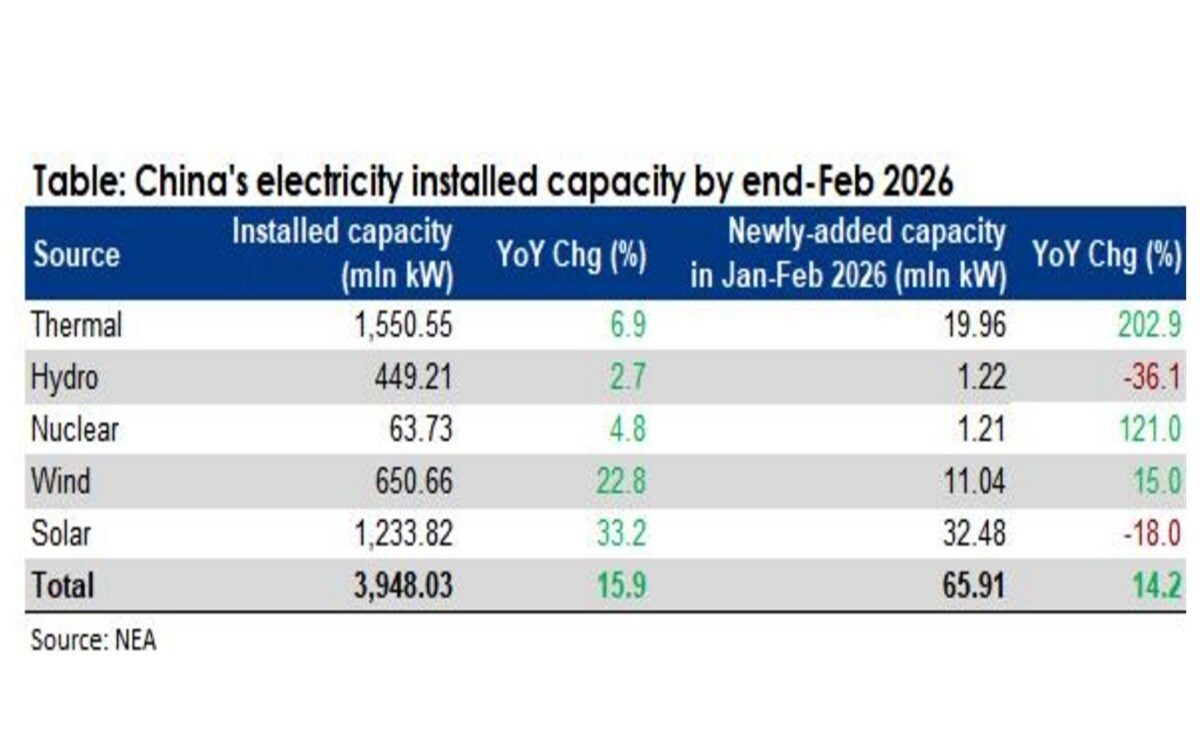
Among all power sources, solar capacity recorded the fastest growth, surging 33.2 per cent on year to 1.23 billion kW, followed by wind power, which rose 22.8 per cent to 650.7 million kW. In comparison, thermal power capacity increased at a slower pace of 6.9 per cent, reaching 1.55 billion kW.
{alcircleadd}For the global aluminium value-chain 2026 outlook, book our exclusive report “Global ALuminium Industry Outlook 2026"
Newly installed capacity across all power sources totalled 65.91 million kW in January-February, up 14.2 per cent year on year. Thermal and nuclear power led the incremental growth rates, surging by 202.9 per cent and 121 per cent, respectively.
For example, newly-added thermal power capacity totalled 19.96 GW in January-February this year, while in January-February last year, only 6.59 GW were added, with the growth calculated at 202.9 per cent, pointing to faster growth in installation over the same period, Mysteel Global notes.
Also Read: NEA: China's power consumption jumps 6.1 per cent in Jan-Feb
By the end of February, combined wind and solar capacity reached 1.88 billion kW, accounting for 47.6 per cent of the national total and underscoring the country's accelerating shift towards a lower-carbon power system, analysts said.
However, the rapid expansion of installed capacity has not been fully matched by utilisation. Average utilisation hours of power generation facilities stood at 466 hours over January-February, lower by 39 hours from a year earlier, the NEA data showed.
This decline probably indicates lower utilisation efficiency as solar and wind operations are susceptible to weather conditions, analysts noted. Meanwhile, with the rapid expansion of renewable installations, thermal power units need to make way for clean energy, leading to a significant decline in utilisation hours of thermal power, which dragged down the overall average utilisation value.
Looking ahead, capacity growth is expected to remain strong. The China Electricity Council (CEC) forecasts that more than 400 million kW of new capacity will be added in 2026, of which over 300 million kW will come from wind and solar.
By the end of 2026, solar power is expected to surpass thermal power to become China's largest power source, while coal-fired capacity is projected to account for around 31 per cent of the total mix.
Don’t miss out- Buyers are looking for your products on our B2B platform
Note: This news is published under a content and exchange agreement with Mysteel

Responses