NEA: China's power consumption jumps 6.1 per cent in Jan-Feb
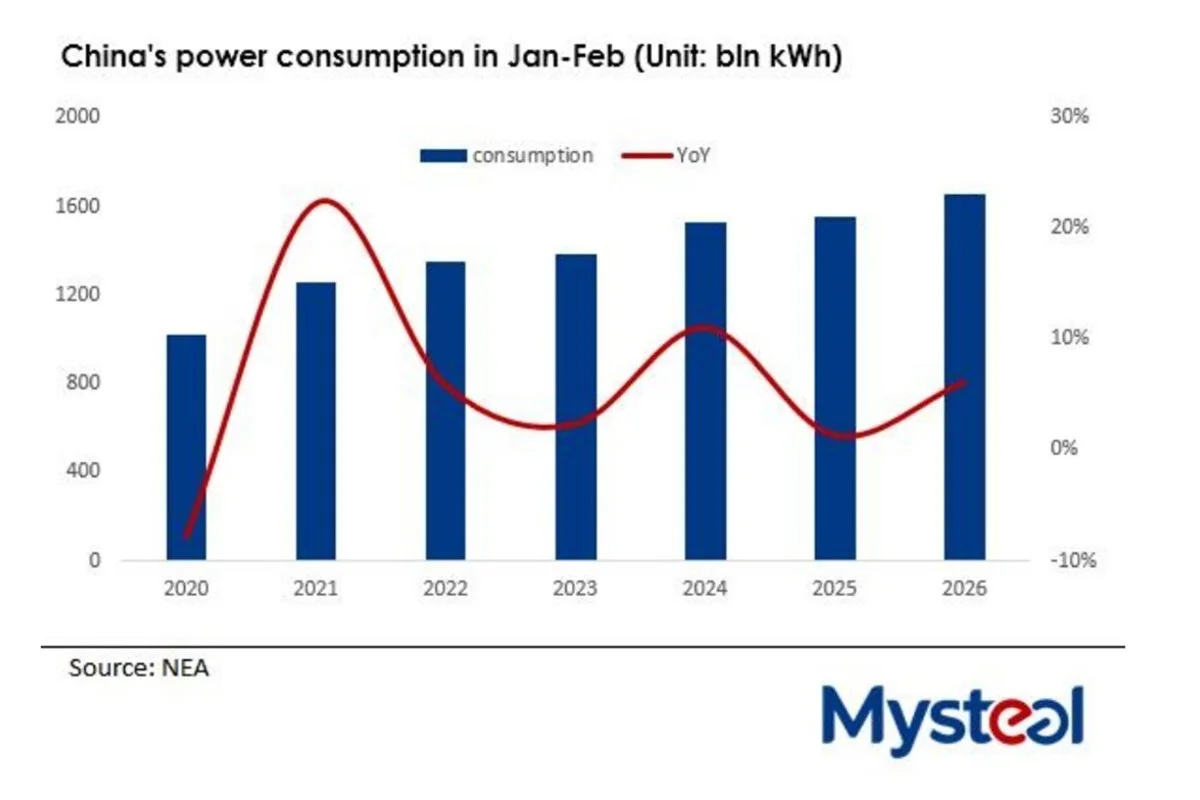
The figure represents a record high for the January-February period, with the 6.1 per cent on-year rise also exceeding the upper end of the 5-6 per cent annual growth range that the China Electricity Council had forecast earlier this year, Mysteel Global observes.
For the global aluminium value-chain 2026 outlook, book our exclusive report “Global ALuminium Industry Outlook 2026"
As a key barometer of economic activity, the stronger-than-expected growth in power consumption portends a robust start to China's economic performance in 2026.
The main driver came from the secondary consumption sector, the country's industrial and manufacturing backbone, which consumed 1,027.9 billion kWh over the period, up 6.3 per cent year on year, the NEA data showed.
Within this segment, high-tech manufacturing stood out, with power consumption surging 10.6per cent on year. This reflects China's ongoing structural shift in electricity demand, moving away from traditional heavy industries such as steel and cement toward emerging sectors including electric vehicles, semiconductors, and advanced equipment manufacturing, a trend that mirrors the broader economic transformation, analysts said.
Meanwhile, power consumption in the tertiary sector mainly services rose 8.3per cent on year to 323.1 billion kWh.
Growth was led by a sharp increase in emerging industries, including a 55.1per cent surge in EV battery charging and swapping, as well as a 46.2per cent jump in data centre usage. Analysts view this as a signal that China is entering a new phase of electricity demand driven by digitalisation and electrification, particularly in the AI and EV-related sectors.
Residential power consumption posted a relatively modest increase of 2.7 per cent to 281.3 billion kWh, largely due to a milder winter capping heating demand.
In the primary sector covering agriculture and livestock, power usage rose 7.4per cent on year to 22.3 billion kWh, indicating steady progress in agricultural production and rural development.
China's official data for January and February are typically aggregated to smooth out distortions caused by the Chinese New Year holiday, which falls in either month.
Don’t miss out- Buyers are looking for your products on our B2B platform
Note: This news is published under a content and exchange agreement with Mysteel

GUVNL awards 625 MW solar project tender at a tariff of $0.025/unit amid competitive bidding
Next articleCanada and Peru formalise partnership on sustainable mining
Grow with
AL Circle