您想继续阅读英文文章还
是切换到中文?
是切换到中文?

THINK ALUMINIUM THINK AL CIRCLE

The image used in this article is generated with an AI tool and does not depict any real-time moment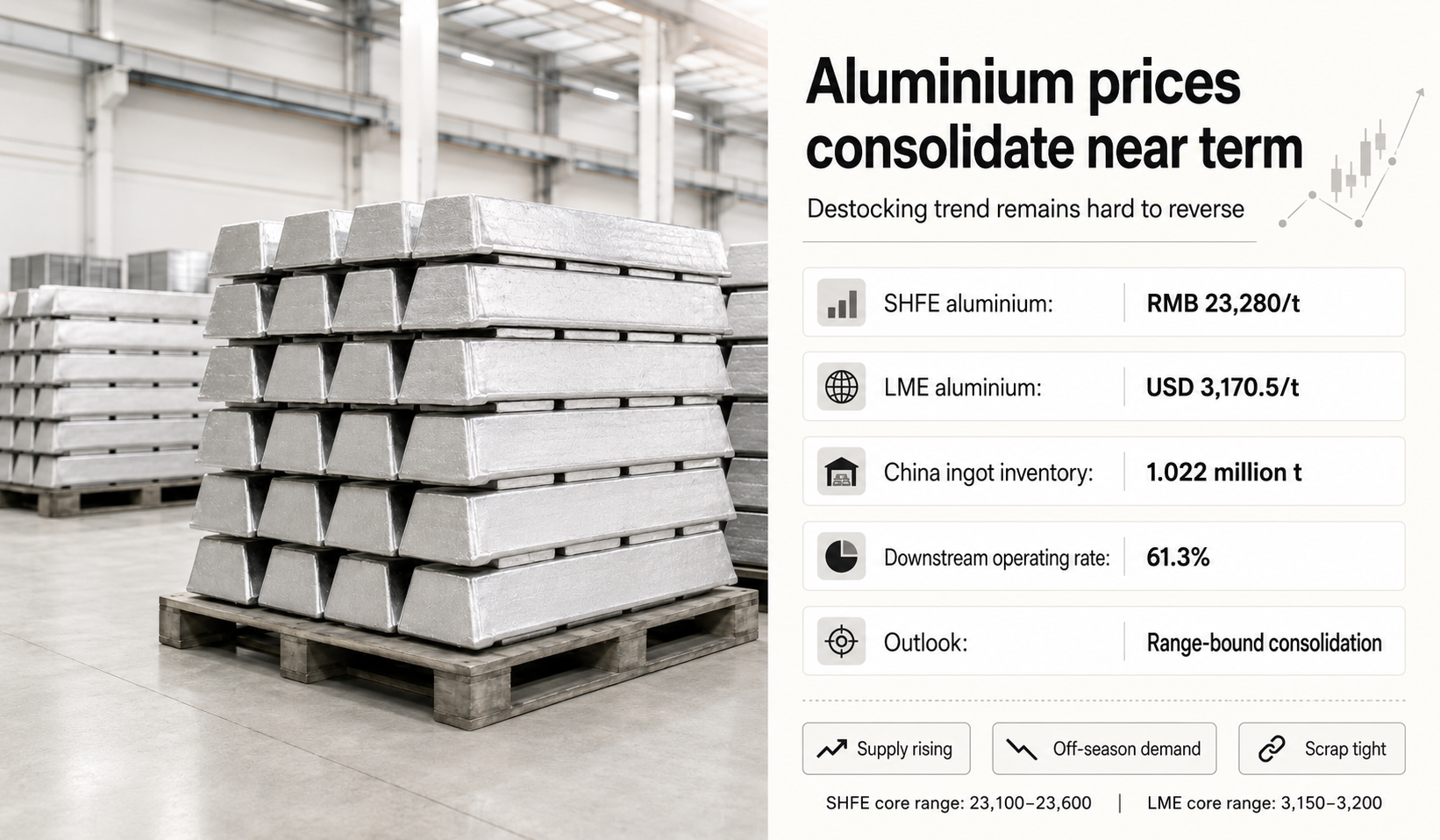
Futures: Futures: SHFE aluminium closed at RMB 23,280 per tonne, edging up 0.22 per cent, with intraday fluctuations between 23,145 and 23,295. The price was slightly above the 5-day MA (23,250) and 10-day MA (23,150.5), but well below the 30-day MA (23,409) and 60-day MA (24,028). Short-term moving averages provided limited support, while medium-term MAs still exerted bearish pressure.
{alcircleadd}The MACD histogram showed DIF=-181.82, DEA=-272.64, and the negative histogram turned sharply positive to 181.64 (previously negative), forming a low-level golden cross, indicating that bearish momentum significantly weakened and bulls began to gain strength. Trading volume shrank to 59,200 lots, and the rebound lacked volume support.
The recommended core trading range for SHFE aluminium is 23,100-23,600. LME aluminium closed at USD 3,170.5 per tonne, edging up 0.13 per cent, with intraday fluctuations between 3,154.5 and 3,173. The price was slightly above the 5-day MA (3,166.8) and 10-day MA (3,162.35), but well below the 30-day MA (3,247.72) and 60-day MA (3,425.84). Short-term MAs provided support but medium-term bearish pressure was pronounced.
The MACD histogram showed DIF=-62.39, DEA=-81.55, and the negative histogram turned positive to 38.31 (previously negative), forming a golden cross, with bearish momentum weakening. The recommended core trading range for LME aluminium is 3,150-3,200.
Macro front: The US-Iran conflict continued to escalate. On July 17, the US military launched further airstrikes against Iran, and Iran launched large-scale strikes on US targets in Kuwait and Syria, while also attacking US-related facilities in Bahrain. Iran warned that if the US continued its attacks on Iranian targets, Iran would expand its strikes to target US industrial, technological, and AI-related assets in the Middle East.
Fundamentals: Supply side, the proportion of liquid aluminium in China’s aluminium production rose by 0.37 percentage points W-o-W last week, mainly due to good performance of aluminium billet processing fees, which increased the share of direct molten aluminium supply and further reduced aluminium ingot casting volume; overseas, with ongoing production ramp-up of new projects and production resumptions, aluminium supply is expected to continue rising.
Overall, however, the short-term global aluminium ingot destocking trend is unlikely to be reversed. Demand side, the downstream processing industry was in the traditional consumption off-season, with divergent sector performance but mainly under pressure. The operating rate of leading aluminium downstream processors recorded 61.3 per cent, down 0.6 percentage points W-o-W.
The SHFE/LME aluminium price ratio recovered, squeezing downstream export profits. As orders on hand were digested, the support from exports to demand is expected to weaken. Inventory side, domestic aluminium social inventory continued to destock this week. As of this Thursday, as of this Thursday, China’s aluminium ingot social inventory fell by 2,000 tonnes from last Thursday to 1.022 million tonnes, and by 25,000 tonnes from Monday.
Primary aluminium market: In early trading, the SHFE aluminium 2606 contract’s trading centre was higher than the same period of the previous trading day. Affected by the off-season, market purchasing sentiment remained weak today, although overall purchasing sentiment improved M-o-M from yesterday, with ample supply circulating in the market.
Transactions were concluded at parity to a discount of RMB 20 per tonne against the SHFE aluminium August contract. In east China, the selling sentiment index closed at 3.11, flat M-o-M; the purchasing sentiment index was 2.90, up 0.01 M-o-M.
Market sentiment in central China continued to rebound from the previous two days. As it was Friday, stockpiling demand from downstream processing enterprises was released, and trading firms engaging in both spot and futures market continued their strong stockpiling sentiment, providing solid support for prices.
Additionally, suppliers showed a notable intention to hold prices firm and hold back from selling. Ultimately, the actual transaction prices in central China concentrated at a discount of RMB 110-140 per tonne against the SHFE aluminium August contract, with an upward trend. In central China, the selling sentiment index was 2.99, up 0.05 M-o-M; the purchasing sentiment index was 3.03, up 0.12 M-o-M.
Secondary aluminium materials: Today, SMM A00 spot aluminium price closed at 23,220 RMB per tonne, up 50 RMB per tonne from the previous trading day. The aluminium scrap market remained steady overall. Regarding the price difference between A00 aluminium and aluminium scrap, on July 17, the price difference between A00 aluminium and mixed aluminium extrusion scrap free of paint in Foshan stood at 2,042 RMB per tonne, and the price difference between A00 aluminium and shredded aluminium tense scrap was 728 RMB per tonne, both remaining at extremely low levels.
Supply-side constraints continued to strengthen, with the impact of the reverse invoicing policy deepening, increasing the scarcity of compliant invoice-bearing aluminium scrap. On the import side, China's imported aluminium scrap prices edged down this week. Imported shredded aluminium scrap prices at Ningbo port were lowered from 21,920 RMB per tonne to 21,820 RMB per tonne (tax inclusive), while at Tianjin port they dropped from 21,970 RMB per tonne to 21,770 RMB per tonne (tax inclusive).
As overseas aluminium scrap quotations continued to pull back, orders for aluminium scrap imports from Southeast Asia into Guangdong increased recently compared to before, with the import window improving further. However, new transactions were still primarily concentrated on some low-priced resources and long-term clients, with limited spot market activity. The aluminium scrap market is expected to remain at high levels and move sideways.
On the supply side, the reverse invoicing policy constraint is unlikely to reverse in the short term, and the tightness of invoice-bearing aluminium scrap will persist. On the import side, multiple bearish overlapping effects will gradually materialise in the coming months, keeping the supplement of high-quality overseas scrap low. On the demand side, as the off-season deepens, downstream operating rates will remain low, with no substantial improvement in terminal orders.
Scrap utilisation enterprises will continue purchasing as needed, and procurement sentiment will be hard to improve significantly. The price difference between A00 aluminium and aluminium scrap has narrowed to a historical low, sharply eroding the economic advantage of aluminium scrap over primary aluminium. If aluminium prices continue to decline, the substitution effect will accelerate.
Secondary aluminium alloy: The ADC12 market continued to run steadily today, with mainstream producers' quotes basically flat. The SMM ADC12 price remained stable at 24,100 RMB per tonne from the previous trading day. On the one hand, recent aluminium price fluctuations were limited, lacking new cost-side drivers, while aluminium scrap supply remained tight, providing some support to secondary aluminium alloy prices and leaving enterprises generally reluctant to adjust prices.
On the other hand, end-use demand stayed in the off-season, downstream orders were insufficiently released, and procurement was mostly need-based, resulting in subdued trading sentiment. Some enterprises reported that demand weakened further compared to earlier.
Against the backdrop of a tug-of-war between longs and shorts amid cost support and weak demand, the market overall maintained a cautious, wait-and-see stance. ADC12 prices are expected to mostly move sideways in a narrow range in the short term, with focus on aluminium price fluctuations, changes in scrap supply, and improvement in downstream orders.
Outlook: With repeated Middle East tensions, lingering rate hike concerns, and continuous production resumptions, yet a destocking pattern hard to reverse in the short term, aluminium prices are expected to consolidate in the near term amid the tug-of-war between longs and shorts. Going forward, attention should be paid to the progress of production resumptions in the Middle East and geopolitical conflict trends, LME aluminium ingot inventory changes, and domestic downstream processing orders and aluminium semis export data.
Note: This article has been issued by SMM and has been published by AL Circle with its original information without any modifications or edits to the core subject/data.
Responses