您想继续阅读英文文章还
是切换到中文?
是切换到中文?

THINK ALUMINIUM THINK AL CIRCLE

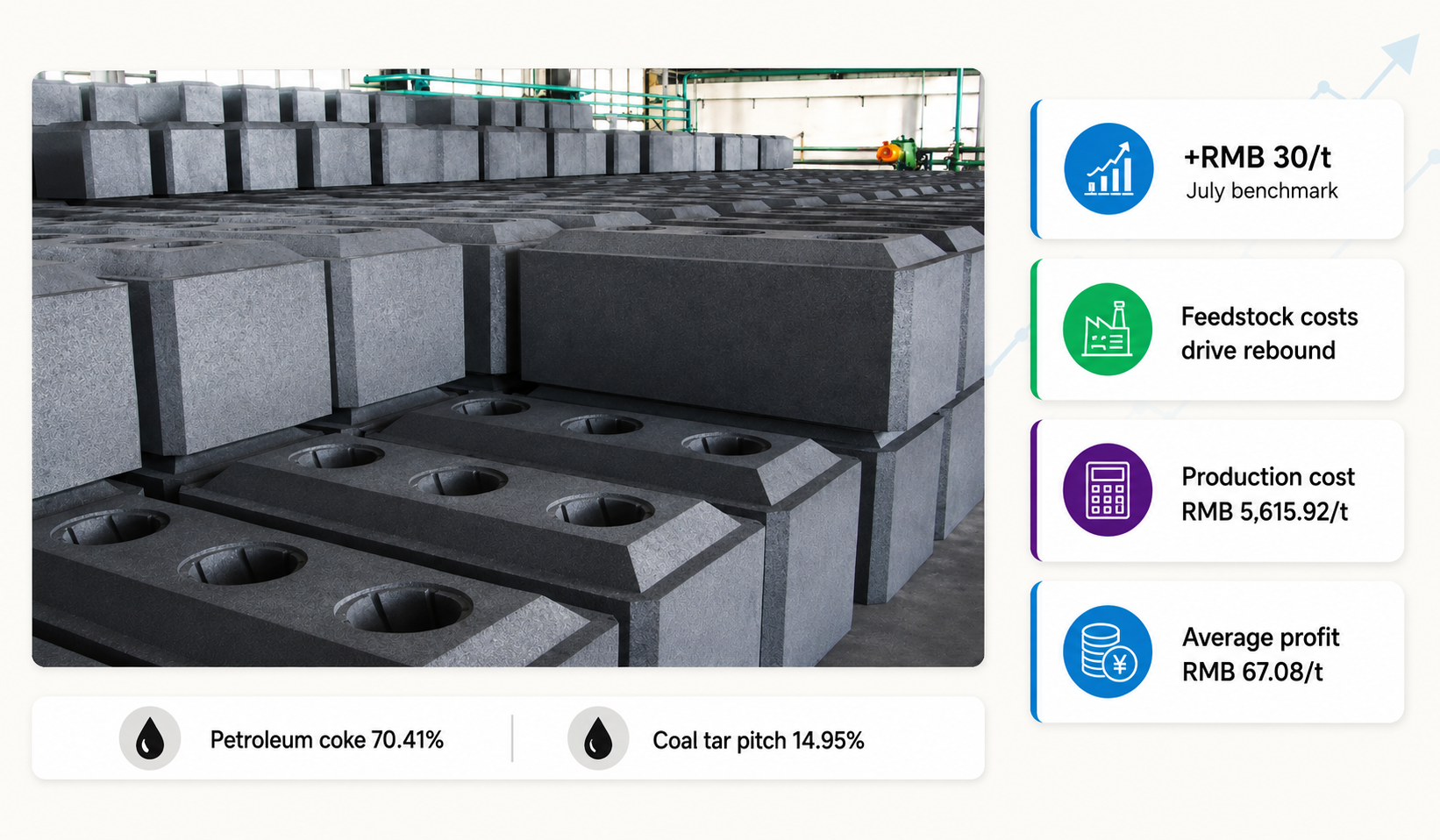
The image used in this article is generated with an AI tool and does not depict any real-time moment
Riding the wave of firmer feedstock costs, the Chinese prebaked anode market has snapped its brief downtrend, with a major smelter in Shandong lifting its July procurement benchmark by RMB 30 per tonne. While current margins remain healthy above breakeven, looming new capacity is set to intensify localised competitive pressure in the second half.
{alcircleadd}Prebaked anode prices rebound RMB 30 per tonne as feedstock costs resurface
Driven by rising raw material prices during the settlement cycle, cost support for anodes has re-emerged, and the prebaked anode market has once again shown a trend of halting its decline and turning upward in the short term. According to Mysteel, the July 2026 prebaked anode procurement benchmark price at a major Shandong-based aluminium smelter increased by RMB 30 per tonne month-on-month, with the set at RMB 5,683 per tonne by cash and RMB 5,707 per tonne by acceptance. After a brief downturn, the prebaked anode market swiftly rebounded.
In terms of profitability, based on cost calculations using Shandong market prices, the production cost of prebaked anodes during this settlement cycle stood at approximately RMB 5,615.92 per tonne. Compared to the Shandong procurement benchmark price, the average enterprise profit was around RMB 67.08 per tonne.
The price movement of anodes this month aligned closely with the upward pricing trends of upstream raw materials, petroleum coke and coal tar pitch, with rising feedstock costs successfully passed through to finished products. While the industry's overall cost faced mild pressure, it remained firmly above the breakeven line, with only marginal fluctuations.
During this settlement cycle, petroleum coke accounted for 70.41 per cent of prebaked anode raw material costs, while coal tar pitch contributed 14.95 per cent. Prices of both petroleum coke and coal tar pitch fluctuated within a narrow range, and the cost composition saw little change compared to the previous month.
Explore- Most comprehensive and forward-looking industry-focused report — Global Bauxite & Alumina Market Forecast to 2036: Supply–Demand, Trade Flows & Price Outlook
Market trading weakened M-o-M; medium-sulfur petcoke prices rose before falling
In the petroleum coke segment, refinery maintenance continued into June with new additions, and some refineries adjusted operating rates, leading to a notable drop in output. Besides, due to fewer production days and declining downstream consumption, overall sales performance was tepid, with demand primarily driven by rigid procurement needs. Prices oscillated as a result.
Specifically, bids for low-sulfur petcoke from state-owned refineries in early June posted significant M-o-M declines, while prices for standard-grade cargoes were stable with minor adjustments, and high-sulfur petcoke prices edged up.
In the independent refinery sector, product specifications shifted frequently due to varying sulfur content, resulting in a pattern of initial price increases followed by a pullback. During this settlement cycle, the average price of 3A petroleum coke in the Shandong market was RMB 3,727.4 per tonne (up RMB 30.5 per tonne M-o-M), 3B at RMB 3,470.5 per tonne (up RMB 12.6 per tonne M-o-M), and 3C at RMB 2,868.8 per tonne (up RMB 174.1 per tonne M-o-M).
Cost support provided tailwinds; coal tar pitch prices edged up
In the coal tar pitch market, domestic average prices showed a modest upward trend in June. The average price of feedstock high-temperature coal tar rose, lending cost-side support to pitch pricing. Concurrently, plant turnarounds and frequent unplanned shutdowns at coal tar deep-processing facilities tightened spot supply slightly. Downstream buyers adopted a cautious stance in early June, purchasing only on dips, which dampened buying enthusiasm.
However, later in the month, increased supply weighed on prices. The primary driver behind these supply-demand shifts was the ramp-up in coal tar pitch availability, which capped upside momentum; consequently, the market exhibited a choppy trajectory, rising initially, retreating, bottoming out, and then rebounding. During this settlement cycle, the average price of modified coal tar pitch was RMB 4,938 per tonne in Shandong (up RMB 96 per tonne M-o-M) and RMB 4,940 per tonne in Shanxi (up RMB 214 per tonne M-o-M).
Entering July, petroleum coke prices declined initially before staging a modest recovery, with trading activity showing signs of warming. However, the rebound failed to fully offset earlier losses, leaving overall prices on a downward trend. For coal tar pitch, feedstock high-temperature coal tar prices moved higher, providing solid cost support and bolstering producers' resolve to hold firm on offers, resulting in mildly higher pricing.
According to Mysteel estimates, prebaked anode production costs as of now have decreased by approximately RMB 65 per tonne compared to June. Heading into mid-to-late July, independent refiners have ramped up sales efforts, drawing down inventories. As downstream buyers re-enter the market to procure raw materials, trading activity has improved markedly, driving a stabilisation and tentative rebound in independent refinery petroleum coke prices, with a near-term bias toward steady-to-firmer pricing.
Conversely, auction prices for high-temperature coal tar have begun to soften, eroding cost support for coal tar pitch. Meanwhile, deep-processing plants are operating at high utilisation rates, offering no supply-side incentives for price hikes. Downstream buyers remain cautious, leaving negotiations deadlocked; in the short term, the coal tar pitch market is expected to trend lower.
Outlook
Overall, recent narrow-range fluctuations in petroleum coke and coal tar pitch prices have continued to ease cost pressures on the anode sector. Downstream aluminium smelters are maintaining stable operating rates, sustaining steady rigid demand for anodes.
However, market participants should monitor potential upside risks: a renewed surge in crude oil prices triggered by geopolitical events could reinforce the floor under petroleum coke prices, while the commissioning of new anode capacity in the second half of the year may lead to regional competitive pressure due to oversupply.
Conclusion
In conclusion, while feedstock volatility continues to define the short-term pricing narrative, the anode market's fundamentals appear stable for now, with industry margins holding above the breakeven point. The key inflection point to watch will be the second half of the year: unless downstream aluminium demand sees a significant surprise to the upside, the anticipated release of new anode capacity will likely shift the market dynamic from cost-push inflation to localised competitive pressure, potentially capping price upsides despite firm raw material costs.
Unlock key insights from leading companies and experts across the aluminium ecosystem with our e-Magazine - Mine to Market: ALuminium Producers & Manufacturers 2026
Note: This news is published under a content and exchange agreement with Mysteel
Responses