The extended period of weak demand for aluminium has adversely affected both prices and metal deliveries. This trend is evident in European aluminium foil shipments, which totalled 217,800 tonnes in the first three months of 2024. According to the European Aluminium Foil Association, this shipment figure represents a year-on-year fall of 6 per cent compared to 231,700 tonnes.
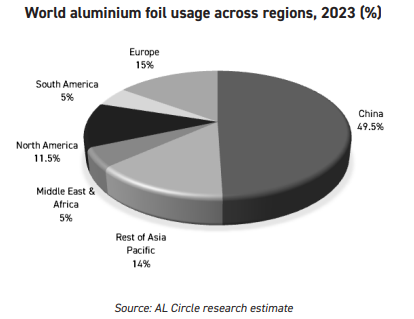
Europe is the second-largest consumer of aluminium foil globally, accounting for 15 percent of the world's usage. China remains the largest, representing approximately 49.5 percent of global consumption.
The decline in shipments during Q1 2024 stemmed from a 3 per cent drop in demand. The downtrend in foil demand during the first quarter of 2024 was not only limited within the domestic market but also branched out into foreign lands, resulting in a 26.6 per cent plunge in exports. Sales were also down by 22 per cent Y-o-Y, mirroring the difficult market conditions seen throughout 2023.
The factors that worsened the demand for aluminium foil in Europe were high interest rates and inflated prices. Sales of thinner gauges, used mainly for flexible packaging and household foils, fell 7.7 per cent compared with Q1 2023. Demand for the product was down by 4.1 per cent inside Europe, while that in the overseas market plunged by 30 per cent.
Deliveries of thicker gauges, used for semi-rigid containers and technical or other applications, fell by 3.6 per cent Y-o-Y during the March quarter. While domestic deliveries dipped by only 1 per cent, exports slumped by over 20 per cent year-over-year.
However, the bright side was that the volume of deliveries was 10 per cent higher quarter-on-quarter than nearly 200,000 tonnes. Normally, the first quarter of a year is stronger in terms of demand as companies restock. But this year reflected an exception with continued cautious outlook amid unenthusiastic buying sentiment.
Guido Aufdemkamp, Executive Director of EAFA, said: “This is now a familiar picture. Until we see a sustained upturn in economic activity and consumer confidence the industry will continue to struggle with lower demand. The current geopolitical situation continues to have a negative impact on all markets.”
He added, “But there are some signs that the depressed market conditions are bottoming out in Europe. There cannot be much more destocking to be done and interest rates are finally on a downward trajectory. The export scenario remains challenging. European foil rollers have become adept at dealing with volatile market conditions and will continue to respond to challenges and opportunities.”
Effect of subdued demand on aluminium prices
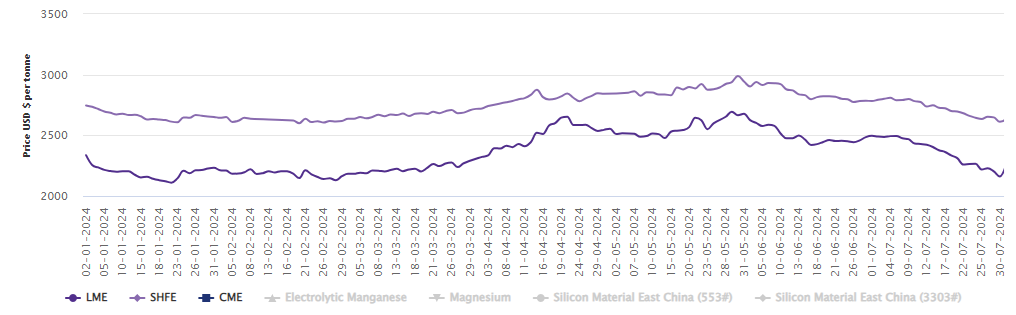
Currently, the lacklustre demand for aluminium against the backdrop of growing production has led to a significant fall in the LME aluminium benchmark price through July 2024. From US$2,625 per tonne on July 1, the price decreased to US$2,485.50 per tonne at the end of the month, reflecting a sharp fall of 5.31 per cent.
However, compared with the price at the end of March 2024, the LME aluminium price at the end of July stood 9.49 per cent higher, attributed to the recovery during April, May, and June owing to fresh sanctions against Russia by the United Kingdom and United States. On April 12, the US and UK announced they would not accept deliveries of Russian metal produced after that day on the London Metal Exchange or Chicago Metal Exchange. Within a week of the sanctions, about 172,500 tonnes was cancelled, draining warranted stocks to 152,000 tonnes.
At the end of the first quarter of 2024, the LME aluminium price stood at US$2,270 per tonne, demonstrating a downfall of 2.85 per cent from US$2,336.50 per tonne at the beginning of the quarter due to the continued weak demand.
Weak demand vs high production
Amid the lingering muted demand in Europe, there was a production hike, driven by operation resumptions at smelters on the ease of electricity supply. According to the International Aluminium Institute, primary aluminium production across Europe (including Russia) stood at 1.696 million tonnes in Q1, up by 1.8 per cent from 1.666 million tonnes during the corresponding period of the previous year.
In the next quarter, the production amounted to 1.72 million tonnes, growing by 1.42 per cent quarter-on-quarter and 2.87 per cent higher than 1.672 million tonnes. In the entire H1 2024, Europe’s aluminium production totalled 3.415 million tonnes, up by 2.31 per cent from 3.338 million tonnes in H1 2023.














_md.webp)








