Tesla’s Optimus needs a brain, a battery and a whole lot of aluminium
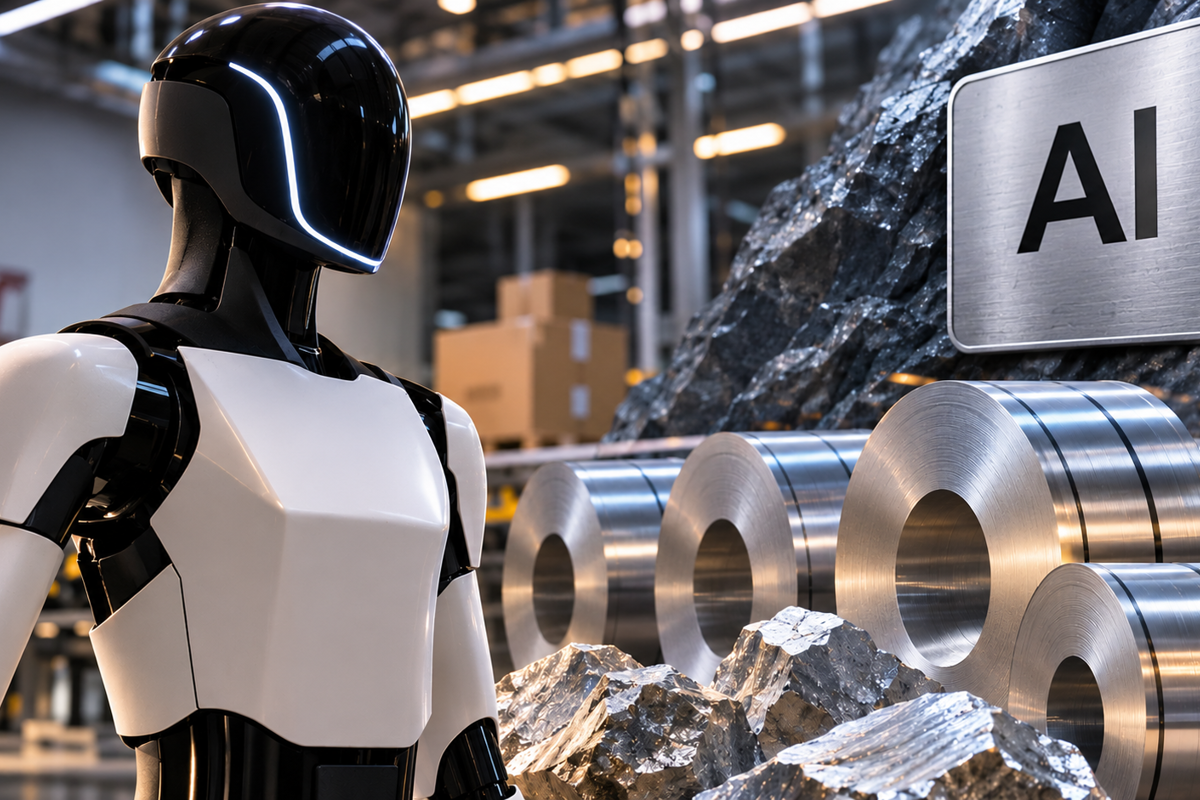
The image used in this article is generated with an AI tool and does not depict any real-time moment.
Tesla's ambitions for its Optimus humanoid robot extend well beyond factory automation, with the company envisioning a future in which robots could support vehicle servicing, logistics and even last-mile delivery. However, turning that vision into a commercially viable product will require more than advances in artificial intelligence and robotics. It will also depend on access to aluminium, critical minerals and the downstream manufacturing capabilities needed to produce increasingly sophisticated hardware at scale.
Tesla has already taken an important step towards that ambition. On October 21, 2026, the company announced that Optimus production had begun on its high-volume manufacturing line in Fremont, California. Tesla described the units coming off the line as its first production-quality robots, although the operation remains in an early production phase and the company expects the manufacturing ramp-up to take time.
Elon Musk has indicated that reaching an annualised production rate of 20,000 robots per week could take at least a year, reflecting the complexity of manufacturing a humanoid robot with numerous specialised components. Commercial deliveries to external customers are not yet established, with the company discussing a potential timeline around the end of 2027.
The development brings Tesla's robotics ambitions closer to industrial production, but the challenges extend beyond the factory floor. The company has previously outlined a broader transportation ecosystem involving Optimus, Cybercab, Robo Van and Tesla Semi. Within this vision, autonomous vehicles would handle transportation, while humanoid robots could undertake flexible physical tasks that conventional automated systems may struggle to perform.
In a Munro Live interview, Tesla executives Lars Moravy and Eric Earley discussed a possible progression for Optimus, beginning with charging Tesla's robotaxi fleet in controlled environments, followed by vehicle servicing, and eventually potential delivery applications. However, these remain prospective applications rather than confirmed commercial deployments.
The gap between that ambition and existing logistics infrastructure is significant. Amazon already operates more than one million robots across its fulfilment network, using its DeepFleet fleet-management system to coordinate warehouse operations. Its robots perform specialised tasks involving material movement, sorting and fulfilment-centre operations. Tesla's Optimus, by comparison, is still developing the capabilities required for reliable operations beyond controlled environments.
The distinction matters because last-mile delivery would demand dependable outdoor navigation, battery endurance, package handling and the ability to operate safely around people. A robot designed for controlled factory tasks cannot automatically perform these functions in unpredictable public environments.
Explore AL Circle’s report ALuminium Wires & Cables - Insights & Forecast to 2030 for insights into aluminium applications, industry developments and opportunities across the electrical sector.
The materials behind the humanoid robotics ambition
Beyond software, autonomy and mechanical engineering, humanoid robots depend on a complex combination of industrial materials. Aluminium, magnesium and steel provide structural foundations, while copper and rare earth elements are important inputs for electric motors and wiring. Batteries require materials such as lithium, nickel, cobalt and manganese, while electronic systems depend on silicon, tantalum, tin, silver and other specialised materials.
Aluminium has a particularly important place in this manufacturing ecosystem because of its use in lightweight structural applications. Its combination of relatively low weight and suitability for engineering applications makes it relevant to the development of mobile machines, including humanoid robots. Reducing structural weight can be important for equipment that must move continuously while carrying batteries, motors, sensors and computing hardware.
This distinction between primary metal production and downstream processing is central to the wider manufacturing challenge. A country may produce substantial quantities of aluminium but still depend on imported semi-fabricated products, specialised alloys or processed components.
The same issue applies to other materials used in robotics. The critical-metals article identifies neodymium, praseodymium, dysprosium and terbium among the materials associated with motor technologies, alongside battery inputs and specialised electronic materials. It argues that limited domestic production of several of these resources leaves US manufacturers dependent on international supply chains.
Tantalum offers another example of the challenges involved in securing specialised materials. Used extensively in electronic components, particularly capacitors, the metal also has applications in high-performance alloys. The supplied industry analysis points to the closure of the last US domestic tantalum mine in 1959 and growing reliance on imports as demand for advanced electronics has increased.
These material requirements do not constitute a verified bill of materials for Tesla's Optimus. Nevertheless, they illustrate the broader industrial inputs associated with humanoid robotics and the importance of securing reliable supplies of both metals and processed materials.
North American aluminium demand exposes the processing gap
The importance of aluminium processing becomes clearer when examining the North American market. Despite its established aluminium industry, the United States and Canada are experiencing a divergence between rising regional demand and declining shipments from domestic producers.
Preliminary industry estimates show that North American aluminium demand increased 3.5 per cent year on year in the first half of 2026, reaching approximately 13.57 billion pounds (6.16 million tonnes), compared with 13.12 billion pounds (5.95 million tonnes) during the corresponding period of 2025.
Demand for semi-fabricated aluminium products, including sheet, plate and extrusions, reached 9.87 billion pounds (4.48 million tonnes), representing a 1.5 per cent increase. Apparent aluminium consumption also advanced 1.8 per cent to approximately 12.14 billion pounds (5.51 million tonnes).
However, deliveries of semi-fabricated aluminium products from US and Canadian producers declined 3.6 per cent during the same period. Imports, particularly aluminium sheet, helped bridge the gap between regional consumption and domestic shipments.
Charles Johnson, President and CEO of the Aluminum Association, highlighted the divergence between the two trends, noting that growing demand was being accompanied by declining domestic mill shipments as imports filled much of the supply gap.
For robotics manufacturers, this distinction is important because the aluminium required for structural applications must meet specific engineering and processing requirements. The availability of raw metal alone does not guarantee that the appropriate grades, forms and finished components can be sourced domestically.
The Aluminum Association is seeking to address these broader supply-chain concerns through its America Needs Aluminum campaign. The initiative calls for increased primary and recycled aluminium production, access to affordable and reliable energy, greater domestic manufacturing investment and targeted trade enforcement.
The association also points to more than USD 11 billion invested in US aluminium operations over the past decade, with much of the investment directed towards midstream, downstream manufacturing and recycling activities.
Read more at: North American aluminum demand rises 3.5% in H1 2026 as imports offset domestic supply decline
Why aluminium processing matters as much as mining
The relationship between raw-material availability and manufacturing capacity extends beyond aluminium. The critical-metals analysis argues that limited domestic mining and processing capabilities leave US industries exposed to supply disruptions involving several materials used in advanced technologies.
For aluminium, the challenge is not simply securing bauxite or producing primary metal. It is also about developing the capacity to transform that metal into rolled products, engineered alloys and finished components required by manufacturers.
This becomes particularly relevant as Tesla works towards increasing Optimus production. Scaling humanoid robotics would require a reliable network of suppliers capable of delivering structural materials, motors, batteries, electronic components and precision-engineered parts in consistent volumes.
The North American aluminium market figures demonstrate that even when demand is growing, domestic production and processing capabilities may not expand at the same pace. Reliance on imported semi-fabricated products can therefore remain a vulnerability despite the presence of an established primary aluminium industry.
The Aluminum Association's call for greater domestic investment reflects this concern. Expanding recycling and primary production is important, but strengthening processing and fabrication capacity is equally relevant to manufacturers seeking more resilient supply chains.
Can Tesla turn its robotics vision into a scalable manufacturing business?
Tesla's move into early Optimus production represents progress towards commercialising its humanoid robotics programme. However, the company's ambitions in logistics and last-mile delivery remain dependent on capabilities that have yet to be demonstrated at commercial scale.
The robot must establish reliable outdoor autonomy, sustained battery performance, safe interaction with people and consistent handling of packages with different sizes and weights. Its manufacturing process must also become sufficiently reliable and cost-effective to support large-scale production.
Material availability adds another layer to the challenge. Aluminium and other metals must be sourced, processed and converted into components that meet the requirements of increasingly complex robotic systems. Meanwhile, dependence on concentrated international supply chains for critical minerals could expose manufacturers to trade restrictions, geopolitical disruptions and supply constraints.
Tesla's early production milestone therefore represents only one part of a much larger industrial undertaking. Its ability to expand Optimus manufacturing will depend not only on improvements in robotics and artificial intelligence but also on the strength of the material suppliers and processing industries supporting the programme.
For the aluminium industry, the wider opportunity lies in the growing importance of lightweight materials across advanced manufacturing. As robotics, electric mobility and automation develop, demand for engineered aluminium products and reliable downstream processing capabilities could become increasingly significant.
The question surrounding Optimus is ultimately bigger than whether a humanoid robot can deliver a package. It is whether the industrial supply chains behind advanced robotics can keep pace with the ambitions of technology companies. In that equation, aluminium is not merely another raw material. Its processing, fabrication and availability form part of the manufacturing foundation on which the next generation of machines will depend.
Explore AL Circle’s B2B Marketplace to discover aluminium electrical and power products, including conductors, busbars, cables and wires, and connect with suppliers across the industry.
Grow with
AL Circle