Speculations of a phase-wise ban revolve around the European Union’s 16th sanction package against Russia as the date of implementation draws near. Russia, which has been at gunpoint since its invasion into Ukraine.
Opposing the Russian Federation’s annexation of Crimea and Sevastopol in 2014, a political call by the Russian Federation to recognise Donetsk and Luhansk oblasts as independent entities (followed later by Kherson and Zaporizhzhia), and the Russian Federation’s full-scale invasion of Ukraine on February 24, 2022, the EU introduced a series of trade-related restrictive measures (till date 16) known as sanction packages.
The 16th sanctions package, circulated among member states this week, proposes measures that would cut approximately 15 banks off from the SWIFT banking system. It also targets over 70 dark-fleet vessels involved in shipping Russian oil. This specific sanctions package would permit European buyers to import Russian metal under a quota system for one year before a complete ban takes effect, according to sources who spoke on condition of anonymity.
The plans will require unanimous backing from all member states and may change before they are formally proposed. There have been ongoing calls for the EU to ban Russian aluminium ever since the invasion of Ukraine, leading to a significant decline in Russia’s shipments to the bloc as manufacturers have sought alternative suppliers. However, some buyers and member states have resisted such measures, arguing that certain key products will be challenging to replace entirely.
It is uncertain whether the EU will reach an agreement on this package, which would mark the 16th set of sanctions against Russia. Hungary has been increasingly resistant to imposing additional penalties on Moscow.
EU’s aluminium trade 2024
According to the data from the Global Aluminium Trade Monitor (GATM), in 2024, the EU’s aluminium trade saw a continuation of trends from prior years, with imports significantly outpacing exports. Through October 2024, the EU imported an estimated 6,615,968 tonnes of aluminium, while exports stood at 1,677,842 tonnes. From a year-on-year perspective, both imports and exports have experienced significant fluctuations. Imports increased by approximately 11.6 per cent in 2020 (7,383,062 tonnes) and 9.1 per cent in 2021 (8,052,236 tonnes), followed by a more elevated rise of 13.3 per cent in 2022 (9,122,648 tonnes). However, in 2023, imports declined by 8.5 per cent to 8,347,217 tonnes. Exports, on the other hand, surged by 34.3 per cent in 2020 (2,254,016 tonnes) but then slowed down to 4.8 per cent in 2021 (2,361,840 tonnes). Subsequent years saw declines of 7.9 per cent in 2022 (2,175,322 tonnes) and 7.6 per cent in 2023 (2,009,162 tonnes).
- European Union X Ukraine:
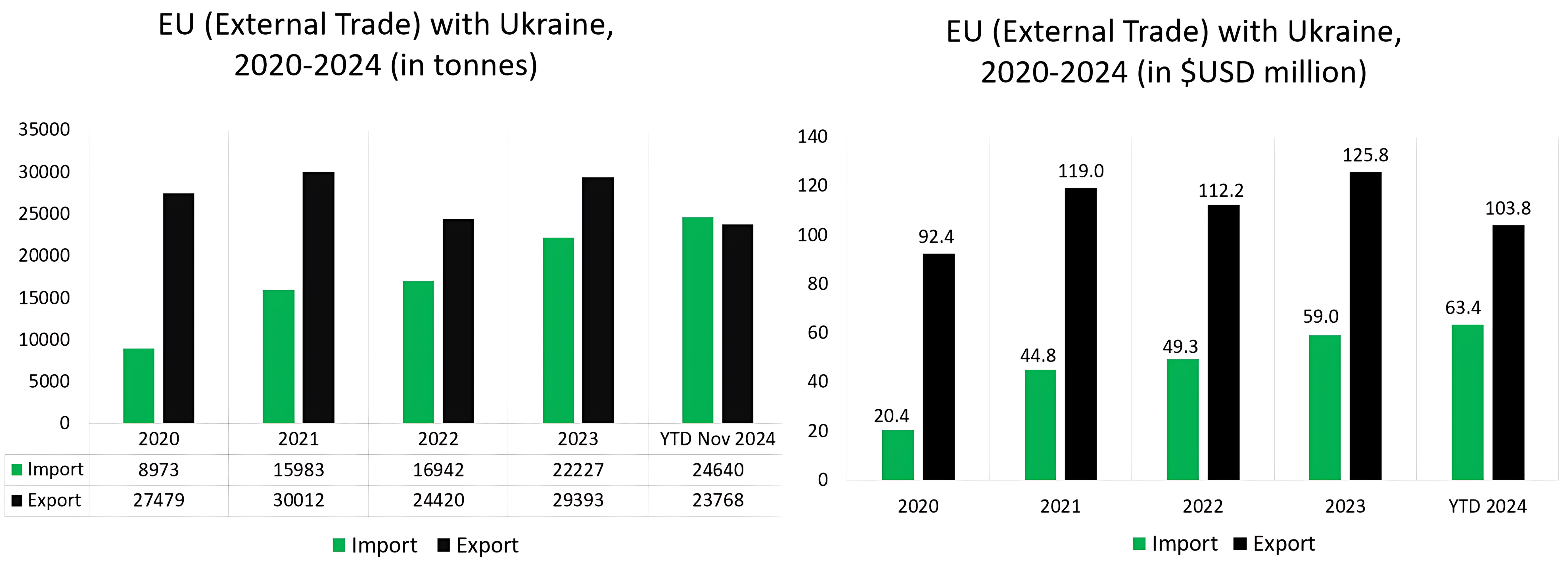
Among the cumulative trade, Based on the provided assorted aluminium trade data in GATM between the European Union and Ukraine from 2020 to YTD November 2024, a comprehensive year-on-year analysis of trade dynamics in terms of both monetary value and quantity can be chalked out.
In 2020, exports stood at US$92.39 million, with imports amounting to US$20.44 million. Exports were recorded at 27,478 tonnes, while imports stood at 8,972 tonnes. The next year, there was an export increase to US$118.99 million (+28.8 per cent), and imports nearly doubled to US$44.77 million (+118.8 per cent). The sharp rise in import value may have been driven by increased demand for Ukrainian goods or improved trade relations. On the quantitative front, exports increased to 30,012 tonnes (+9.2 per cent), and imports rose significantly to 15,982 tonnes (+78.1 per cent). The rise in quantities aligns with the increased trade value.
On the contrary, exports saw a slight decline to US$112.20 million (-5.7 per cent), while imports grew moderately to US$49.30 million (+10 per cent) in 2022. The geopolitical unrest in Ukraine has contributed to the drop in exports. Export quantities dropped to 24,419 tonnes (-18.6 per cent), while imports grew to 16,941 tonnes (+6%). The decline in export quantity can be attributed to supply chain disruptions and conflict-related production setbacks.
Exports of all sorts of aluminium rebounded in both volume and value, wherein the first grew to US$125.78 million (+12.1 per cent), and imports surged to US$59.02 million (+19.8 per cent). Exports rebounded to 29,393 tonnes (+20.3 per cent), with imports climbing to 22,226 tonnes (+31.2 per cent). The recovery suggests some stabilisation of trade routes and economic recovery in Ukraine, along with improved logistics and demand stabilisation despite ongoing challenges.
As for YTD November 2024, exports reached US$103.75 million, indicating a strong performance with the potential to match or surpass 2023 levels. Imports rose to US$63.40 million, exceeding the previous year’s value in the 11 months. Whereas export quantities stand at 23,768 tonnes and imports reached 24,640 tonnes.
The conflict in Ukraine since 2022 likely disrupted trade, causing a temporary decline in export volumes and monetary value. By 2023, trade volumes and values show signs of recovery. The consistent increase in import quantities and value from the EU highlights a growing demand for Ukrainian goods.
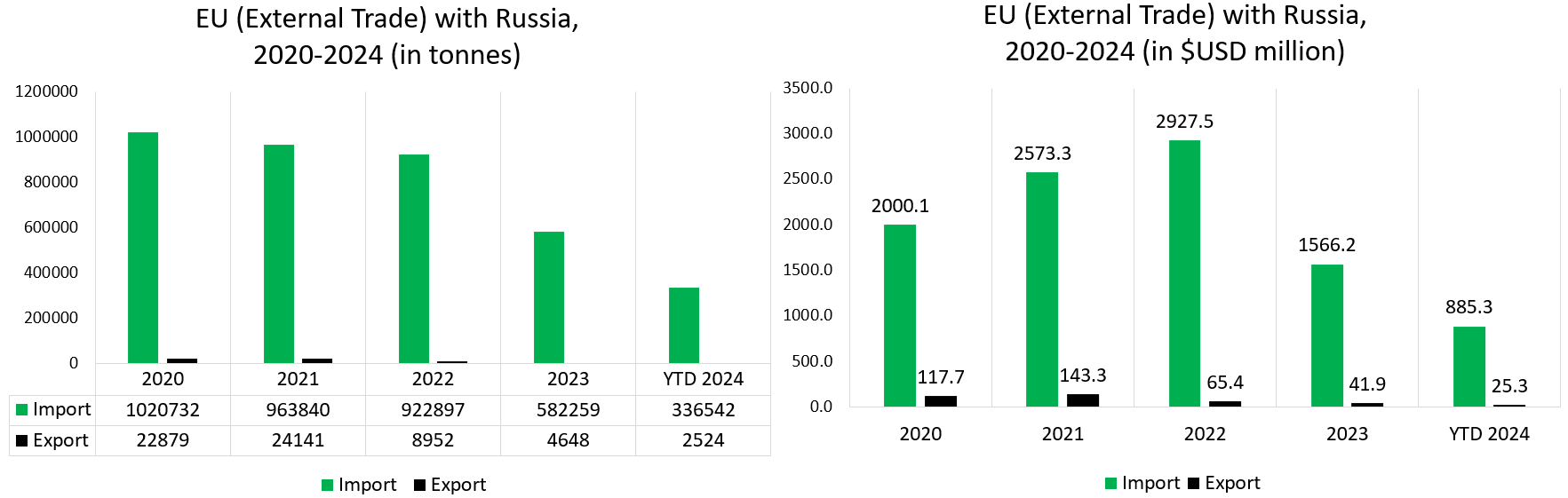
A detailed year-on-year analysis of aluminium trade dynamics between the European Union (EU) and Russia from 2020 to YTD November 2024 suggests that in 2020, Russia exported 22,879 tonnes of aluminium to the EU, while imports from the EU totalled 1,020,732 tonnes. Russia’s aluminium exports were valued at US$117.72 million, while imports were worth US$2 billion.
The consecutive year, exports grew by 5.5 per cent to 24,140 tonnes, whereas imports decreased slightly to 963,839.84 tonnes (-5.6 per cent). Export value surged by over 21 per cent to US$143.28 million, and import value increased to US$2.57 billion (+28.7 per cent), likely driven by market recovery and price fluctuations.
A steep decline in exports to 8,951 tonnes (-62.9 per cent) occurred in 2022, while imports reduced to 922,896 tonnes (-4.2 per cent). This dramatic drop in Russian exports likely resulted from the onset of geopolitical and sanction-related restrictions. Export value dropped sharply to $65.37 million (-54.4%) amid ongoing geopolitical challenges. Import value grew to $2.93 billion (+13.8%), suggesting higher aluminium prices despite declining quantities.
In 2023, export volumes plunged further to 4,648 tonnes (-48.1 per cent), with imports also significantly reduced to 582,258 tonnes (-36.9 per cent). Sanctions and reduced demand due to uncertainty in supply chains likely drove this decline. Export value continued its decline to US$41.88 million (-35.9 per cent), while import value nearly halved to US$1.57 billion (-46.5 per cent). The reduced import bill correlates with the sharp fall in import volumes.
As for YTD November 2024, exports have dwindled further to 2,524 tonnes (-45.7 per cent compared to the entire 2023 numbers), and imports stood at 336,541 tonnes (-42.2 per cent), reflecting continued trade restrictions and a decoupling between the EU and Russian aluminium sectors. Export value stands at $25.33 million (-39.5 per cent compared to 2023), and import value decreased to $885.27 million (-43.5 per cent), indicating ongoing disinvestment and reduced trade flows.
The decline in Russian exports from 2022 onward is primarily attributed to sanctions and geopolitical conflicts, resulting in restricted trade flows with the EU.
Why does the EU support Ukraine and ban Russia in trade dynamics?
The Association Agreement (AA) between the European Union (EU) and Ukraine, including a Deep and Comprehensive Free Trade Area (DCFTA), was negotiated from 2007 to 2011 and formally signed on March 21 and June 27 2014. The AA serves as a critical framework for fostering stronger political ties, economic cooperation, and mutual adherence to shared values. Following ratification by all EU Member States, the agreement officially came into force on September 1, 2017, with the DCFTA provisionally applied on January 1, 2016.
Aiming to accelerate and monitor the full implementation of the DCFTA, the EU and Ukraine adopted a Priority Action Plan (PAP) for 2023-2024. This blueprint outlines concrete steps to provide Ukraine with enhanced access to the EU Single Market, marking a significant effort to deepen economic integration.
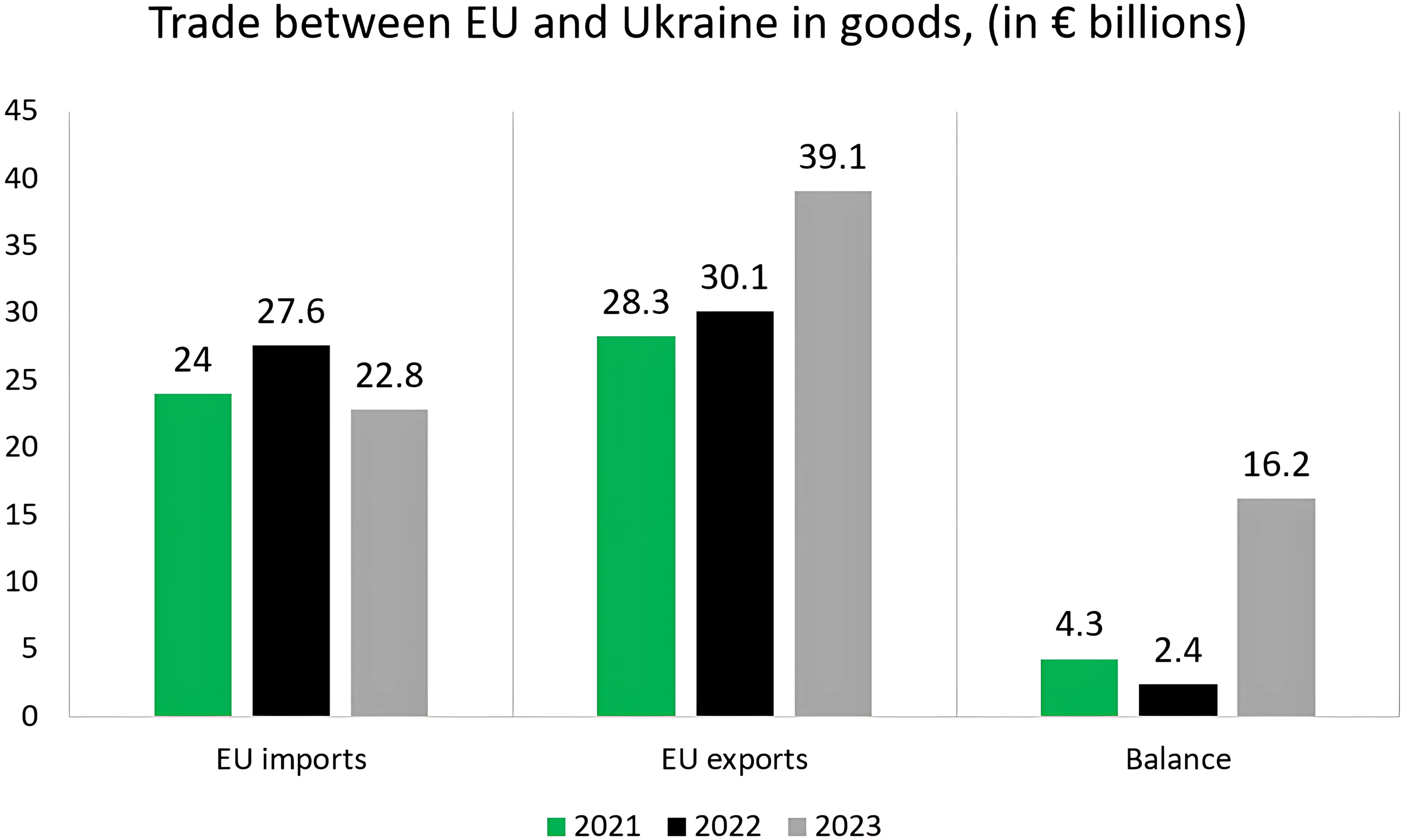 Image Source: European Commision
According to a report by the European Commission, the AA/DCFTA is designed to stimulate trade in goods and services between the EU and Ukraine by gradually reducing tariffs and harmonising Ukraine’s regulations with EU standards in key industrial and agricultural sectors. To better integrate with the EU market, Ukraine continues to align its legislation with EU norms for industrial and other commodities.
Before the radical shift in relations caused by Russia’s invasion of Ukraine in 2022, the EU was Russia’s largest trading partner, with Russia playing a key role in Europe’s energy sector. However, ties had been increasingly strained since Russia’s annexation of Crimea and the onset of the conflict in Donbas, prompting the EU to impose a series of sanctions on the Russian Federation.
The 2022 invasion further escalated tensions, leading to a complete diplomatic breakdown between Russia and the EU. In response, the EU provided military aid to Ukraine, froze Russian assets, and suspended direct flights to Russia. On November 23 2022, the European Parliament passed a motion formally designating Russia as a state sponsor of terrorism.
Not only the EU, Russia, and Ukraine but also the entire global aluminium industry are at the crossroads of innovation, sustainability, and growth. As we approach 2025, key trends and market dynamics are shaping the way we produce, consume and trade aluminium. AL Circle’s industry-focused report, ‘Global Aluminium Industry Outlook 2025’, is your guide to understanding these trends, unlocking opportunities and staying ahead of the competition.














_md.webp)








