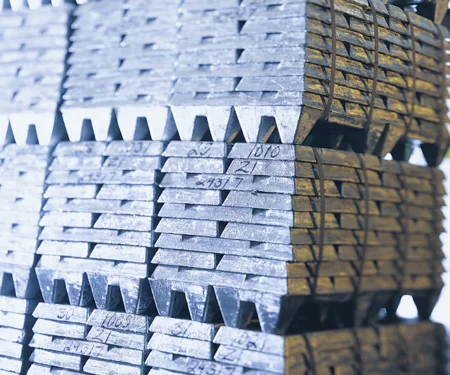
Rio Tinto's aluminium business remains key earnings driver as H1 EBITDA rises 28%
The image used in this article is generated with an AI tool and does not depict any real-time moment
Rio Tinto reported a strong first half of 2026, with its aluminium business remaining one of the company's key earnings drivers alongside copper and lithium. Together, the three commodities contributed more than 50 per cent of the Group's underlying EBITDA during the period.
The miner posted an underlying EBITDA of USD 14.8 billion, up 28 per cent year-on-year, while free cash flow increased 75 per cent to USD 3.8 billion. Underlying earnings rose 43 per cent to USD 6.85 billion, allowing the company to declare an interim dividend of USD 3.4 billion, up 43 per cent from a year earlier.
Rio Tinto said its aluminium operations maintained strong performance during the first six months of the year, with primary aluminium production remaining steady at 1.68 million tonnes. Higher output from Kitimat, New Zealand Aluminium Smelter (NZAS) and AP60 largely offset the planned closure of Arvida. The company also continued investing in measures to reduce the carbon footprint of aluminium production.
In Australia, Boyne Smelters secured an AUD 2 billion (USD 1.4 billion) government funding package over ten years to help extend operations to at least 2040, supported by new renewable energy and energy storage agreements in Queensland.
To know the production, demand and consumption forecasts on bauxite and alumina, explore the report "Global Bauxite & Alumina Market Forecast to 2036: Supply–Demand, Trade Flows & Price Outlook"
Kitimat continued ramping up towards nameplate capacity as improved hydrological conditions supported higher hydroelectric power generation, while NZAS operated at full capacity. The transition from Arvida to AP60 progressed as planned, with the final Arvida potlines closed in June. AP60 continues to ramp up towards full capacity by the end of 2026, while its expansion in Quebec produced first metal in March this year.
At the Gladstone alumina refineries, Rio Tinto signed a five-year bio-pellet offtake agreement with SuperChar in July as part of its efforts to reduce reliance on fossil fuels. The company said these initiatives support its target of cutting Scope 1 and Scope 2 emissions by 50 per cent by 2030 compared with the 2018 baseline. During the first half of 2026, emissions were already 14 per cent below the baseline.
Explore primary aluminium suppliers, product listings and trade opportunities on AL Biz
Rio Tinto's alumina production increased 8 per cent year-on-year to 4.0 million tonnes, reflecting full ownership of Queensland Alumina Limited (QAL). The increase was partly offset by weather and reliability issues at the Yarwun refinery in Australia and the Vaudreuil refinery in Canada. Bauxite production declined 7 per cent to 28.5 million tonnes after weather disruptions during the first quarter reduced output by about 0.9 million tonnes. The company expects to recover the lost production over the remainder of the year.
Chief Executive Simon Trott said Rio Tinto delivered a step-change in operational and financial performance during the first half, supported by stronger commodity prices, productivity gains and continued investment in growth projects. Copper equivalent production increased 3 per cent, while the company's productivity programme generated USD 870 million in benefits and remains on track to achieve an annualised run rate of USD 1.8 billion by the end of 2026.
Unlock key insights from leading companies and experts across the aluminium ecosystem with our e-Magazine: Mine to Market: Aluminium Producers & Manufacturers 2026
Net cash generated from operating activities increased 32 per cent to USD 9.17 billion, while consolidated sales revenue rose 15 per cent to USD 31.03 billion. Rio Tinto invested USD 5.04 billion in capital projects during the period as it continued expanding its portfolio across aluminium, copper, lithium and iron ore.
For 2026, Rio Tinto maintained its production guidance of 3.25-3.45 million tonnes of aluminium, 7.6-8 million tonnes of alumina and 58-61 million tonnes of bauxite.
LME aluminium price cools after brief recovery; cash eases over 1%, stocks reach 271,275t
Next articleAluminium price rose, shipments sentiment rose, downstream procurement sentiment was weak
Grow with
AL Circle