Environmental protection-related controls combined with off-season weakness cause aluminium processing operating rate to pull back slightly
The image used in this article is from SMM
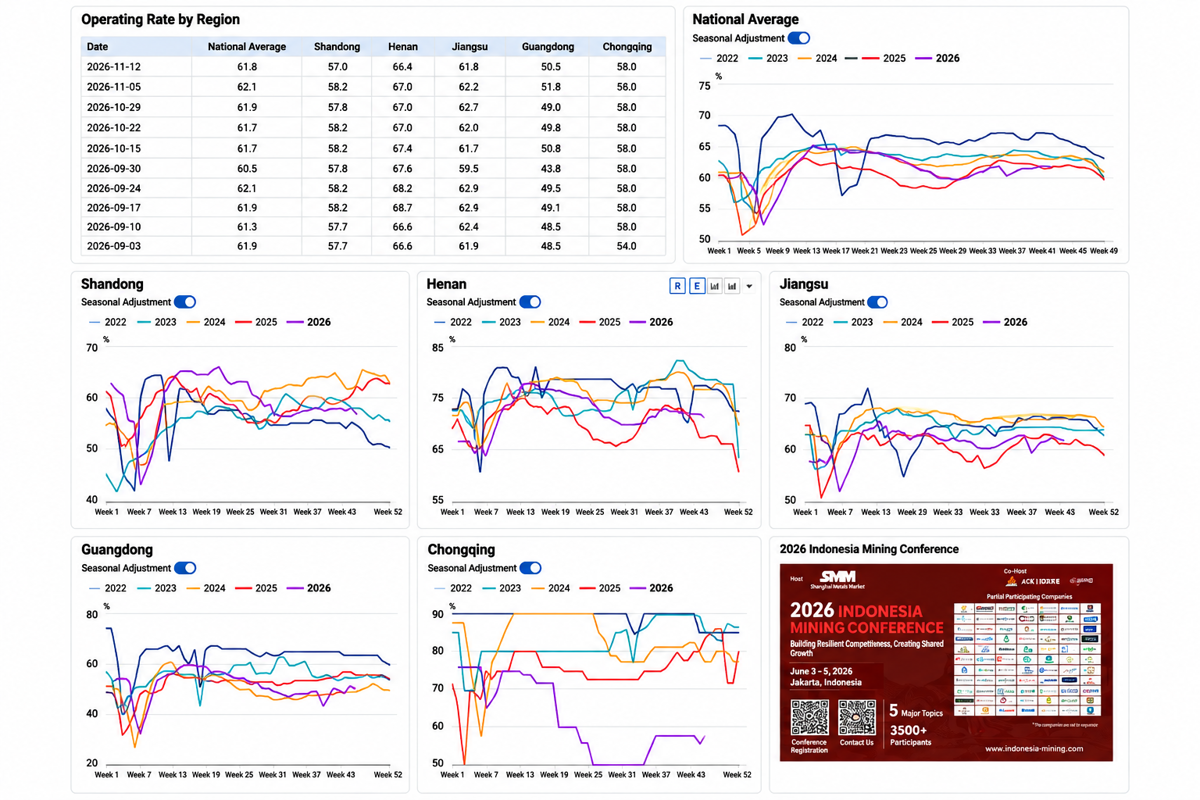
This week, the operating rate of leading downstream aluminium processing enterprises stood at 61.8 per cent, down 0.2 percentage points W-o-W, as off-season weakness and environmental protection-related controls converged. By segment, only aluminium wire and cable rebounded, while aluminium plate per sheet and strip posted the largest decline. Primary aluminium alloy held steady at 61.4 per cent, as production cuts from line upgrades were offset by automakers' year-end push and full order schedules, keeping the segment stable in the near term. Aluminium plate per sheet and strip fell to 68.0 per cent, with Henan imposing 50 per cent environmental protection-driven production restrictions and controls on heavy-duty transport. Orders for 5-series and 6-series thick plate dropped 10 per cent-20 per cent M-o-M, and restocking only partially eased inventory pressure, with further contraction expected. Aluminium wire and cable rose to 65.2 per cent, as lower aluminium prices opened up lock-in profit margins and boosted willingness to schedule production. The launch of State Grid's sixth batch of UHV tenders provided support, keeping the segment firm in the near term. Aluminium extrusion pulled back to 52.1 per cent, with orders in Shandong and Fujian recovering marginally but lacking sustained momentum, while heavy pollution controls led to production halts, pointing to a downward trend. Aluminium foil fell to 70.7 per cent, as declining battery foil orders fed through to production schedules, air-conditioner foil remained subdued, and packaging foil schedules provided a floor, extending the modest decline. Secondary aluminium held steady at 53.9 per cent, with demand weaker than last year, while environmental protection disruptions in Henan and Jiangsu combined with tight scrap supply posed downside risks. Overall, environmental protection-driven production restrictions and insufficient off-season demand were the main drags. Restocking amid lower aluminium prices was merely a pulse, and only aluminium wire and cable found support from the power grid and PV. Near-term operating rates are likely to consolidate on a subdued note.
This week, the operating rate of leading downstream aluminium processing enterprises reached 61.8 per cent, down 0.2 percentage points W-o-W, as off-season weakness and environmental protection-related controls converged. By segment, only aluminium wire and cable rebounded, while aluminium plate per sheet and strip posted the largest decline. Primary aluminium alloy held steady at 61.4 per cent, as production line upgrade-related production cuts were offset by automakers' year-end push and full order schedules, keeping the segment stable in the short term. Aluminium plate per sheet and strip fell to 68.0 per cent, with Henan imposing 50 per cent environmental protection-driven production restrictions and controls on heavy-duty transport vehicles. Orders for 5-series and 6-series thick plate fell 10 per cent–20 per cent M-o-M, and restocking only partially eased inventory pressure, with further contraction expected. Aluminium wire and cable rose to 65.2 per cent, as lower aluminium prices opened up profit margins on locked prices and boosted willingness to schedule production. The launch of State Grid's sixth batch of ultra-high-voltage tenders provided support, keeping the segment firm in the short term. Aluminium extrusion pulled back to 52.1 per cent, with orders in Shandong and Fujian recovering marginally but lacking sustained momentum, while heavy pollution-related controls caused production halts, pointing to a downward trend. Aluminium foil fell to 70.7 per cent, as declining battery foil orders fed through to production schedules, air-conditioner foil remained sluggish, and packaging foil schedules provided a floor, extending the modest decline. Secondary aluminium held steady at 53.9 per cent, with demand weaker than last year, while environmental disruptions in Henan and Jiangsu combined with tight supply to pose downside risks. Overall, environmental protection-driven production restrictions and insufficient off-season demand were the main drags, while restocking triggered by lower aluminium prices was merely a pulse. Only aluminium wire and cable was supported by the power grid and PV, leaving short-term operating rates likely to consolidate on a subdued note.
This week, the operating rate of leading domestic primary aluminium alloy enterprises came in at 61.4 per cent, unchanged from last week, with overall operating levels remaining relatively stable. From the enterprise perspective, leading producers saw some changes in output: some enterprises were required by national policies to upgrade and modify their production lines, which lowered their operating rates; others benefited from gradually improving downstream demand and raised their operating rates. These increases and decreases offset each other, keeping the overall operating rate stable. From the downstream demand perspective, demand is gradually improving, and automakers have entered the final sprint phase of production and sales. Primary aluminium alloy enterprises have relatively full and largely saturated order schedules, which supports output. Meanwhile, aluminium prices are on a downward trend, and the price pullback has revived downstream traders' inquiry sentiment, with transactions improving W-o-W and market activity picking up. Overall, production cuts from line upgrades and output increases from improving demand offset each other, while lower aluminium prices boosted transactions, keeping this week's operating rate stable. The operating rate is expected to remain at current levels next week, with stable operations prevailing.
This week, the operating rate of leading aluminium plate per sheet and strip enterprises was 68.0 per cent, down 0.8 percentage points M-o-M, as weakening off-season demand and supply-side disruptions converged. Over the weekend, Henan initiated environmental protection inspections, and local enterprises received notices of 50 per cent production restrictions and environmental controls on heavy-duty cargo transport vehicles. Some local enterprises came under significant operating pressure, as environmental disruptions shifted from earlier expectations to actual implementation. During the week, aluminium price volatility intensified, with spot prices plunging by as much as RMB 600 per tonne in a single day before rebounding quickly. The sharp drop and rapid rebound triggered a round of concentrated downstream restocking, easing finished product inventory pressure at aluminium plants. In other areas, orders for 5-series and 6-series thick plate fell 10 per cent–20 per cent from October, and the new energy sector's support for operating rates weakened. Overall, with environmental protection-driven production restrictions now in effect and off-season demand insufficient, structural support is simultaneously weakening, and aluminium plate per sheet and strip operating rates will continue to contract in the short term.
This week, the operating rate of leading aluminium foil enterprises was 70.7 per cent, down 0.3 percentage points M-o-M. The impact of earlier order declines at leading battery cell enterprises is gradually feeding through to production schedules, reducing their support for battery foil operations. The packaging segment provided the main floor. Based on consumption periods and foil producers' production cycles, end-user delivery orders for January need to be scheduled starting in November, and current packaging orders on hand remain relatively ample. Overall, with battery foil support weakening and air-conditioner foil sluggish, packaging foil has become the main offsetting force, and aluminium foil operating rates will continue to pull back slightly.
This week, the aluminium extrusion operating rate came in at 52.1 per cent, down 0.4 percentage points M-o-M. In the construction extrusion segment, lower aluminium prices during the week briefly spurred downstream purchasing and restocking, with some enterprises in Shandong and Fujian reporting marginal order recovery and corresponding raw material procurement. However, after aluminium prices consolidated again, end-user purchasing returned to a wait-and-see stance, and the sustainability of order growth remained weak. In addition, some enterprises in Shandong were subject to heavy pollution weather emergency response controls and experienced phased production halts, directly dragging down the segment's operations. The industrial extrusion segment consolidated on a subdued note. Demand for automotive-related extrusion was generally stable, and some large enterprises reported slight M-o-M improvement in orders, but the growth was limited. Small supporting enterprises saw reduced willingness to take orders due to low processing fees and profit pressure, leading to a notable contraction in output. For PV frames, downstream module makers' orders were weaker than expected, and production schedule plans were revised down, weakening frame producers' operating expectations. Overall, this week's lower aluminium prices temporarily stimulated downstream restocking demand, but the order pulse is unlikely to be sustained. Combined with environmental control disruptions and year-end cash flow constraints prompting enterprises to proactively limit orders, the industry's short-term operating rate is expected to continue edging down.
This week, the operating rate of the domestic aluminium wire and cable industry rose to 65.2 per cent, up 0.4 percentage points W-o-W, extending the post-holiday rebound. On the production side, sample enterprises continued to raise their load levels, showing a gradual recovery trend. On the order side, the aluminium price center continued to shift lower, boosting enterprises' willingness to deliver and schedule production. Orders from State Grid were moderate, PV installations continued to provide support, while orders at small and medium-sized enterprises were relatively mediocre, with structural divergence persisting. Entering November, State Grid officially began tendering for the sixth batch of ultra-high-voltage power transmission and transformation orders, providing medium and long-term support for end-use consumption. Overall, this round of operating rate increases was driven by orders and stockpiling demand, and wire and cable operating rates are likely to maintain a firm recovery trend in the short term.
This week, the operating rate of leading secondary aluminium enterprises held steady at 53.9 per cent M-o-M, with overall industry production running smoothly. November end-use consumption was relatively mediocre. Although enterprise orders were mixed, overall demand remained weaker than the same period last year, and the industry lacked the motivation to proactively ramp up production. Regionally, Henan and Jiangsu were affected by environmental protection-related controls, with some enterprises cutting or halting production, causing some disruption to local output. On the raw material side, lower aluminium prices dragged down the aluminium scrap price center, but constrained by tight compliant supply and tax invoice supervision, effective raw material supply remained insufficient. Enterprises faced considerable procurement difficulties and remained cautious in production scheduling. Overall, the industry's short-term operating rate is expected to remain relatively stable, but if environmental controls continue to tighten or end-user orders weaken further, operating levels still face downside risks.
Note: This article has been shared by SMM and has been published by AL Circle with its original information without any modifications or edits to the core subject/data.
Saudi Arabia’s Maadaniyah cancels aluminium foundry project with IGL Group
Next articleCNPC Powder and BLT partner to scale up production and international sales of BLT-AlAM400 aluminium alloy powder
Grow with
AL Circle












_md.webp)
_md.webp)
_md.webp)