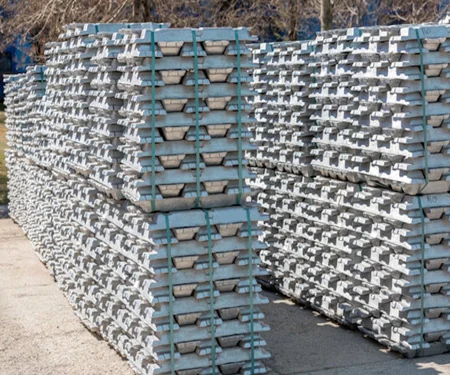
Press Metal strengthens on the aluminium upswing and supply disruption fears
While the global aluminium industry is grappling with the impact driven by the ongoing geopolitical tension, one company is silently marking the upswing in the price to its advantage. According to the Hong Leong Investment Bank Bhd (HLIB Research), Press Metal Aluminium Holdings Bhd, the world-class aluminium producer, is deemed to yield benefits due to the elevated aluminium price.
The firm’s earnings forecasts, as raised by HLIB Research, for the financial years 2026 and 2027, show an increase of 13 per cent and 18.7 per cent, respectively. The increase in the forecasted earnings is owed to the higher aluminium prices assumptions by the London Metal Exchange (LME). Additionally, the higher forecasts are also owed to the revised hedging positions and the stronger Main Japanese Port (MJP) premiums.
The firm has also shifted the stock from "High" to "Buy", with an expanded higher price target from RM 7.64 to RM 8.63.
As noted by the HLIB Research, the push in the LME aluminium price, moving above USD 3,400 per tonne, is mainly because of the rising US-Iran conflict. Due to the same reasons, a further escalation is likely to take place as the global market is deemed to be shifting from the 2025 surplus to the 2026 deficit, because of the supply disruptions.
The current environment, which is being supported by the higher aluminium price, stronger demand rising from the Asia Pacific region, because the buyers are now actively looking for alternative supply sources, and softer alumina costs have nudged prices to see a gain.
In a recent note, the firm declared that if the disruptions in the Strait of Hormuz continue to persist for more than one month, it may result in a deficit of nearly 2.29 million tonnes. This deficit will be high, driven by the logistical issue which is affecting the exports via the Gulf, especially when the smelters are estimated to resume operations in three to six months.
Must read: Key industry individuals share their thoughts on the trending topics
Moreover, in a further escalated situation, if the Strait of Hormuz remains closed for over a month, the market may see a deficit of up to 2.76 million tonnes and the timeline for restarting operations might stretch further from three to six or twelve months.
It has also been pointed out by HLIB Research that the region provides only 9 per cent of the world’s aluminium production, but it heavily relies on imported raw materials. Because of this, the smelters remain vulnerable to disruptions in crucial shipping routes, like the Strait of Hormuz.
This impact has been endured by many producers, including Qatalum, who initially planned a shutdown but later decided to scale back its operations. On the other hand, Aluminium Bahrain is reducing its capacity due to shipping issues. Emirates Global Aluminium (EGA) is also at risk as it is highly reliant on imports, while Iranian smelters are facing heightened risks due to ongoing military activities.
To know predictions and forecasts of how the Middle East crisis is and will be affecting the global aluminium industry, read the report “Global ALuminium Industry Outlook 2026”
Looking at the supply front, there is some supply tightness in the Western markets. The European Union (EU) and the United States (US) are still quite dependent on aluminium imports from the Middle East, which is pushing regional premiums up. On the other hand, the alumina prices are expected to remain low due to a structural oversupply, which should help maintain healthy margins for producers like Press Metal.
The research house quoted that the global alumina market may stay oversupplied for the medium to long term, indicating prices to remain low, nearly USD 300 per tonne.
Owing to this, the firm mentioned it has hedged nearly 65 per cent of its aluminium production at prices between USD 2,750 per tonne and USD 2,800 per tonne, giving them a clear view of their earnings. The remaining 35 per cent, however, allows the firm to take advantage of current spot prices.
Additionally, the firm is also witnessing a rise in orders from the Asia-Pacific region as customers look for immediate supply options due to ongoing disruptions. Buyers believe that the firm is well-positioned to benefit from the current geopolitical situation, especially with high LME aluminium prices and lower alumina costs.
Calculate your carbon emission and the final CBAM cost here
_0_0.png)
Industrial Accelerator Act proposes EU-origin necessities with inferences for trade & supply chains
Next articleBanco Aluminium executes inter-se share transfer, subtly reshaping ownership control
Grow with
AL Circle