Moggaro’s aluminium hybrid dive boat wins award for design and performance
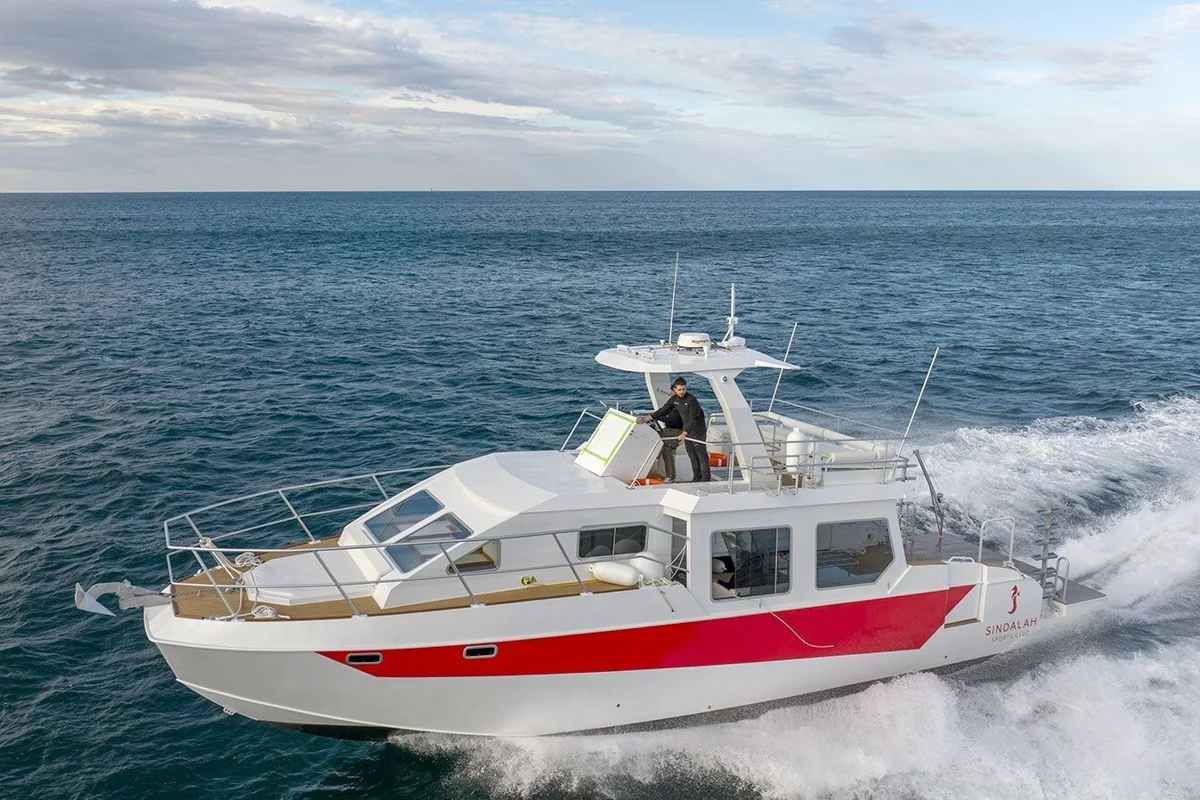
Spain-based Moggaro Aluminium Yachts has picked up recognition at The Baird Maritime 2025 Work Boat World Awards for its 16-metre hybrid aluminium dive boat, built for operations in Saudi Arabia’s Red Sea.
The vessel stands out mainly for how it blends aluminium construction with hybrid propulsion, something that’s still not very common at this scale. It’s designed for dive tourism but built more like a commercial workboat, fast, efficient, and able to go the distance.
On the power side, the diesel engines drive waterjets, while two retractable 15 kW electric outboards, supported by eight lithium-ion batteries, handle low-emission operation. The idea is simple: run silent and clean in ports or dive zones, then switch to diesel when range and speed matter.
It can travel up to 250 nautical miles, with dive trips planned around 60 nautical miles offshore, and still carry a full load without compromising performance.
Santiago Parga Landa, founder of Moggaro, put it pretty directly, “What makes this vessel special… is the level of integration achieved between performance, hybrid technology, and inclusive design, all within a single platform designed for real commercial operation.”
For the global aluminium value-chain 2026 outlook, book our exclusive report “Global ALuminium Industry Outlook 2026"
That “integration” bit shows up in the layout too. The boat has a completely flush deck, no steps anywhere, which makes full wheelchair access possible, something you don’t usually see on high-speed dive boats.
The build had its challenges, though. Weight was a constant issue.
“The vessel had to reach 25 knots… while fully loaded with 25 people, 40 dive cylinders, 1,600 litres of fuel, 350 litres of water… and the additional weight of the hybrid system,” Parga said.
That’s a lot to balance on a 16-metre platform. Add too much weight, you need more power. Add more power, and weight goes up again. It’s a loop, and they had to keep it under control.
To deal with that, the team focused heavily on hull design and propulsion. Small tweaks, like adding hull flaps beneath the waterjets, ended up improving planing and trim without hurting speed.
The hybrid system itself allows zero-emission operation for about 1 hour and 45 minutes, mainly for sensitive areas like dive sites. But Parga was clear, fully electric isn’t ready for everything yet. “In many professional applications… conventional diesel propulsion is still the only viable solution.”
He also pointed out a growing disconnect in the market. Financing and subsidies are increasingly tied to low-emission tech, even when diesel is still needed for real-world operations.
Don't miss out- Buyers are looking for your products on our B2B platform
Beyond this one vessel, there’s a bigger shift happening. The tourist boat market is getting crowded, especially after a strong growth cycle between 2013 and 2023. Boats last long , often 20 years or more , and there’s no proper recycling system, so older vessels just keep circulating.
At the same time, new builders are entering the space. So demand hasn’t disappeared, but it’s changing. Operators now want something different, not just capacity, but experience. That’s pushing shipyards toward more customised builds.
Parga summed it up simply, “A boat must be engineered as a complete system, where every decision has a direct impact on performance, efficiency, and usability.”
For Moggaro, that approach, combining aluminium construction, hybrid systems, and custom design, is where future opportunities lie, especially as the industry moves toward more specialised and globally competitive vessels.
Must read: Key industry individuals share their thoughts on the trending topics

UK aerosol filling stable in 2025 despite 2 per cent decline
Next articleRare earth magnet demand set to rise 30% by 2030 as EV adoption accelerates
Grow with
AL Circle