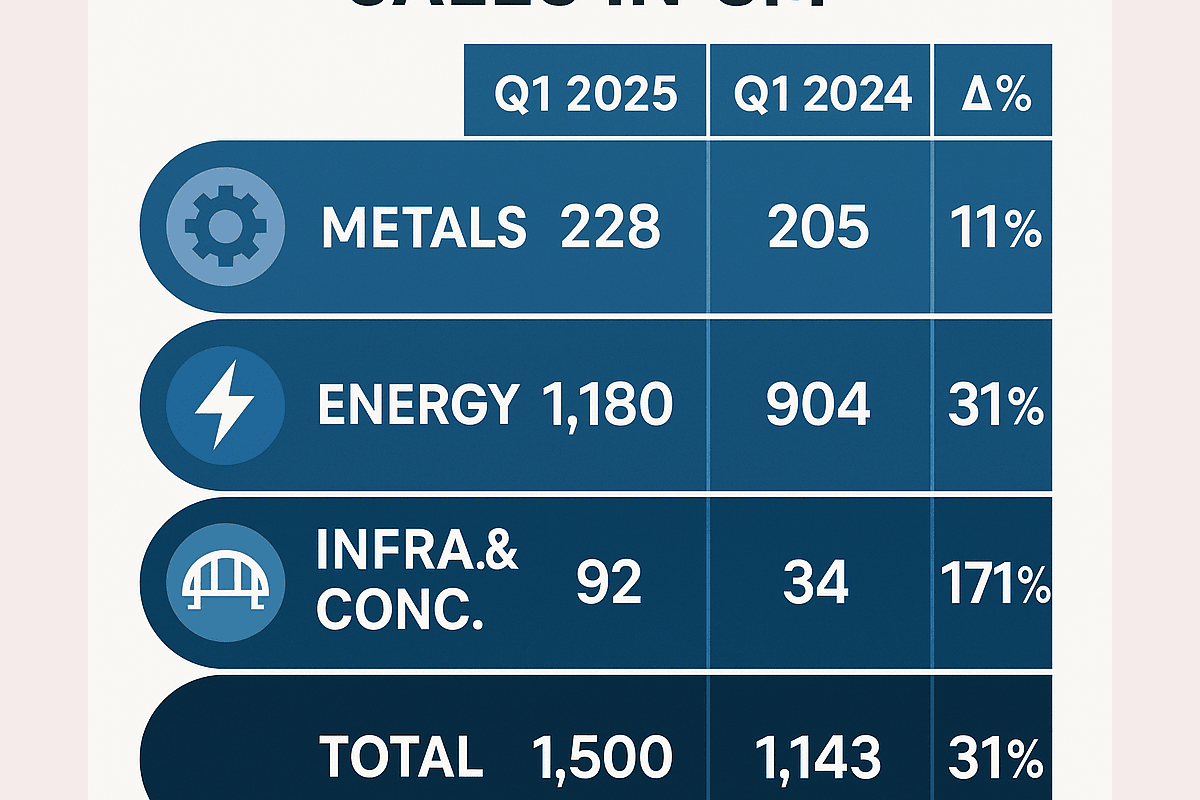
Metlen Energy and Metals has kicked off Q1 2025 with a striking surge in activity, posting total sales of EUR 1.50 billion (a 31 per cent upgrade on the EUR 1.143 billion generated in Q1 2024) steered forward by double-digit gains across Metals (an increase of 11 per cent), Energy (31 per cent growth) and a standout Infra and Concessions division (171 per cent).
Energy output climbed 35 per cent to 3.1 TWh (renewables up 78 per cent to 0.6 TWh), while Metals production dipped marginally by 2.1 per cent to 58 thousand tonnes amid capacity realignments. The quarter also saw planned infusions of investor confidence, wherein Fairfax Financial’s EUR 110 million exchangeable bond will elevate its stake to 8.35 per cent, and a EUR 295.5 million commitment to an integrated bauxite-to-gallium plant, facilitated by a Critical Raw Materials Act designation.
With LME aluminium trading around USD 2,400 per tonne at the end of April and forecasts eyeing USD 2,600 per tonne by Q2, Metlen’s cost-control measures and long-term supply pacts with Rio Tinto position it to navigate market headwinds.
Metlen’s Q1 2025 topline of EUR 1.50 billion represents a 31 per cent year-on-year upswing from EUR 1.143 billion in Q1 2024.
- Metals: EUR 228 million, up 11 per cent from EUR 205 million a year earlier.
- Energy: EUR 1,180 million, a 31 per cent climb from EUR 904 million.
- Infrastructure and concessions: EUR 92 million, surging 171 per cent versus EUR 34 million.
The initial quarter of the CY saw Metlen’s energy sector output expand vigorously, with thermal generation rising to a noteworthy 25 per cent to 2.5 TWh and renewables nearly doubling to 0.6 TWh, culminating in total production of 3.1 TWh (35 per cent growth).
On the contrary, metals’ production showed modest contraction, with alumina deflating 3.3 per cent to 210 thousand tonnes, primary aluminium shrinking 0.5 per cent to 45 thousand tonnes, and secondary aluminium dropping 7.1 per cent to 13 thousand tonnes, for a total of 58 thousand tonnes (a total degrowth of 2.1 per cent).
Developments and investor confidence
Fairfax Financial reinforced its commitment via a EUR 110 million exchangeable bond, granting an option to purchase 2.75 million shares at EUR 40 each and lifting its stake from 6.43 per cent to 8.35 per cent within two years.
On the sustainability front, Metlen earned inclusion in the Dow Jones Best-in-Class Emerging Markets Sustainability Index and the S&P Global Sustainability Yearbook 2025 for the third consecutive year, ranking among the top 6 per cent of global peers in ESG performance.
Evangelos Mytilineos, Chairman and CEO of Metlen, has shared, “We remain committed to delivering growth and long-term value to our shareholders. With a clear focus on operational efficiency and strategic expansion, we continue to build on our strengths to unlock new opportunities in key markets. The year ahead marks a significant milestone for METLEN in London, reinforcing our position as a global leader and opening new roads for growth, innovation, and collaboration.”
Metlen’s energy arm continues to diversify and deepen its capabilities. The company reported:
- A 25 per cent uplift in thermal generation to 2.5 TWh.
- A 78 per cent leap in renewable output to 0.6 TWh.
- Battery storage projects totalling 1.2 GWh, bolstering grid flexibility.
Notable infrastructure milestones include the GBP 2.5 billion Eastern Green Link 1 (EGL1) subsea interconnector between Scotland and England, set to deliver clean power to over two million households. Meanwhile, the retail arm achieved a 19.4 per cent market share in Greece (up from 17.4 per cent), on track for its 30 per cent target.
Though Q1 aluminium volumes dipped slightly, Metlen’s metal division pursued a long-term resilience blueprint through:
- A EUR 295.5 million capex for an integrated bauxite-to-gallium line, bolstered by CRMA Strategic Project status to enhance Europe’s raw-materials autonomy.
- Long-term offtake pacts with Rio Tinto: 14.9 million tonnes of bauxite (2027–37) and 3.9 Mt of alumina (2027–34, with extension option).
- Progress on the European Bauxites merger, consolidating capacity and streamlining operations.
Present and near-future market dynamics play a role
Metlen has seen a volatile quarter in the metals segment as a ripple effect of inter-connected incidents worldwide. Global aluminium prices have swayed owing to supply-side constraints and tariff frictions. LME cash settlement hovered near USD 2,400 per tonne at the end of April, down from USD 2,518 per tonne on March 31, reflecting modest profit-taking on capacity expansions at Chinese smelters. Reuters analysts project a 6.3 per cent average price rise in 2025 to USD 2,573.50 per tonne, buoyed by an anticipated market deficit of 8 thousand tonnes amid China’s smelter caps.
US tariff volatility has spurred a 30 per cent jump in Japan Q1 premiums to USD 22 per tonne, considered a decade’s high, and buyers hedge against North American supply shifts. Meanwhile, Goldman Sachs trimmed its 2025 aluminium forecast to USD 2,000 per tonne for Q3 before a rebound to USD 2,300 per tonne by year-end, citing weaker demand growth (1.1 per cent) and a projected 580 thousand tonnes surplus.
Risks and tactical imperatives
Metlen must explore the regulatory shifts, especially in Europe, where the centre of focus should be fixed on the EU’s Carbon Border Adjustment Mechanism and Critical Raw Materials Act, which could reshape cost structures and supply chains.
Tariff uncertainties, with US policy swings continuing to roil export dynamics and premiums, are also to be borne in mind and is another tactics to battle any long-term hassles.
Metlen’s Capital Markets Day in London on April 28 promises a deep dive into its EUR 2 billion EBITDA mid-term target, leveraging four growth pillars spanning energy, metals, critical raw materials and defence solutions. With a potent Q1 foundation, diversified revenue streams and fortified balance sheet, Metlen is well placed to capitalise on tightening global metals markets and the energy transition — provided it maintains operational rigour and adapts swiftly to evolving trade and regulatory landscapes.












_md.webp)
_md.webp)
_md.webp)







