South32, the global mining and metals giant has flagged a potential impairment about the future of its Mozal Aluminium smelter, in its FY25 financial results due to deepening uncertainty over the smelter’s long-term electricity supply.
The mining and metals major stated that ongoing contract negotiations and worsening drought conditions have thrown the future of the smelter into question.
The financial hit though not yet quantified could mark a critical turning point for one of Mozambique’s largest industrial operations.
South32 stated in a regulatory filing, “HCB has also recently indicated that drought conditions have the potential to impact its electricity generation and capacity to deliver sufficient hydro-electric power to Mozal.
“These factors have resulted in increased uncertainty regarding future electricity supply to Mozal. Given the uncertainty of operating beyond March 2026, FY26 production guidance for Mozal is under review.”
Power supply risks have been mounting for years. South32 has been in stalled negotiations with Hidroeléctrica de Cahora Bassa (HCB) over a new tariff agreement, with the current contract set to expire in March 2026. No deal has yet been reached.
With the clock ticking toward 2026 and no alternative solution secured, South32 has been forced to reassess the smelter’s viability and alert shareholders to the risk of a substantial asset write-down.
Power loop creates cross-border risks for Mozal
Mozal’s power supply depends on an unusual and fragile arrangement. Electricity generated by HCB in northern Mozambique is first exported to South Africa’s Eskom and then routed back into Mozambique through a 1,400km transmission loop.
This infrastructure designed in the 1970s to prioritise exports has no direct link between the Cahora Bassa Dam and the Mozal smelter near Maputo.
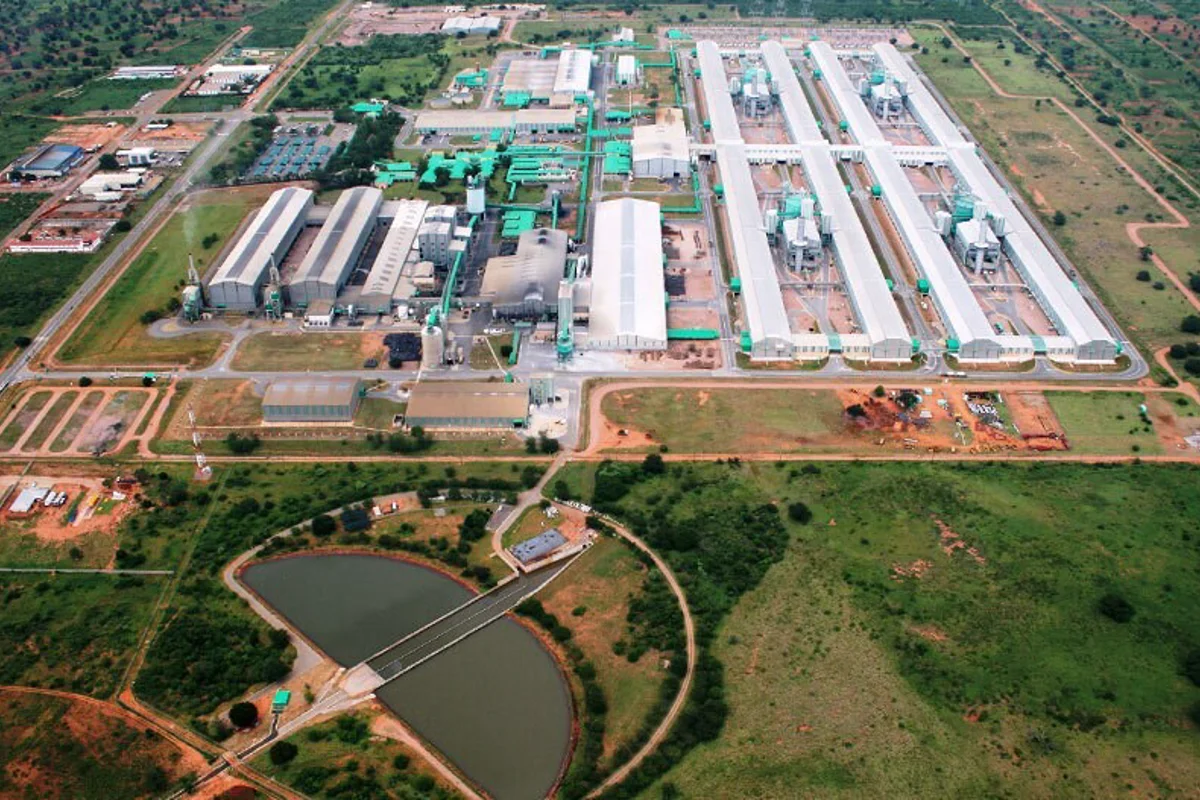
The smelter requires about 950 megawatts of continuous electricity to operate its two production lines, which together produce roughly 580,000 tonnes of aluminium annually. The complex routing system introduces multiple failure points and has become a major operational risk.
- Phase 1, commissioned in 2000, utilizes Aluminium Pechiney AP30S technology with a capacity of 253,000 tonnes per annum.
- Phase 2, completed in 2003, added a second potline, increasing total capacity to 506,000 tonnes per annum.
Reason for drought in the region
The current crisis is rooted in severe climate disruption. The 2023–24 rainy season was one of the driest on record due to a powerful El Niño event, which slashed rainfall across southern Africa. Several regions in the Zambezi Basin, which feeds the Cahora Bassa reservoir, received less than 20 per cent of normal precipitation.
Extreme heat, with temperatures 1–2°C above average, further intensified the problem by accelerating evaporation and lowering water tables. By mid-2024, Cahora Bassa’s reservoir dropped to just 44 per cent of capacity well below the level needed to ensure stable hydropower generation.
2025 sees slight recovery, drought risks remain
January 2025 brought some relief, with seasonal rains briefly boosting inflows to 1,585 m³/s and pushing reservoir levels to 21–22 per cent of usable capacity. However, HCB officials stressed that the crisis is ongoing. Despite modest gains, hydropower output remains constrained, and any recovery is tentative given the unpredictability of climate patterns.
The government has since revised down its national electricity production forecast for 2025 by 1.3 per cent, with hydropower expected to decline by 4.1 per cent. Meanwhile, gas-fired output is being scaled up to fill the gap but not fast enough to stabilise industrial baseload demand on its own.
Other power supply option
In response to mounting risks, Mozambique is racing to diversify its power sources. A key development is Mozal’s plan to source electricity directly from Electricidade de Moçambique (EDM), bypassing Eskom’s intermediary role. This shift could reduce transmission losses and increase reliability by keeping power flows domestic.
Mozambique is also scaling up renewables. Operational solar projects such as Mocuba (40 MW), Metoro (41 MW), and Cuamba (20 MW hybrid with battery storage) are already feeding the grid. The Namaacha Wind Project (~120 MW) is under development, offering additional clean energy.
A long-term solution may come from the planned 1,500 MW Mphanda Nkuwa hydroelectric project, located downstream of Cahora Bassa. The government is also building out gas-fired generation, including the Temane power station in Inhambane Province, to provide dispatchable backup power.
Transmission from these sources would continue to rely on Motraco, the tri-national utility currently managing power flows to Mozal.
Outlook: a race against time
Mozal Aluminium remains one of Mozambique’s largest employers, exporters, and energy consumers but its future is tied to decisions made in the next 18 months. Without a new power agreement and reliable electricity infrastructure, South32 could face operational disruptions, higher costs, or even production curtailments.
The expiration of the current supply contract in March 2026 is fast approaching. With climate risks worsening and infrastructure bottlenecks unresolved, the smelter’s long-term sustainability is in serious doubt.
South32 is expected to provide further updates in its quarterly operations review, scheduled for July 21.












_md.webp)