India’s solar costs ease 11.4% in Q4 2025: What to expect in 2026 and how aluminium fits into the scene?
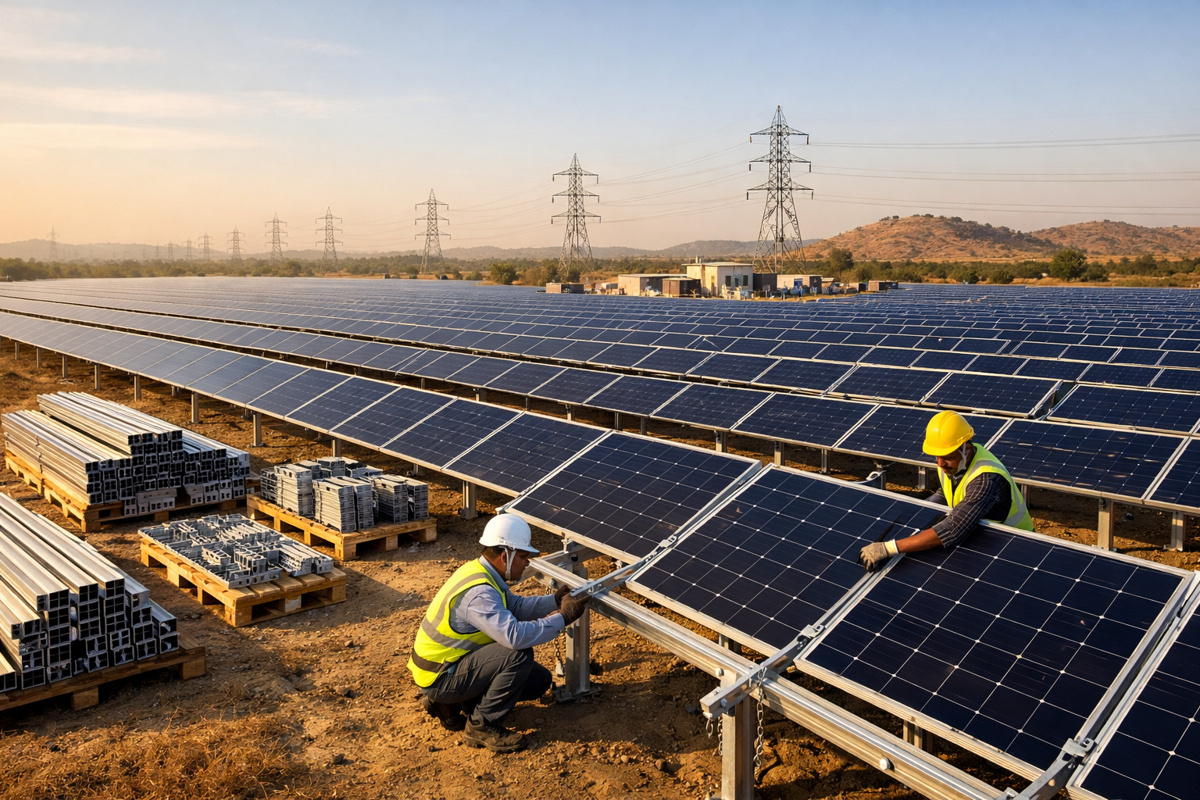
India’s renewable sector (focusing on solar this time) came to the end of 2025 with the highest-ever renewable energy expansion in India’s energy transition journey. Among all, solar installed capacity touched 132.85 GW as India added nearly 35 GW from January to November 2025, as compared to the 20.85 GW during the same period last year.
A broad quarter-on-quarter decline in several components of large-scale solar project costs drove the growth. The trend, highlighted in the Q4 2025 India Solar Market Update by Mercom India, reflects easing input costs, stabilising supply chains, and moderating inflationary pressures. Yet the decline also reveals deeper structural tensions.
According to a 2020 study by the World Bank, aluminium is the single most widely used material in solar photovoltaic (PV) applications. In fact, the metal accounts for more than 85 per cent of most solar PV components- frames to panels. And thus, as the solar projects in India progress, so does the aluminium industry. Why? Manufacturing 1 MW of solar PV capacity requires approximately 21 tonnes of aluminium. Does the falling cost prove beneficial for the Indian aluminium industry?
For the global aluminium value-chain 2026 outlook, book our exclusive report “Global ALuminium Industry Outlook 2026"
A broad cooling in balance-of-system costs
The most immediate driver behind falling project costs in Q4 2025 was the decline in balance-of-system (BoS) components, particularly mounting structures and inverters.
Module mounting structure (MMS) costs fell sharply by 11.4 per cent quarter-over-quarter, largely due to declining steel prices. These structures typically represent 4.6 per cent to 7.2 per cent of the total cost of large-scale solar projects, meaning even modest changes in steel prices can materially affect overall project economics.
Solar inverters, grouped under power conditioning units (PCUs), also recorded a slight decline of 0.6 per cent Q-o-Q, accounting for about 4.3 per cent to 6.8 per cent of total system costs. While the drop was marginal, it reflected a period of relative stability in the global supply chain for electronic components and inverter hardware.
Other BoS components, including cabling, transformers, and auxiliary electrical equipment, remained largely stable, contributing roughly 1.2 per cent to 1.9 per cent of overall project costs.
Taken together, these shifts point to a stabilising procurement environment after several years of volatility triggered by pandemic-era disruptions, commodity inflation, and logistics bottlenecks.
International and domestic costing go hand-in-hand
Another contributor to declining solar project costs was the broader macroeconomic environment in India during late 2025.
Retail inflation eased to 1.33 per cent in December 2025, down from 1.54 per cent in September, reducing pressure on transportation, labour, and auxiliary inputs used in project construction.
With effect from September, 2025, Goods and Services Tax has been reduced from 12 per cent to 5 per cent, inter alia, on the following solar energy devices & parts for their manufacture:
- Solar power-based devices
- Solar power generator
- Solar lantern / solar lamp
- Photovoltaic cells, whether or not assembled in modules or made up into panels
Don't miss out- Buyers are looking for your products on our B2B platform
Simultaneously, as of February 2025, India has reduced its Basic Customs Duty (BCD) on imported solar cells and modules to 20 per cent to manage high costs, down from 25 per cent on cells and 40 per cent on modules. While this reduces the tax burden, higher Agriculture Infrastructure and Development Cess (AIDC) maintains overall high import costs to support domestic manufacturing, with 12 per cent IGST also applicable.
Contextually, India primarily imports finished solar PV modules (panels) and solar cells for module assembly, with over 78 per cent of these imports coming from China, followed by Vietnam and Malaysia. Whereas, the nation produces a wide range of solar energy products, driven by major manufacturers like Waaree, Tata Power Solar, Adani Solar, and Vikram Solar. Key products include monocrystalline, polycrystalline, and bifacial (PERC) PV modules, solar cells, inverters, batteries, solar water pumps, and turnkey EPC solutions for residential and utility-scale projects. And, the country primarily exports solar photovoltaic (PV) modules and cells, with exports skyrocketing to over USD 2 billion in FY2024, a 23x increase in two years, primarily driven by demand from the United States. The US accounts for 97 per cent of these exports. Just a week ago, US imposed countervailing duties on solar imports from India, Indonesia and Laos which will potentially impact India's solar projects in 2026.
Other exported products include solar pumps, inverters, and battery storage solutions (lithium and tubular batteries). Key exporters include Waaree Energies, Adani Solar, and Vikram Solar.
But not all solar projects are getting cheaper
Despite the general cost decline, not all solar installations benefited equally. A key dividing line lies in the technology and origin of the modules used in projects.
Projects built with Indian-manufactured modules across different technologies experienced consistent quarter-over-quarter cost declines.
However, installations using Chinese TOPCon modules, a newer, high-efficiency photovoltaic technology, recorded cost increases during the same period.
This divergence reflects the technological transition currently underway in the global solar industry. TOPCon (Tunnel Oxide Passivated Contact) cells are gradually replacing older mono PERC modules due to higher efficiency and improved performance. But newer technologies often come with higher upfront costs, particularly when supply chains are still scaling.
Domestic manufacturing comes at a cost
Perhaps the most striking cost gap in India’s solar sector lies in the difference between projects using imported modules and those complying with Domestic Content Requirement (DCR) rules.
According to industry analysis:
- Projects using DCR-compliant mono PERC modules cost about 24 per cent more than projects using non-DCR modules.
- Projects using DCR-based TOPCon modules are even more expensive, with costs 37 per cent-38 per cent higher than projects relying on Chinese modules.
These premiums highlight a structural challenge for India’s solar manufacturing push. Policies such as the Approved List of Models and Manufacturers (ALMM) and domestic-content mandates aim to build local supply chains and reduce dependence on imports—particularly from China.
But until India achieves economies of scale comparable to Chinese manufacturers, developers must absorb higher equipment costs when using locally produced modules.
Implications for developers and tariffs
For developers bidding in solar auctions, cost movements directly affect tariff competitiveness. Even a small change in system costs can translate into measurable shifts in bid prices.
Falling BoS costs in Q4 2025 may therefore provide some breathing room for developers facing higher module costs due to domestic sourcing rules. However, the premium associated with DCR modules could still limit tariff reductions in government-backed projects that require domestic equipment.
A 24-38 per cent cost premium for domestic-content projects therefore has clear implications for tariff competitiveness.
At the same time, falling costs in certain components could improve project viability in merchant or open-access solar markets, where developers have greater flexibility in technology and equipment sourcing.
Must read: Key industry individuals share their thoughts on the trending topics
Aluminium, as the primary component
According to industry reports, roughly 8 kg is used per panel, mostly in frames and mounting structures. Driven by 100 GW solar targets, this demand could reach 1.2 million tonnes for future installations, using durable, corrosion-resistant alloys like 6063 for long-term, lightweight support. The rapid expansion of solar capacity, including floating photovoltaics, requires extensive use of extruded aluminium. Developing 1 GW of solar capacity demands approximately 20 kilotonnes (KT) of aluminium.
Also, the use of lightweight aluminium profiles increases solar installation speed by 20 per cent and reduces costs by 15 per cent.
In the aluminium production front, electricity accounts for roughly 30-40 per cent of aluminium production costs. Falling solar prices make it a cheaper alternative to traditional grid or coal-based power, with some estimates suggesting heavy industries could save up to 10 per cent on operational costs.
However, it's all a loop. With aluminium price reaching over USD 3300s in LME, the cost viability is again in question as India progresses through 2026 in its solar energy expansion journey. And again, if solar energy production is expensive, companies like Vedanta and Hindalco, who invest heavily in solar, will struggle to reduce their reliance on volatile coal prices and expensive grid power in the near future.
Ardagh Metal Packaging 2025 report: 3% shipments hike and 12% in revenue with “minimal” tariff impacts
Next articleBeiersdorf pushes sustainability with recycled aluminium can usage expansion in Europe
Grow with
AL Circle