Australia stands as a major global player in aluminium production. As per AL Circle's report, Australia continues to be the second major producer and the biggest exporting country of alumina in the world. The country is estimated to have produced around 18.25 million tonnes in 2023-24, a decrease from 18.97 million tonnes in 2022-23.
According to various sources and AL Circle's forecast, Australia's alumina production for 2024-25 & 2025-26 is to attain 16.39 million tonnes (approx.) & 16.28 million tonnes (approx.), respectively. The forecast is that there will be a dip due to the production curtailment at the Kwinana refinery.
As per EnergyQuest, the alumina and aluminium sectors generate more than $13 billion in export earnings each year, underpinning a total industry value that exceeds $15 billion. And at the core of this success story is Western Australia (WA), home to some of the world's biggest bauxite mines and alumina refineries.
Yet, this industrial giant is entering turbulent waters. Australia, despite its abundant natural gas reserves, is confronting twin energy crises - one on the east coast, the other in Western Australia. This energy crisis is expected to impact both the aluminium and the alumina industry.
How will this impact both the alumina & aluminium industry?
The alumina and aluminium industry in Western Australia is poised to bear a heavy cost burden from the state's deepening gas crisis. With wholesale gas prices more than doubling since 2019 and Woodside and Santos prices up by 96 per cent and 68 per cent respectively since 2020, refineries that rely on gas for the energy-intensive Bayer process face a steep rise in operating expenses. Below is a graph showing how sharply the prices have grown for two of Australia's leading oil, gas, and LNG producers -
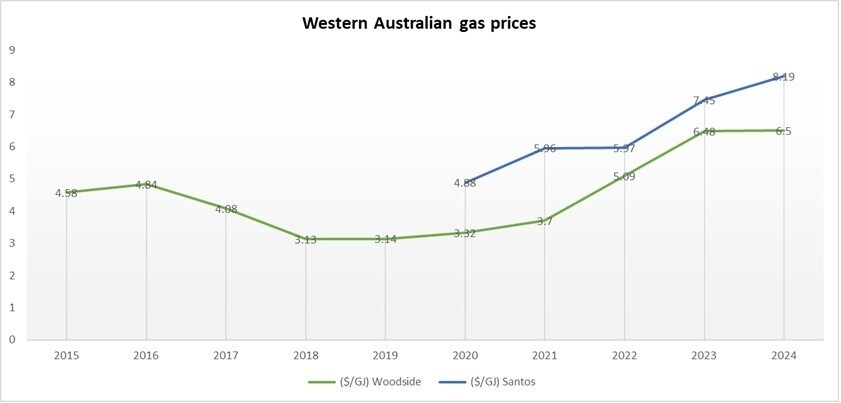
Given the industry's massive gas consumption, even a few dollars more per gigajoule translates into hundreds of millions in additional annual costs, potentially adding a staggering amount to the sector's energy bill. This surge will erode margins, threaten global price competitiveness, and could force operators to scale back production, delay upgrades, or accelerate costly shifts to alternative technologies. In a market where WA supplies a large share of the world's alumina, these pressures risk not only disrupting local operations but also tightening global supply, driving up aluminium prices, and reverberating across industries from automotive to construction.
For WA, once celebrated for its abundant, affordable gas, prices have surged more than 100 per cent since 2019, and the threat of a deepening supply crunch looms as the state's last coal-fired power plants head for closure by 2029. The warning signs are already flashing, and one sector which is at the core of this challenge is alumina refining.
In early 2023, Alcoa was forced to slash output at its Kwinana alumina refinery by 30 per cent after gas shortages, switching boilers to diesel just to keep operating. More recently, gas supply disruptions triggered downtime at its Pinjarra refinery, underscoring how vulnerable WA's alumina sector has become.
Alcoa's Pinjarra and Wagerup refineries make the company WA's single largest gas user, while South32's Worsley Alumina refinery has sharply increased demand after converting two of its five boilers from coal to gas, a change that, in some months, makes it the state's top gas-consuming facility. Both companies are exploring electrification technologies to power the energy-intensive Bayer process, but these innovations are still in early development. Until they are commercially viable, WA's alumina industry will remain heavily dependent on gas.
South32’s Worsley Alumina refinery, already one of WA’s largest gas users, is now taking a significant step towards reducing its reliance on fossil fuels. In August 2024, South32 announced that it will investigate electrification options for its alumina refining operations, supported by the Australian Renewable Energy Agency (ARENA). This feasibility study will assess replacing gas-fired boilers with renewable-powered electrical alternatives, aiming to cut carbon emissions and mitigate exposure to volatile gas prices.
If successful, the initiative could help South32 navigate WA’s tightening gas market while setting a precedent for the entire alumina sector offering a viable path to secure production and meet global decarbonisation targets. Although the current gas shortfall discussion focuses largely on alumina refining, aluminium smelting in Australia is also at risk.
How it is affecting the aluminium industry?
Australia is one of the few countries with a complete mine‑to‑market chain, spanning bauxite mining, alumina refining, smelting, and extrusion, which supports over 20,700 direct and 55,000 indirect jobs and contributes more than A$18 billion annually to the national economy, with over A$15 billion in exports from alumina and aluminium alone. Smelters are hugely energy‑intensive and face mounting pressure as gas‑driven electricity costs rise.
This threatens margins and global competitiveness, especially as the world smelting market grows, from US $91.5 billion in 2023 to an estimated US $131.3 billion by 2030 at a CAGR of 5.3 per cent. In a market where aluminium buyers demand both cost efficiency and low-carbon production, prolonged volatility in WA’s gas supply risks undermining the long-term viability of smelting operations alongside refining.
Is the region bracing for a serious gas squeeze?
The region is bracing for a serious gas squeeze, with prices having more than doubled since 2019 and further strain expected as the state's last two coal-fired power stations prepare to close by 2029. EnergyQuest head of consulting Matt Paull warns of an impending "pinch point" where miners, mineral processors, and the South West power grid could all be competing for the same limited supply.
South32, in its 2024 sustainability report, confirmed keeping its options open on converting the remainder of its boilers to gas, citing uncertainty in both domestic coal and gas availability.
The stakes are clear - without decisive action, WA's gas shortage could morph from a regional supply challenge into a national industrial crisis, eroding the cost competitiveness of Australia's $13 billion alumina and aluminium export engine. For a sector built on the promise of cheap, abundant energy, the coming decade will be a test of adaptation, innovation, and resilience.
A looming energy pinch point for WA's industrial heartland
This demand-side pressure is emerging just as supply risks mount. The closure of Collie's coal-fired plants, doubts over the privately owned Bluewaters station, and the rising cost of mining Collie coal all threaten the state's electricity stability. Renewable projects are not expanding fast enough to replace retiring coal capacity, making gas back-up a necessity, a move that risks locking in fossil fuel dependence for decades. In the north, iron ore miners shifting from diesel to battery-electric fleets will further increase electricity demand, again requiring gas as a stabilising supply source.
This evolving energy equation is more than an economic issue, it's a structural shift that could redefine WA's industrial base. Since Sir Charles Court's premiership in the early 1980s, WA has tied economic growth to gas development. But EnergyQuest expects supply to increasingly lag demand, with the gap widening over time. For energy-intensive industries like alumina refining, built on the foundation of abundant, affordable energy, the next decade could bring sustained cost pressures, tighter supply conditions, and a pressing need to accelerate alternative energy adoption.












_md.webp)
_md.webp)
_md.webp)







