Guinea’s mining production leaps, tax revenues dip: IMF wonders about income from mining
On 9th December ‘20, the Board of Directors of the International Monetary Fund (IMF) approved a disbursement of $ 49.47 million for Guinea as part of the aid to the nation facing the difficulties of stabilizing their balance of payments. The government of Guinea has praised the continuation of the program so vital for the economic survival of Guinea, especially in these difficult times of pandemic.
However, the IMF wonders about the disconnect between mining production and tax revenues in Guinea, as the country receives most of its income in foreign currency due to the export of bauxite, whose figures have risen in recent years making it the second-largest exporter of bauxite in the world just behind Australia.
As per the IMF report: “While the overall growth has been supported by a vibrant mining sector, the covid-19 pandemic had significant consequences on the non-mining economy, where the real growth is expected to reach 5.2% but non-mining activity is only expected to grow by 2.4%. Improved mining production has not translated into higher tax revenues. The situation of the most vulnerable and households and workers in the informal sector has also worsened. "
The IMF publicly manoeuvres that Guinea must do better so that mining production can benefit the population. Criticism from the residents of the bauxite mining areas of Boké - Boffa and Fria has been making since the launch of mining operations in the area.
Several international NGOs in addition to pollution accusations have also sounded the alarm on the growing gap between the wealth of subcontracting mining companies in which certain senior leaders have interests and the destitution and pollution suffered by residents. Some international NGOs have even filed complaints against multinationals and donors for "complicity in violations of environmental rights" of rural areas.
The mines of Guinea, in particular, the bauxite are extremely rich and especially easy to access is located near the sea coasts and are the object of many covets. This is how several mining concessions have been granted to Chinese, Russian and Qatari companies and of course the North American giants Rio Tinto, Alcoa already present in Sangarédi through the CBG. Not to mention the mining permits offered to "well-placed Guineans" who sometimes resell them at a high price or become passive shareholders.
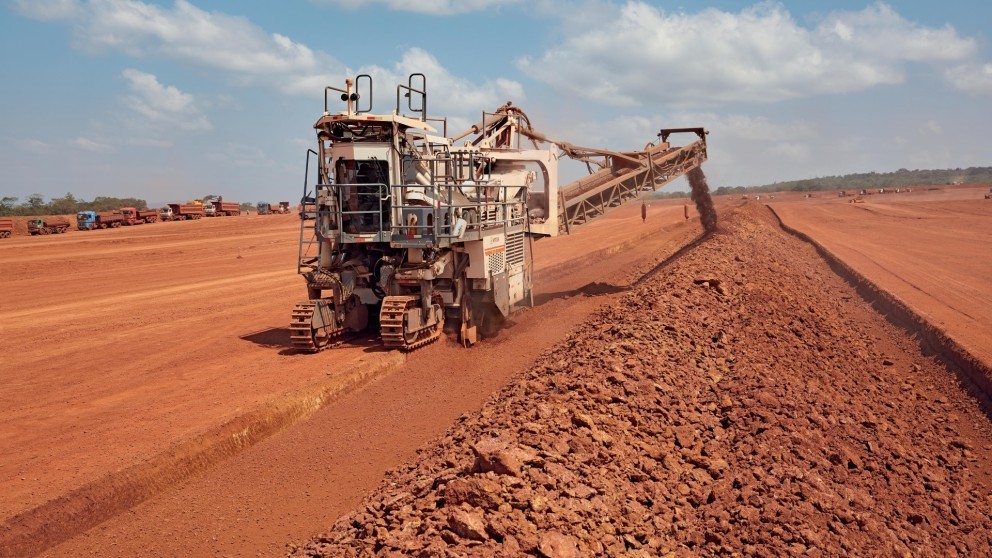
The commissioning of the GAC (a subsidiary of the Emirates Global Alumina) and SMB deposits was one of the major turning points in bauxite mining production in Guinea. These two companies have almost doubled the production of bauxite in Guinea until then confined to SBK and CBG.
After an investment of $ 1.4 billion financed in part by the World Bank and the ADB, it is in 2019 that GAC begins its export of bauxite using the redeveloped infrastructure of the CBG. Production is rapidly grown to 12 million tonnes per year.
According to the report of the Ministry of Mines, Guinean bauxite production which was 17 million tonnes in 2010, 21 million in 2015 jumped to a record level of 70.2 million tonnes in 2019 the year of the launch of GAC's mines, COBAD. The US Geological Survey estimated Guinean bauxite production at 57 million tonnes in 2018 and forecast 62 million tonnes for 2019.

The Ministry of Mines contradicting the IMF affirms that: “The period from 2017 to 2019 is marked by a sharp increase in the State's mining revenues which progressively went from $310 million in 2017 to $ 397 million in 2019 or 1.4 times their 2016 level and 3.4 times 2010 revenue, thanks in particular to the entry into production of several bauxite companies.”
The mining transparency NGO, ITIE (Initiative pour la Transparence dans les Industries Exctractives) in its 2019 report on Guinea also provides details on production: “Partly impacted by socio-political movements, mining activities have ended 2019 with relatively good momentum. The cumulative production of bauxite is 70,173,326 tonnes. The cumulative export of Bauxite stood at 66,279,526 tonnes.”
Canyon Resources: Cliff Lawrenson joins the board as Chairman, David Netherway steps down
Next articleASI welcomes Brazil’s largest bauxite producer as a new Production & Transformation member
Grow with
AL Circle