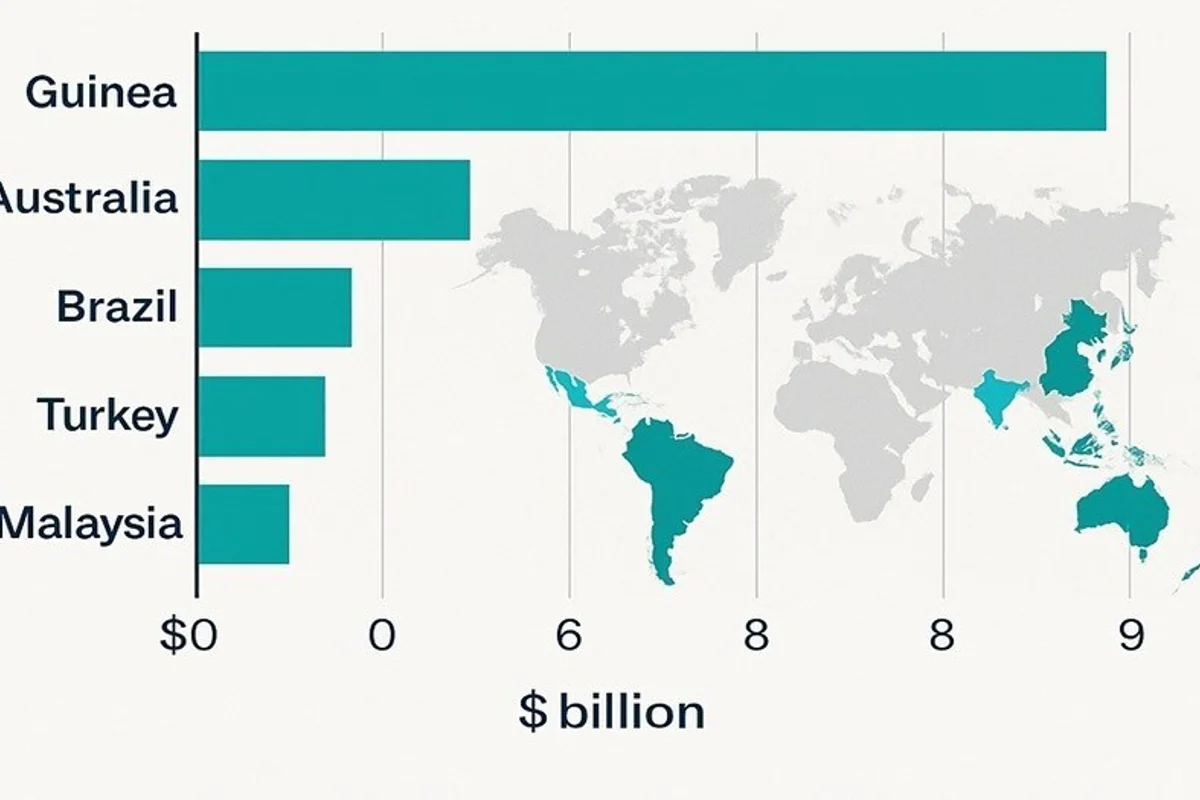
The first half of 2025 showed a divided picture for the global bauxite trade. Some producers set new records, while others stumbled against logistical and policy headwinds. Guinea and Australia stayed firmly ahead, fuelled by Chinese demand and reliable supply chains. At the same time, Turkey and Brazil slipped back, leaving room for smaller exporters such as Malaysia and Guyana to carve out a bigger role.
Export performance: gainers and losers
Guinea, the world’s largest supplier, shipped about 99.8 million tonnes between January and June — a 36 per cent jump from 73.4 million tonnes a year ago. Export earnings hit roughly USD 8.9 billion, most of it from China, which alone takes around 60 per cent of the country’s ore.
Australia also turned in a solid performance. Volumes rose 11 per cent, from 17.6 million tonnes in H1 2024 to 19.4 million tonnes, while export revenues climbed 69 per cent to USD 1.16 billion, due to firmer prices.
For a broader view of the global bauxite market click: A Comprehensive Analysis of Bauxite Residue - Red Mud
Smaller players made headlines too. Malaysia’s exports more than tripled to 455,000 tonnes, lifting values nearly eleven-fold to USD 44 million. Guyana outpaced that growth, expanding six-fold to 1.57 million tonnes worth about USD 60 million.
Not every producer shared in the upswing. Turkey’s shipments fell 12 per cent to 1.82 million tonnes, though higher prices kept earnings up at USD 70 million. Brazil, hampered by incomplete data and shipment delays in May and June, posted a 9.5 per cent drop in value to about USD 100 million in the first half.
Why Guinea and Australia pulled ahead
Guinea’s rise was driven largely by strong Chinese demand. Chinese smelters ramped up aluminium output by about 4 per cent in the first five months of the year, driving appetite for ore. Large, Chinese-backed miners such as SMB and CDM-CHINE filled the gap left by smaller firms that lost licences under the country’s tougher rules.
Infrastructure also played a role. With nine ports now in operation, up from five, congestion eased and vessel calls rose nearly 40 per cent in Q1. At this rate, Guinea could finish 2025 above 199 million tonnes — an extraordinary figure for a market still coping with political uncertainty.
Australia, by contrast, moved forward on stability rather than scale. Its mining sector is highly developed, its ports run efficiently, and its regulatory system gives buyers confidence. Asia and China in particular — continued to provide the main outlet. Tariffs that hurt other exporters barely touched Australia, keeping trade flows smooth.
Also, Australian producers, including Rio Tinto and Metro Mining, are pushing ahead with expansion projects at major sites like Amrun and Weipa, strengthening future output and reinforcing Australia’s role as a global supplier.
Setbacks for Turkey and Brazil
Turkey’s decline reflects deeper challenges. Mining capacity is limited, transport bottlenecks slow delivery, and American tariffs have bitten hard. A 15 per cent duty, plus a 50 per cent surcharge on steel and aluminium products, squeezed margins in one of its most important markets. Rising freight costs and insurance bills only added to the pressure.
Brazil’s problems looked different. Infrastructure is stretched, labour unrest remains a risk, and environmental disputes often interrupt operations. Export data for May and June was not available, suggesting delays or cancellations. With revenues down nearly 10 per cent to USD 100 million in the half-year, the country’s position in the trade looks shaky.
Malaysia and Guyana step forward
The real surprise came from Malaysia and Guyana. Both countries poured money into mining and port capacity, and both are now reaping the rewards. Malaysia shipped 455,000 tonnes in H1 2025, more than triple the year before.
Guyana, starting from a smaller base, jumped to 1.57 million tonnes. Investors are betting on stronger governance and new trade deals, while buyers in Asia and Latin America are eager to diversify supply.












_md.webp)
_md.webp)
_md.webp)







