Giga-Casting: The aluminium shot - How Tesla's aluminium revolution turned 70 parts into one shot and rewired the global foundry industry
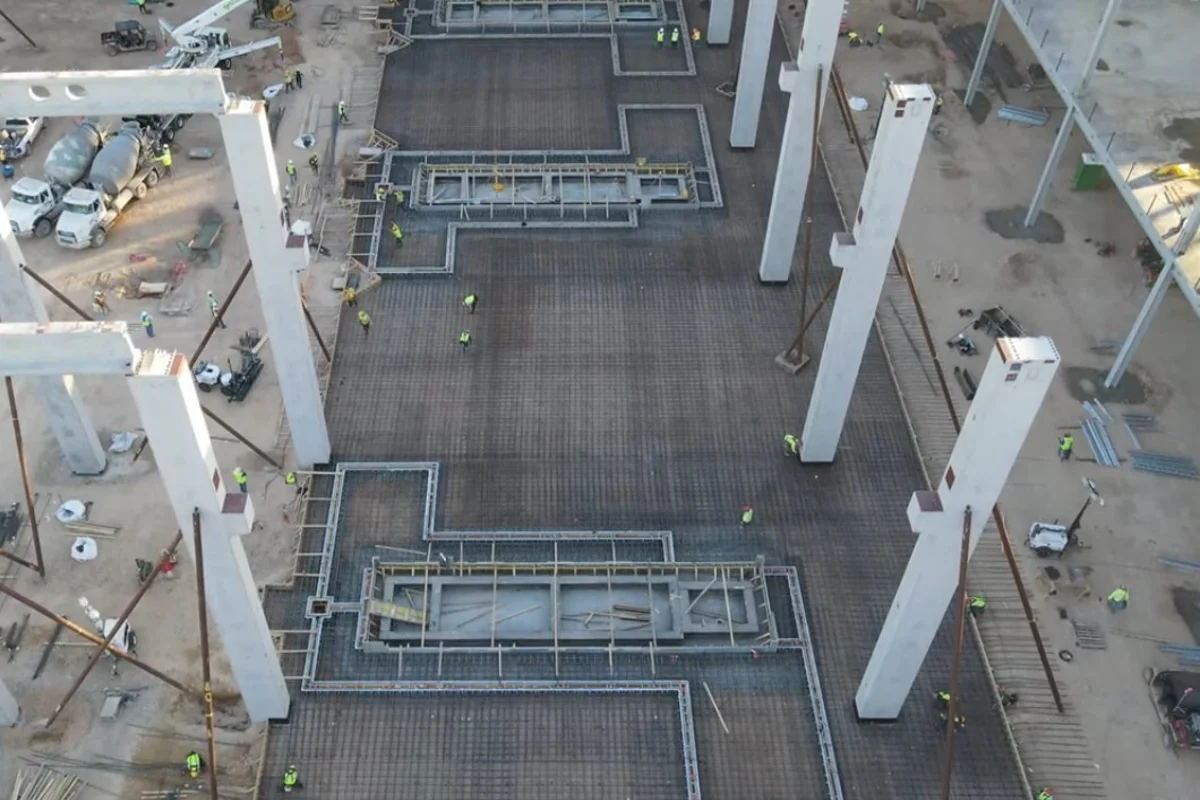
Aerial view of three Giga Press foundation sites under construction at Tesla's Gigafactory Texas, January 2021. Each foundation anchors a 410-tonne aluminium giga-casting machine. (Photo: Wikimedia Commons / CC BY 3.0)
Tesla started it. BYD, Toyota, Volvo, Hyundai, NIO, and Xiaomi are racing to match it. The machines at the centre of this aluminium giga-casting revolution - some weighing 410 tonnes and injecting metal at pressures exceeding 1,500 bar-are making the conventional automotive die casting industry structurally obsolete. Giga-casting technology is not a trend. It is a permanent restructuring of how the world builds cars, and every aluminium foundry, alloy producer, and equipment maker on Earth now operates in its shadow.
A plant manager in Bavaria
Klaus Hartmann has run an 800-tonne HPDC unit south of Munich for fourteen years. His machines produce structural brackets and subframe nodes for a German OEM. Twenty-two parts per platform. His line runs three shifts. His margin sits at seven per cent, which in European die casting means you are doing well.
In early 2024, a letter arrives from his OEM procurement team. The next EV platform will use a single rear underbody giga-casting produced in-house on a machine the OEM has already ordered from an Italian equipment builder. His twenty-two parts are no longer required. His 800-tonne press is no longer relevant to that platform.
He is not a victim of poor management. His quality record is clean. His delivery performance is strong. His pricing has been competitive for more than a decade.
He is a victim of physics. A 9,000-tonne press operating at 1,500 bar injection pressure makes his entire process category economically irrational. One shot replaces twenty-two components, collapses twenty-two logistics lines into one, and removes twenty-two sets of tooling from the OEM's cost base. No amount of operational excellence closes that gap.
Elon Musk put it plainly when Tesla announced the programme: "We're trying to make the car manufacturing process much simpler, the way you would design it if you were starting from scratch." That sentence described the obsolescence of an entire supply chain tier. Klaus Hartmann's story is currently unfolding in every automotive die-casting market worldwide.
The mathematics of part consolidation
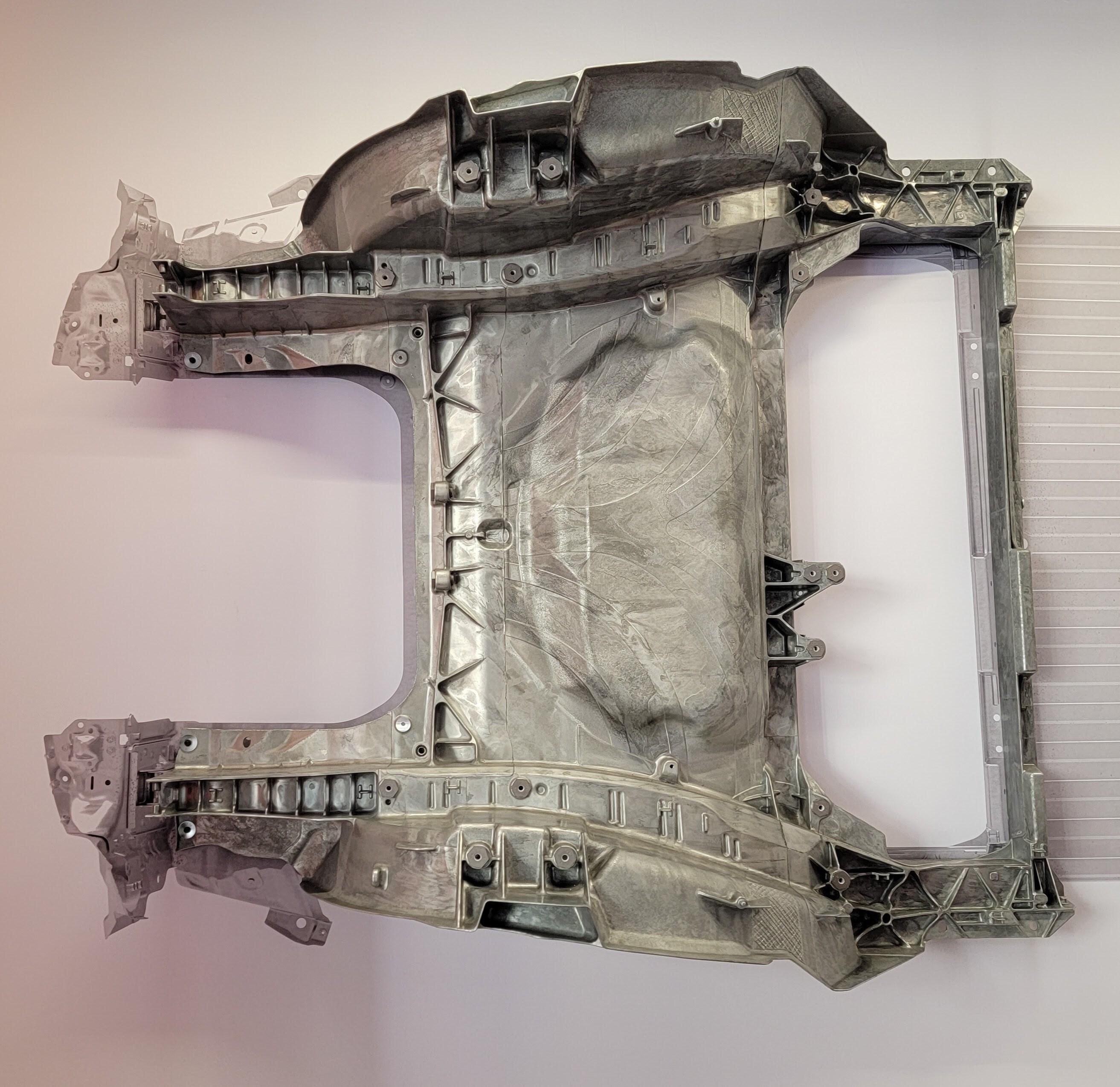 The single monolithic aluminium giga-casting that replaced approximately 171 stamped parts in the Tesla Model Y - eliminating 1,600 welds and 300 assembly robots. (Photo: Wikimedia Commons / CC BY-SA 4.0)
The origin point is 2019. Tesla proposed giga-casting technology and used it to produce the rear floor plate of the Model Y, reducing the number of parts from 70 to just 1 (Tesla Battery Day, September 2020; Reuters, September 2020). That single engineering decision stripped approximately 300 assembly robots from the factory floor (Tesla Battery Day 2020; Castman, 2025) and compressed manufacturing cycle time from 120 minutes to roughly 80 to 90 seconds, enabling 40 to 45 castings per hour (Wikipedia Giga Press; LinkedIn, Jake Hall, February 2021; Torque News, June 2022). It set in motion the largest structural change in automotive manufacturing since the introduction of the moving assembly line.
The machines that do this are extraordinary in scale. IDRA, the Italian die casting equipment manufacturer now owned by China's LK Group, produces the dominant giga-press lines in the world. Their machines range from 19.7 x 7 x 6 metres to 22 x 8 x 6.5 metres, with clamping forces from 5,500 to 9,000 tonnes. The units installed at Tesla's Gigafactory Texas are approximately 19.5 metres long, 7.3 metres wide, and 5.3 metres high - a single machine weighs 410 tonnes (IDRA official catalogue; Wikipedia).
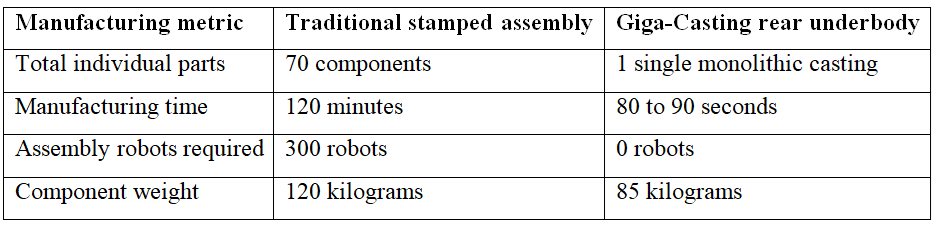
Tesla replaced approximately 171 stamped parts with two large castings in the Model Y, eliminating 1,600 welds. New model development timelines have compressed from 48 months to 18 to 24 months (Yang et al., Journal of Alloys and Compounds, 2025). A well-optimised giga-press cell processes up to 45 castings per hour (Torque News, June 2022; LinkedIn, Jake Hall, 2021).
Volvo's megacasting for the EX60 replaces 60 to 100 welded steel components with a single aluminium casting, delivering 15 to 20 per cent section weight reduction and a 35 per cent cost reduction versus a mixed steel-aluminium structure (Chalmers University, January 2026; LinkedIn, Luca Greco, January 2026; Euroguss, February 2026). Tesla's plan to replace a 370-component underbody assembly - confirmed at Battery Day 2020 and reported by Design News, March 2025 - is projected to reduce vehicle weight by 30 per cent and manufacturing cost by up to 40 per cent by Tesla's own estimate; independent analyses by Light Metal Age (July 2023) put achievable savings at 20 to 30 per cent.
The machine evolution has been rapid. Tesla introduced 6,000-tonne machines in 2020. The industry progressed from 9,000 tonnes to 12,000 tonnes with the introduction of double injection systems, and then to 16,000 tonnes. Machines of 20,000 tonnes have already been announced - based on announced specifications, these are expected to be approximately 30 metres long and require up to 30 MW of peak electrical power. The first dedicated Giga-Casting Congress was held in Germany in March 2025. By 2027, integrated die casting is expected to cover battery case upper covers, middle floors, and full underbody assemblies in a single production cell.
The global HPDC market, valued at USD 73 billion in 2023, is restructuring at a 6.5 per cent annual growth rate. This rapid adoption has shifted roughly USD 2.2 billion away from traditional stamping equipment towards ultra-large die casting cells globally (ANP Consulting, January and April 2024).
The complete OEM adoption map
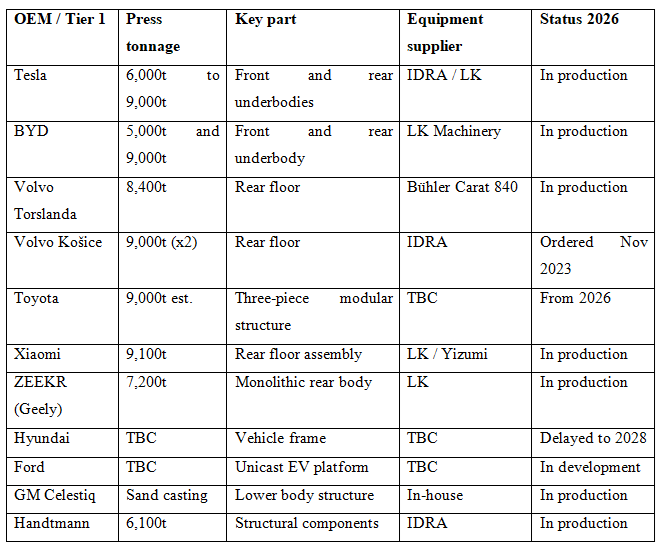
Tesla, the pioneer. Tesla began using the IDRA OL 6100 CS Giga Press in late 2020 for chassis parts on the Model Y. The current configuration uses a three-piece underbody design. Giga Casting 2.0 - the full single-piece underbody - is under active development and is expected to reduce total part count from approximately 400 to just a few components (Reuters, September 2020; Tesla Battery Day transcript). Tesla's key process innovation was using 3D-printed sand binder-jet prototypes to validate die designs at a fraction of the cost of conventional metal tooling iterations.
BYD, the fast follower. BYD installed 5,000-tonne and 9,000-tonne die casting equipment at their new industrial park in Shenzhen, with LK Machinery as the equipment supplier. The initial investment was RMB 390.5 million - approximately USD 54 million - covering one 9,000-tonne giga press and its supporting equipment (LinkedIn, Luca Greco, January 2025; Industry Arsenal, January 2025; X/Twitter, January 2025). BYD uses heat-treatment-free aluminium alloys and targets both front and rear underbody giga-castings across their EV platforms.
Volvo, the Western adopter. Volvo was the first European OEM to formally commit to giga-casting in 2022. At the Torslanda facility in Sweden, Volvo selected Bühler's 8,400-tonne Carat 840 machine (LinkedIn, Luca Greco, January 2026; Industry Arsenal, November 2025). For the new Košice facility in Slovakia, orders were placed in November 2023 for two 9,000-tonne IDRA machines, confirming that competitive pressure between equipment suppliers is now producing real differentiation in procurement decisions (Repairer Driven News, November 2023). The EX60 megacasting replaces 60 to 100 stamped components with a single aluminium casting (Chalmers University, January 2026; Volvo official YouTube, January 2026).
Toyota, the conservative convert. Toyota plans to adopt megacasting for EVs going on sale in 2026. The vision is a three-segment body with giga-castings for the front and rear sections. Toyota's Shanghai factory will be the first to implement this configuration. When Toyota adopts a manufacturing technology, it indicates that the technology has entered the mainstream.
Hyundai, the delayed adopter. Hyundai's hypercasting programme, originally planned for 2026, has been pushed back by two years, reflecting the genuine engineering difficulty of deploying this technology outside China and the United States, where giga-scale casting infrastructure is more mature.
NIO, ZEEKR, Xpeng, and Xiaomi - China's native Giga-Casters. These are now among the most aggressive adopters globally. Xpeng is expanding a 16,000-tonne die casting machine for next-generation CIB and centre-floor integrated die casting. Xiaomi developed its proprietary Titan Metal alloy specifically for giga-casting, described as highly moldable with excellent fluidity and a stable balance between strength and toughness.
Ford, the American parallel. Ford is integrating battery systems and casting several structural sections simultaneously on their novel EV platform, branding the approach unicasting.
General Motors, the alternative path. For lower-volume applications, GM applied mega precision sand casting to combine underbody components in the Cadillac CELESTIQ, reducing part count by approximately 40 per cent. GM's UniCast alloy tolerates higher iron content, enabling 100 per cent recycled aluminium feedstock.
Tier 1 suppliers entering the field. Handtmann in Germany was the first Tier 1 supplier globally to invest in giga-casting, purchasing a 6,100-tonne machine. GF Altenmarkt in Austria operates one 6,100-tonne machine and is expected to commission a second in 2026 or 2027. Linamar was the first North American Tier 1 to make the investment. OEMs still account for approximately 80 per cent of the giga-casting investment in Europe. The Tier 1 window is open, but it is closing.
The machine makers
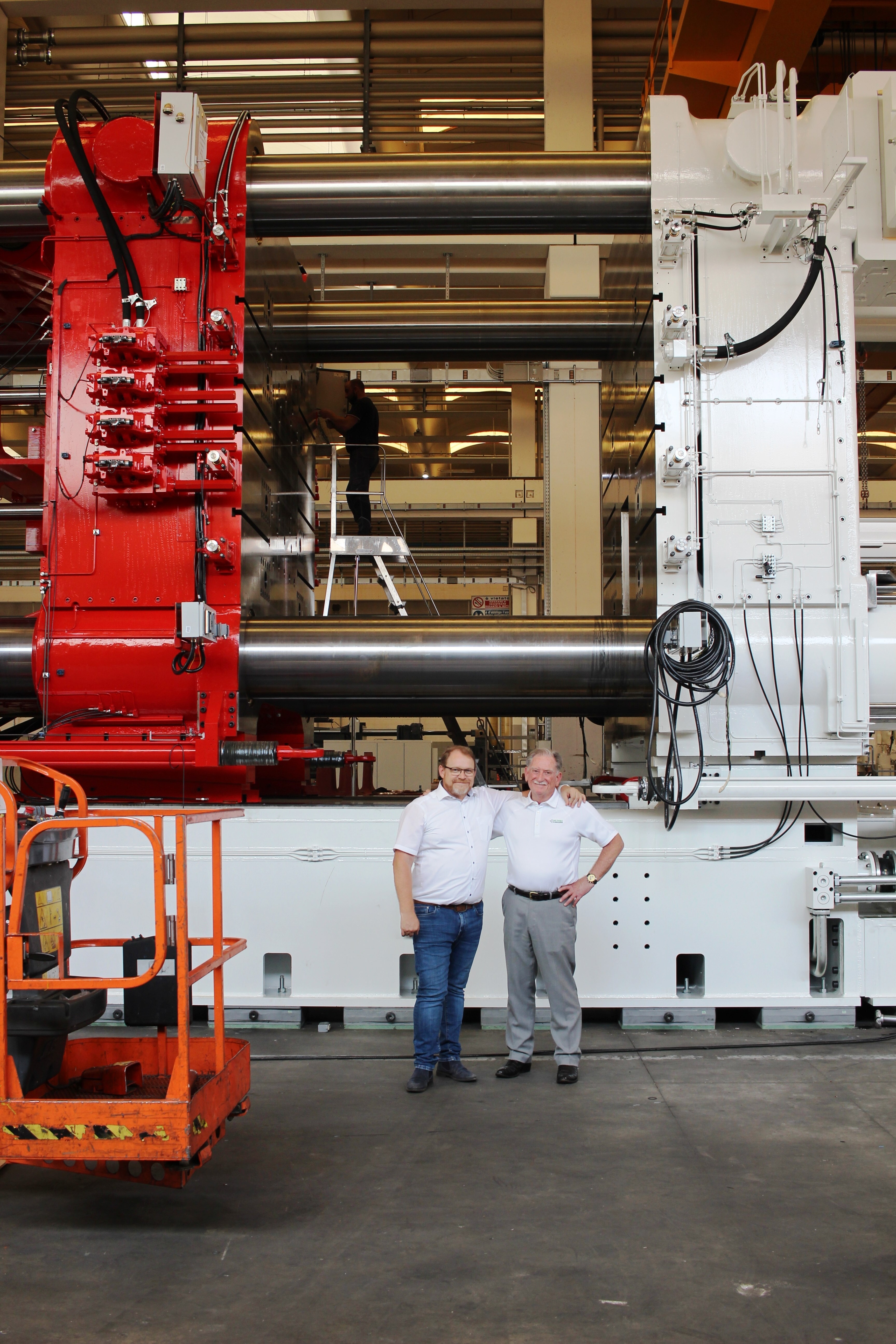 The IDRA OL 9,000-tonne Giga Press is located at IDRA's facility in Italy. IDRA General Manager John Stokes (left) and teardown analyst Sandy Munro (right) provide scale. This machine produces single-piece aluminium underbody castings for Tesla. (Photo: Wikimedia Commons / CC BY-SA 4.0)
IDRA (Italy), owned by LK Group of China, was a niche manufacturer before Tesla selected them as the Model Y launch partner. They build 9,000-tonne machines for Tesla and are developing 20,000-tonne systems. LK Group's Chinese ownership gives IDRA simultaneous access to European OEM relationships and the Chinese EV market - a structural advantage that Western-owned competitors cannot easily replicate.
Bühler Group (Switzerland) is the principal competitor in Europe and is gaining market share. Volvo selected Bühler's 8,400-tonne Carat 840 for Torslanda. For the new Košice facility in Slovakia, Volvo chose two 9,000-tonne IDRA machines, ordered in November 2023, confirming that competitive pressure between equipment suppliers is now producing real differentiation in procurement decisions (Repairer Driven News, November 2023).
LK Machinery (China) supplies giga-presses to Tesla Giga Shanghai and is BYD's chosen supplier. As the parent company of IDRA, the LK Group holds effective presence on both sides of the global equipment trade.
Haitian (China) recently put into production one of the world's largest thixomolding machines, the HMG3600, in partnership with Chongqing University (Yang et al., Journal of Alloys and Compounds, 2025). Their Chinese cost structure provides them the potential to undercut IDRA and Bühler as the technology standardises over the next decade.
Yizumi and Ube Machinery are both expanding giga-press capacity in response to accelerating Chinese domestic demand. Yizumi's equipment now appears in peer-reviewed giga-casting literature, indicating their machines are under academic scrutiny.
A 9,000-tonne giga press costs between EUR 6 and 20 million per unit, depending on specification (ANP Consulting, April 2024). The total cell investment - covering die tooling, peripheral equipment, die spraying systems, and building infrastructure with ceiling heights above 12 metres, floor footprints exceeding 50 metres, and a dedicated 10 MW power supply - typically runs USD 50 to 100 million per giga-casting cell (ANP Consulting, January 2024).
Part 2 of this series named "Giga-Casting: The aluminium shot"covers the aluminium alloy revolution inside the machine, the vacuum HPDC imperative, demand mathematics, scrap loop economics, and the survival pivot for foundries in Germany, China, North America, and India - will be published next week exclusively for AL Circle members.
Disclaimer: The opinions, information, claims, and references presented here are those of the author alone and AL Circle holds no responsibility.

Press Metal Q1 net profit jumps 35% to a record MYR 624.5M on higher aluminium prices
Next articleRemote-controlled demolition robots help improve safety in foundries
Grow with
AL Circle