Gallium, germanium in automotive electronics: Study maps Europe’s critical-mineral recycling edge
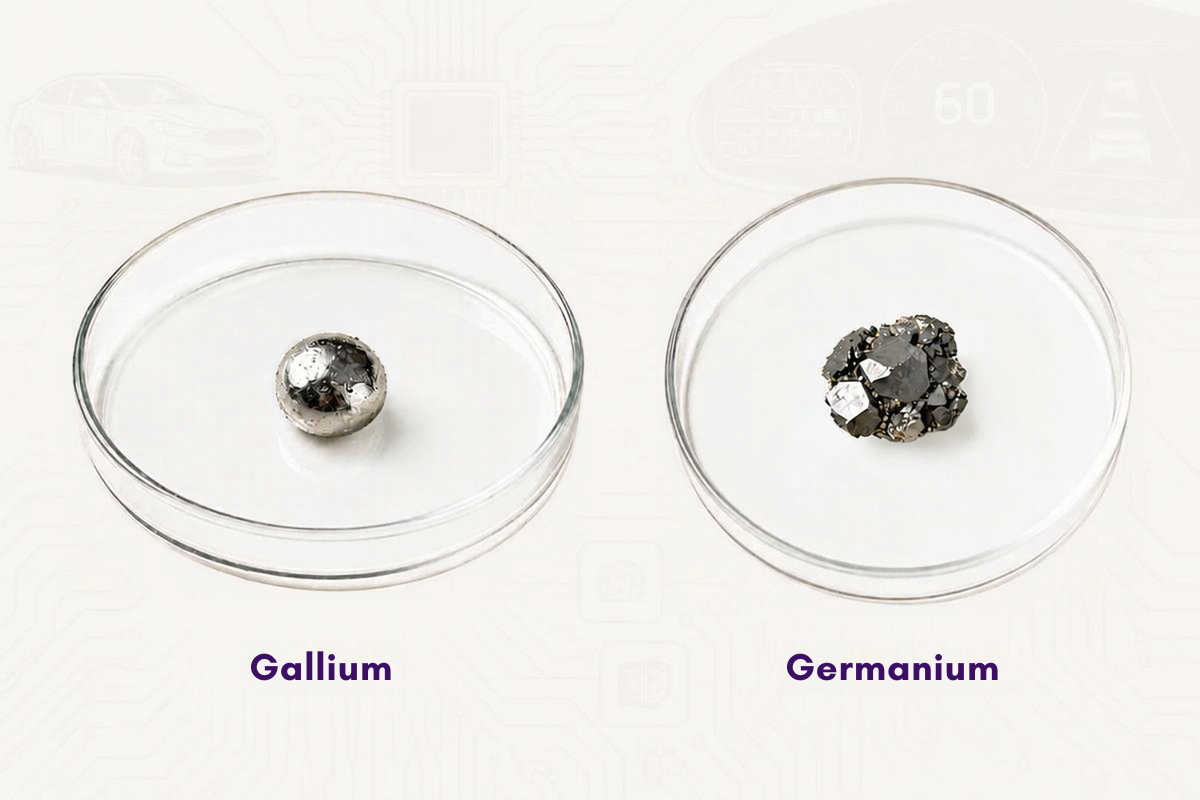
The image used in this article is generated with an AI tool and does not depict any real-time moment.
As electronics occupy a larger share of the backbone of automotive industry, Europe’s reliance on imported critical minerals is drawing greater attention. A recent bachelor’s thesis from Chalmers University of Technology in Gothenburg has explored the recycling potential of two strategic materials, viz., gallium and germanium, within automotive electronics, particularly in Electronic Control Units (ECUs), which control functions ranging from powertrain systems and safety technologies to battery management in electric vehicles.
Although recycling rates for both metals remain negligible today, the study suggests that industrial waste streams, semiconductor scrap and future end-of-life electronics could become important secondary sources if recovery infrastructure develops in time.
To learn about the market potential of aluminium dross, explore "ALuminium Dross Processing: Generation, Recovery & Strategic Roadmap"
Why gallium and germanium are gaining strategic importance
Modern vehicles contain an expanding network of ECUs, with electric vehicles using as many as 150 units. Electronics are expected to account for around 45 per cent of vehicle manufacturing costs by 2030, increasing the importance of semiconductor-related raw materials.
Gallium is primarily used in gallium nitride (GaN) and gallium arsenide (GaAs) wafers, which offer high-temperature and high-voltage performance. Germanium, valued for its superior electron mobility, is used as a silicon dopant in semiconductor applications. Both are included in the European Union’s Critical Raw Materials list.
Neither critical mineral is mined directly. Approximately 95 per cent of gallium originates as a by-product of bauxite processing during alumina production, while germanium is mainly recovered from zinc refining residues and coal ash. As a result, supply depends heavily on the production cycles of other industries.
China remains the dominant supplier, refining 130.5 tonnes of germanium annually, i.e., equivalent to about 94 per cent of global output. The country also produces 99 per cent of low-grade gallium and 51 per cent of high-grade gallium, while Japan accounts for 27 per cent of high-purity production. Moreover, China controls about 94 per cent of global germanium refining.
The vulnerability of this supply chain became evident after export restrictions introduced in 2023. Gallium prices outside China nearly doubled within months, while European germanium prices rose by as much as 400 per cent.
To keep your aluminum operations running efficiently, explore essential consumables and connect with global suppliers on AL Biz.
Recycling remains limited, but industrial scrap offers an opening
End-of-life recycling rates stand at virtually zero for gallium and around 2 per cent for germanium. Existing circularity is concentrated mainly in production scrap streams, with recycled material estimated to contribute nearly 30 per cent of global germanium supply.
The Chalmers study, based on literature reviews, interviews, email consultations and recycling-site observations, identified several examples already operating in the market:
- NEO Performance Materials (Canada): Produces gallium from semiconductor scrap at 8N purity (99.999999 per cent).
- Indium Corporation (US): Recovers gallium scrap and participates in US Department of Energy-supported recycling initiatives.
- Umicore (Belgium): Sources more than half of its germanium feedstock from recycled materials, processing streams containing at least 0.5 per cent germanium.
- STL and Umicore (DRC): Produced recycled germanium from mining tailings in 2024.
- US defence programmes: Since 2022, germanium has been recovered from military equipment such as night-vision optics and vehicle systems, with about 3,000 kg of ingots procured—equivalent to around 10 per cent of US refined germanium demand.
Scrap recycling is commercially attractive because concentrations are higher, material streams are less complex, and hydrometallurgical processes generally require less energy.
Red mud and zinc residues: The larger resource opportunity
The study highlights industrial residues as a far larger opportunity than end-of-life electronics.
Red mud, generated during alumina refining, contains 20–80 ppm of gallium. Global generation is estimated at around 150 million tonnes annually, including roughly 7 million tonnes in Europe. One cited process achieved gallium recovery rates of up to 80 per cent through acid leaching.
At the lower concentration estimate of 20 ppm, Europe may currently be losing around 140 tonnes of gallium each year in red mud streams—almost three times the annual output targeted by METLEN’s planned gallium production facility in Greece, which aims to produce around 50 tonnes annually under the EU’s Critical Raw Materials Act.
Jarosite residues from zinc refining present another opportunity. Europe produces approximately 0.6 million tonnes of these residues annually, potentially containing around 30 tonnes of gallium and 48 tonnes of germanium. Modern leaching technologies can recover up to 98 per cent of gallium and 94 per cent of germanium.
The authors suggest locating recovery operations close to primary production and refining sites, where waste streams are stable and processing infrastructure already exists.
Emerging technologies may improve future recovery economics.
Flash Joule Heating (FJH), which rapidly heats materials above 3,000°C, is being explored for recovering gallium from electronic waste and red mud. AI-assisted sorting technologies have demonstrated recovery rates of 99 per cent for gallium from GaAs and LED waste and 94 per cent for germanium from optical and fibre applications.
However, none of these approaches has yet reached widespread industrial deployment.
Why automotive electronics remain difficult to recycle
Recovering gallium and germanium from end-of-life ECUs remains technically challenging due to the small quantities embedded within highly complex assemblies.
Industry interviews cited in the study describe current recycling incentives as weak because primary gallium remains relatively inexpensive and the recovered quantities are low. Precious metals such as gold, copper and silver continue to dominate recycling economics.
Product design adds another obstacle. Adhesives and rivets, commonly used to ensure dust and water resistance, significantly complicate disassembly. One ECU case study showed that tool-free designs caused no damage during dismantling, while glued and riveted assemblies resulted in severe component loss.
Researchers interviewed for the study suggested that widespread standardisation of electronic systems remains unlikely, as manufacturers continue to prioritise innovation and performance.
At the same time, gallium use expanded 19-fold between 2000 and 2021, meaning much of the material is still in use and has not yet reached end of life. Urban mining may therefore become more important over the coming decades, provided collection and recycling infrastructure develops in parallel.
Unlock key insights from leading companies and experts across the aluminum ecosystem with our e-Magazine - Mine to Market: Aluminium Producers & Manufacturers 2026
Policy, geopolitics and Europe’s supply challenge
The study notes that Chinese supply dominance could influence future recycling economics through price pressure, referencing the sharp declines seen in cobalt and nickel markets between 2022 and 2025.
The EU’s Critical Raw Materials Act sets targets for 2030, including:
- 10 per cent of consumption extracted within the EU
- 40 per cent processed domestically
- At least 25 per cent sourced from recycling
- No more than 65 per cent dependence on any single external supplier
Other initiatives, such as the EU-funded CLOSER project launched in October 2024, are also focused on establishing circular value chains for gallium, germanium, silicon and indium.
The study concludes that supply security, especially for defence and advanced technology sectors, will remain the main driver behind future recycling efforts. However, the authors argue that reuse, repair, refurbishment and remanufacturing should remain higher priorities than recycling under the circular economy framework.
While the findings are based on limited interviews and case studies, the research points to a clear message that industrial residues, semiconductor scrap and better product design may prove more important to Europe’s critical-mineral future than end-of-life electronics alone.
CanJET digital proofing ecosystem launches in North America for metal cans
Next articleCritical Metals gains ground as Greenland approves Tanbreez mining plan through 2050
Grow with
AL Circle