China has topped the aluminium production for the past few years. An aluminium production cap to curtail overcapacity and emissions, a cumulative tariff of 145 per cent on Chinese aluminium articles entering the US imposed phase by phase, or bauxite import restrictions from multiple prime destinations have hit China’s ambitious industrial boom several times. However, the free flow of trade expansion is far from being curbed.
This is an AI-generated image
Of the total trade of aluminium worldwide in 2024, which was 13.68 million tonnes valued at USD 39.46 billion, 51.46 per cent was occupied for export of plates, sheets and strip exports, accounting for over 7 million tonnes. Meanwhile, foil exports contributed 23.41 per cent (3.2 million tonnes) to the total export number. Bars and rods were next at 16.31 per cent of outbound trade, with an export quantity of 2.2 million tonnes. The rest of the exports were 745 thousand tonnes of unwrought (5.11 per cent), 295 thousand tonnes of pipes and tubes, 88 thousand tonnes of wire and 77 thousand tonnes of tube or pipe fittings.
According to International Trade Administration published data, among the 224 listed countries that have imported aluminium in one form or the other from China during CY 2024, Mexico tops the list, importing various aluminium products in a whopping quantity of over 662 thousand tonnes (value USD 2.21 billion) during the stipulated time period, followed by South Korea, who imported 509 thousand tonnes (value USD 1.78 billion) of aluminium from China.
If we are to list the top 10 importers of Chinese aluminium products, as per the International Trade Administration, four nations — Vietnam, 27 member nations of the European Union, Thailand and India — will come next, importing 413.18 thousand tonnes, 367.47 thousand tonnes, 359.48 thousand tonnes and 356.9 thousand tonnes, respectively, from the country.
Ranking at number 7 comes the country that has stirred the global trade scenario in the past few months due to its tariff imposition trait. The United States imported USD 926 million worth of aluminium from China in 2024 (before Trump 2.0 happened), amounting to 258.72 thousand tonnes. However, in these stances, scrap exports from China have not been taken into account. When including scrap in the scenario, the United States ranks first in imports from China, according to the Observatory of Economic Complexity. The Trump-presided nation is known to be the leading consumer of aluminium scrap and imports USD 4.23 billion worth of cumulative aluminium articles (4 times the amount when calculated excluding scrap).
Next in order are Japan, Canada, and Indonesia, which imported 255.86 thousand tonnes, 252.89 thousand tonnes, and 251.09 thousand tonnes of various aluminium articles from China in 2024.
Despite mounting global resistance to its surging shipments of low-cost goods, China has pledged to increase support for exporting companies. Beijing’s new policies aim to sustain its export boom, which is on track to reach record levels, even as trading partners accuse it of undercutting local industries and distorting global markets.
Wang Shouwen, China’s international trade representative and vice minister of commerce, announced in November a range of measures to support exporters. These include financial aid, insurance assistance, and directives to expand cargo capacity through state-backed shipping firms. “Our focus is on promoting high-quality trade and addressing practical challenges faced by Chinese companies,” Wang said during a press conference in Beijing.
In contrast to export numbers, the Observatory of Economic Complexity states that in 2024, China imported USD 15.1 billion of aluminium articles (including scrap imports), the 23rd most imported product (out of 97) in China. In 2024, the main origins of China’s aluminium articles imports were from Russia (worth USD 3.58 billion), Malaysia (USD 2.21 billion), Japan (USD 1.14 billion), South Korea (USD 1.09 billion), and Thailand (USD 1.02 billion).
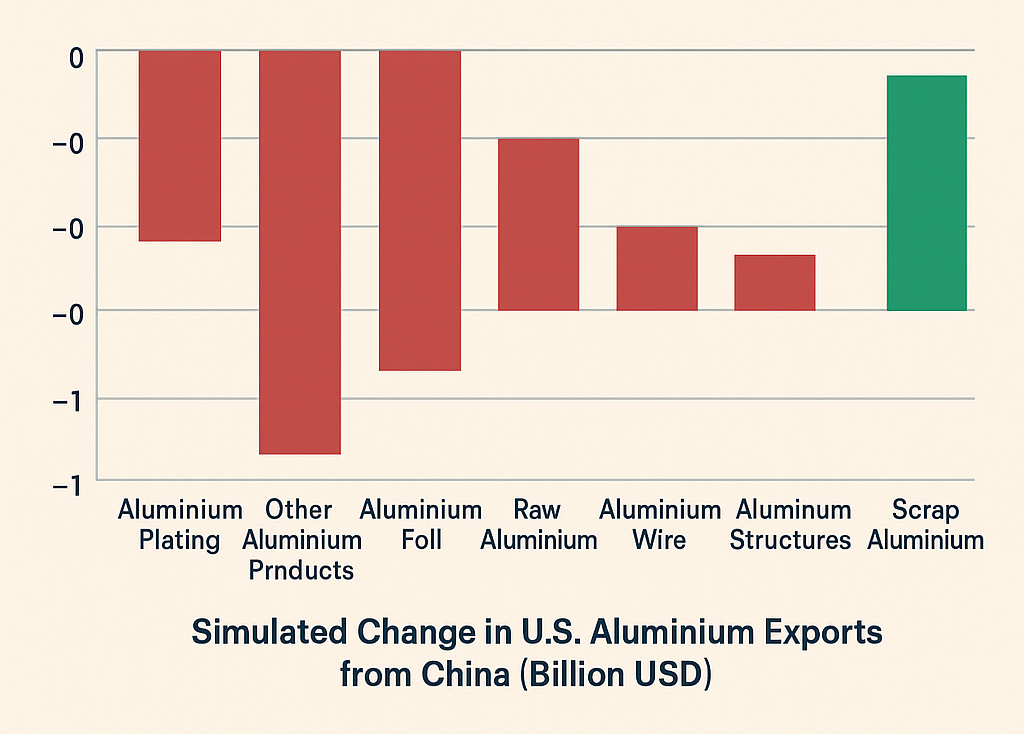
Now, as Trump imposed a series of tariffs in the initial quarter of 2025 upon China in addition to the prevailing tariffs since 2018, China’s aluminium exports to the United States are poised for a steep decline by 2026, as projected tariffs significantly dampen trade volumes across key aluminium product categories. According to simulated trade data obtained from the Observatory of Economic Complexity, the cumulative loss across 19 key HS4 aluminium categories could exceed USD 6.36 billion compared to a no-change scenario.
Aluminium plating is expected to take the hardest hit, with projected exports dropping from USD 10.19 billion (no change scenario) to USD 8.92 billion, leading to a sharp loss of over USD 1.26 billion. Other aluminium products and aluminium foil also face steep declines of USD 1.07 billion and USD 705.86 million, respectively.
Overall, 18 of the 19 product categories listed show a decline in estimated trade volumes under the new tariff regime. Raw aluminium, aluminium wire, and aluminium structures each face cuts ranging between USD 177 million to USD 628 million.
The only positive outlier is Scrap Aluminium, which is projected to rise from USD 611 million in 2023 to over USD 1.36 billion in 2026 — an increase of USD 380 million, potentially due to its zero-tariff status.
The metals section, dominating the list, is uniformly impacted, indicating a broad tariff strategy targeting core industrial materials.
Even aluminium oxide and ores, classified under chemical and mineral products respectively, aren’t spared, facing combined losses of over USD 480 million.
The simulated tariff hike could disrupt China’s dominance in the US aluminium supply chain, opening potential windows for alternative suppliers or local manufacturing substitutes. However, with the spike in Scrap Aluminium imports, the US may also focus on sourcing recyclable materials over processed imports.
China’s aluminium production is under a maximum cap of 45 million tonnes per year, a ceiling imposed by the nation’s government back in 2017. This cap was put in place to address overcapacity and reduce emissions in the industry. While China’s aluminium output is expected to reach a record high of over 43 million tons this year, the cap is already being hit in annual capacity. The restriction on production growth is expected to have significant implications for both the domestic and global aluminium markets.
To know better manage the ongoing calendar year, and stay ahead of the adversities, closely follow our deduction revelation published in the latest edition of AL Circle’s outlook report — Global Aluminium Industry Outlook 2025.














_md.webp)








