Europe secures 76.3% in aluminium can recycling, led by Germany with 99%
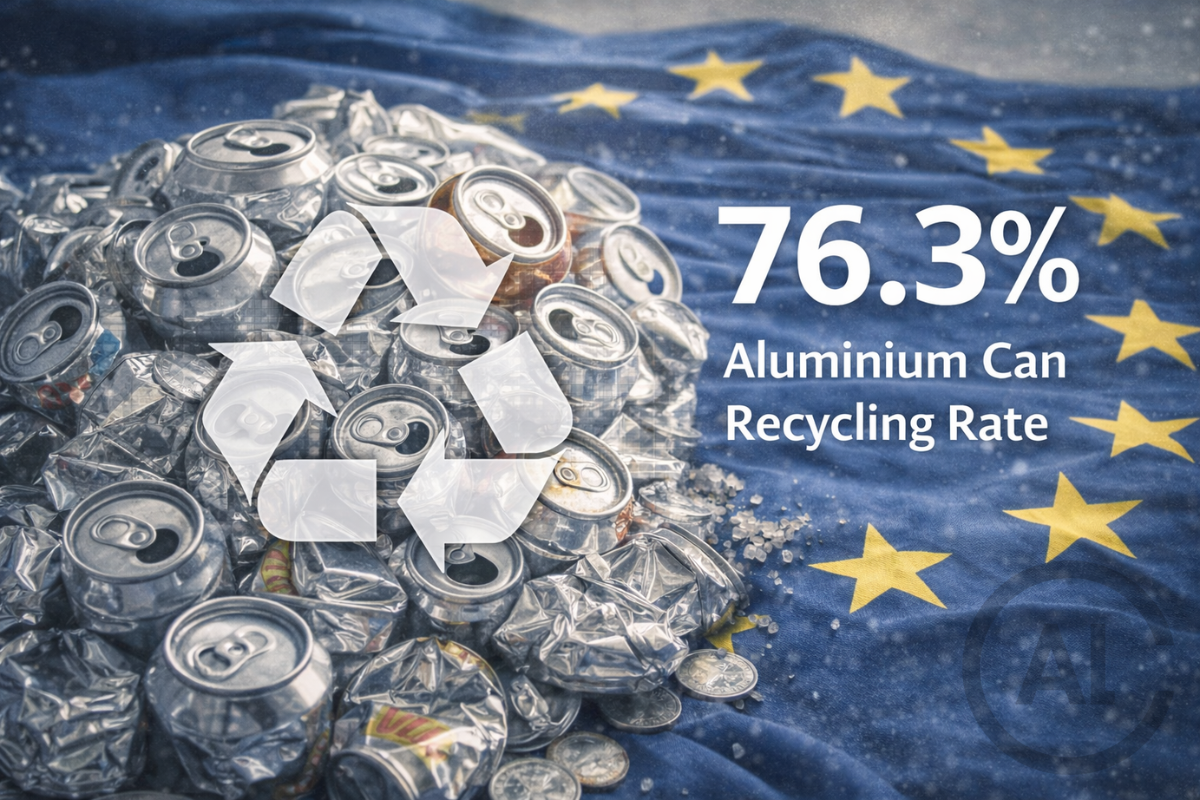
The aluminium beverage can-recycling performance of Europe continues to strengthen, offering a boost to the region’s broader climate and circular economy ambitions. As declared in the joint report from Metal Packaging Europe and European Aluminium, the can recycling rate across the EU, UK, Switzerland, Norway and Iceland reached 76.3 per cent in 2023.
To learn about the global aluminium outlook, download our report: Global Aluminium Industry Outlook 2026
The data indicates the trend of steady progress rather than a sudden spike. Volumes of aluminium cans placed on the market rose by 4 per cent year-on-year (Y-o-Y), while recycling tonnages, at a faster pace, increased 7 per cent, recording better collection efficiency as well as higher material recovery. The recycled volumes delivered amounted to an estimated 5.7 million tonnes of carbon equivalent savings, which can be approximately compared to the annual emissions of a mid-sized European city.
As of 2022, the total amount of aluminium recycled from cans in Europe reached 580,000 tonnes, recording a recycling rate of 74.6 per cent. It can be assumed that the rate reaching a record 76.3 per cent will undoubtedly take the recycling volume way over 590,000 tonnes, approximately.
Deposit Return Schemes – the driver of progress?
An exponential component behind the gains has been the expansion of the Deposit Return Schemes (DRS). Malta introduced the DRS in 2023, which lifted its recycling rate from 50 per cent to 80 per cent within a year. Implementing the DRS earlier in 2022, Latvia climbed from 60 per cent to 74 per cent, and the Slovak Republic jumped from 58 per cent to 91 per cent.
These findings highlight aluminium’s inherent circular advantage. Recycling aluminium consumes much less energy than primary production, reducing lifecycle emissions by a remarkable margin of 95 per cent. Broader DRS rollouts and supportive policy measures like export duties on aluminium scrap could further advance closed-loop, can-to-can recycling within the European boundary.
While progress is evident, stakeholders hold that to meet the industry’s ambition of 100 per cent circularity by 2050, further harmonisation and infrastructure development are of immense importance.
The Y-o-Y record shows the potential of well-designed Deposit Return Schemes as they “offer consumers the additional incentive to return high value aluminium beverage cans for high quality recycling, at the same time creating the opportunity for closed product loop, circular economy solutions within Europe,” said Andy Doran, Director of the Packaging Group at European Aluminium.
“Full Member State implementation is still needed of the Packaging & Packaging Waste Regulation National requirements for DRS, so that all EU citizens can now experience this simple and effective collection solution,” he added.
Adding to that note, CEO of Metal Packaging Europe, Krassimira Kazashka, remarked, “We are encouraged by the latest achievements and believe the industry is on the right long-term path.”
Regarding the contribution of aluminium in this game-changing development, she mentioned that aluminium is a permanent material and a circular resource whose inherent properties do not change, regardless of the number of times it goes through a recycling process. By 2023, 12 Member States had implemented deposit return schemes (DRS) for aluminium beverage cans, with more Member States following. This growing momentum clearly demonstrates that the pathway towards fully circular, canto-can recycling for aluminium beverage cans is taking shape across Europe.
Germany leads with a 99 per cent recycling rate
Germany is a key producer of recycled aluminium in the European region with a capacity of around 700,000-720,000 tonnes annually. It excels in recycled aluminium performance, leading globally with a 99 per cent UBC (used beverage can) recycling rate, due to its robust Deposit Return Schemes (DRS), supported by Novelis and Spiera, and efficient collection infrastructure. Having secured top-tier status among countries like Japan (97 per cent), Brazil (96 per cent), and Norway (94 per cent), the nation credits the DRS for providing a boost in returns via deposits on cans/bottles and mandatory retailer take-back.
Other initiatives include the Dual System (Grüner Punkt) for household sorting, advanced sorting tech (XRT, LIBS), and policy frameworks like the Circular Aluminium Action Plan, aiming for 50 per cent EU recycling by 2050, supported by scrap retention amid export pressures. Novelis operates the world's largest aluminium recycling facility in Nachterstedt, Germany, with a capacity to process up to 400,000 metric tons of aluminium scrap annually.
Hydro-owned WMR Recycling GmbH (WMR) in Dormagen, Germany, supplies advanced technology-driven recycling machines to the aluminium industry. The plant has X-ray transmission and several sorting machines and has the capacity to sort 36,000 tonnes of aluminium scrap per annum.
Trimet Aluminium SE has expanded its Gelsenkirchen recycling facility in Germany, increasing production capacity by 20 per cent, raising output to 80,000 tonnes of recycled aluminium.
UK accelerates the recycling trend
On average, the UK at present recycles around 166,000 tonnes of aluminium packaging annually. The National Packaging Waste Database recorded that in 2024, the UK exceeded its standard recycling obligation of 151,281 tonnes and recycled 157,049 tonnes of aluminium packaging, achieving a recycling rate considerably more than that of Europe as a whole in 2023.
Tom Giddings, Executive Director of Alupro, said, “the recycling rate for beverage cans maintained an impressive 81 per cent.”
He too emphasised accelerating the DRS, formalising Extended Producer Responsibility (EPR) legislation, and comprehensive PRN reform to improve waste-management practices and recycling rates further.
As of 2024, Novelis invested USD 90 million in its Latchford plant’s recycling operations in the UK, more than doubling the site’s current used beverage can (UBC) processing capacity by 85,000 tonnes annually, targeted for completion by December 2026.
Upon commissioning, the upgraded plant will process the entire volume of UBCs collected through the UK’s deposit return scheme domestically, removing the need to export aluminium scrap. The investment is also expected to lower carbon emissions by approximately 350,000 tonnes annually, reinforcing the company’s focus on circular production and lower-carbon aluminium solutions.
According to the AL Circle curated report of World Recycled ALuminium Market Analysis Industry forecast to 2032, Europe is expected to be in the lead of the global beverage can recycling rate, which is projected to surpass 80 per cent by 2032.
Brazil is taking the lead in recycling on the global platform
The 2024 recycling rate of aluminium beverage cans in Brazil reached 97.3 per cent, reducing 18 million tonnes of GHG emissions.
In 2024, the scrap trade positions of Brazil and the European Union differed sharply. Brazil exported 52,737 tonnes of aluminium scrap while importing 157,036 tonnes, resulting in a net import surplus of 1,04,299 tonnes. This indicated the country’s retention and circulation of a major portion of scrap within its system while still supplying overseas markets.
By contrast, the European Union’s scrap export, exceeding the record 1.2 million tonnes in 2024, stood at 1.36 million tonnes, but imported 654,292 tonnes. EU exports outpaced negligible import volume, highlighting the situation of “scrap leakage”.
Comparing the scrap retention positions, Brazil’s surplus stands in stark contrast to the EU’s net import deficit of over 700,000 tonnes on average. Hence, Brazil’s net scrap retention position is approximately 15 per cent stronger than that of the EU.
Implications of scrap recycling under CBAM
Aluminium scrap represents a significant portion of the global aluminium trade, and its current exclusion means that close to half of worldwide aluminium volumes fall outside the scope of CBAM-related costs. Under the mechanism’s existing framework, remelted scrap is treated as having zero embedded emissions and consequently attracts no carbon charge.
By assigning no emissions to scrap, the system creates room to lower CBAM liabilities, either by inflating declared scrap content or by redirecting high-scrap aluminium products to the European market, without necessarily delivering genuine emissions reductions at the production stage.
Since most aluminium products are manufactured using a blend of primary metal and recycled scrap, increasing the reported scrap share can effectively reduce CBAM exposure under the current rules.
Don't miss out- Buyers are looking for your products on our B2B platform

Alupro helps local authorities get ready for Simpler Recycling
Next articleAluminum Dynamics wins final permit for Benson recycling plant amid local opposition and environmental concerns
Grow with
AL Circle