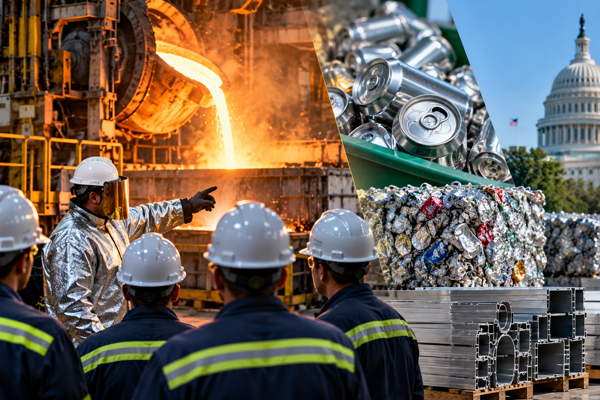
The US aluminum industry is placing renewed emphasis on workforce safety, domestic production, and material recovery, with the Aluminum Association’s sold-out Casthouse Safety Workshop in Charlotte, North Carolina, highlighting the importance of safe molten aluminum handling. The program trained more than 120 industry workers and has been running for over 30 years, with the Association describing it as a global benchmark for casthouse operators and supervisors. The workshop comes as the industry continues to focus on strengthening domestic manufacturing capabilities and supply chains. Alongside workforce training, the Aluminum Association has called for bipartisan permitting reform to accelerate investment in US aluminum production, arguing that faster approvals could help unlock the...
Canada is looking to expand its domestic aluminium processing capacity as the government seeks to reduce the sector’s dependence on the United States. Industry Minister Mélanie Joly has described more than USD 193 million in federal funding for projects at five industrial sites in Quebec as a first step towards strengthening the country’s aluminium supply chain and building the capacity to process more metal at home. The funding, announced in La Baie, Quebec, covers projects at four Rio Tinto facilities in the Saguenay-Lac-Saint-Jean region and the Alouette aluminium smelter in Sept-Îles. Joly, who also serves as the minister responsible for economic development in Quebec, said the investment reflects the strategic importance of aluminium to Canada’s economy and national sovereignty. The...
Grow with
AL Circle

EXECUTIVE SUMMARY: The margin collapse: European foundries face critical insolvencies as surging capital expenditure for massive giga-presses compresses profit margins down to 5 per cent, forcing aggressive Tier 1 corporate consolidation. The primary smelter threat: Oak Ridge National Laboratory’s new "RidgeAlloy" allows structural automotive castings to absorb massive iron levels from post-consumer scrap, actively severing the electric vehicle industry's reliance on primary aluminium dilution. The end of turbulence: To solve the catastrophic defect rates of standard High-Pressure Die Casting (HPDC), the industry is pivoting rapidly to Semi-Solid Metal (SSM) rheocasting to deliver the near-zero porosity required for modern drivetrains. In the first instalment of this AL Circle exclusive...

The global aluminium casting industry is becoming more competitive, regionalised and technologically advanced than ever before. Both primary and secondary manufacturers are investing in new casting processes, OEMs are reshaping sourcing strategies, sustainability regulations are influencing production decisions, and lightweighting continues to redefine demand across key industries. Additionally, electric vehicle (EV) adoption, evolving alloy requirements and regional manufacturing shifts are significantly transforming the competitive landscape. However, irrespective of these changes, much of the market research available today continues to follow a familiar formula, including detailed forecasts, regional outlooks and market sizing. Most studies segment the market by casting process,...

Advanced nuclear technology company Blykalla and electrification company Hitachi Energy have signed a Memorandum of Understanding (MoU) to establish a long-term collaboration on the deployment of Blykalla's lead-cooled advanced modular reactors (AMRs) in Europe and the United States. A key part of Blykalla's reactor technology is its use of proprietary aluminium-alloyed steels, which are designed to withstand the corrosive effects of liquid lead. The company says this materials innovation enables the commercial use of lead-cooled fast reactors, which use lead as the cooling medium Under the agreement, the two companies will work on the electrical systems needed to connect Blykalla’s reactors to the grid and to industrial sites. The work will include grid connections, on-site electrical...

UK filtration technology company Porvair reported record first-half revenue of GBR 106.20 million (USD 140.5 million), up 9 per cent from the same period last year. The company's Metal Melt Quality division recorded strong growth, supported by demand from the aluminium and superalloy markets. Adjusted basic earnings per share increased 11 per cent year on year. The Metal Melt Quality division also benefited from the Drache acquisition. In addition to aluminium and superalloys, demand from the aerospace, nuclear, and life sciences sectors contributed to the division's growth. During the first half, adjusted operating profit reached GBR 13.80 million (USD 18.3 million), while adjusted pretax profit stood at GBR 13.20 million (17.5 million). Reported operating profit was GBR 12.70 million...

CITIC Dicastal has revised its aluminium alloy wheel supply agreement with affiliated companies, raising annual purchase caps through 2028 following changes to its supplier network and expectations of stronger market demand. According to a filing with the Hong Kong Stock Exchange, the new framework agreement replaces an earlier arrangement after several wheel manufacturers became, or are expected to become, connected parties following acquisitions by parent company CITIC Group. Under the revised agreement, the annual cap for purchases of aluminium alloy wheels will increase from 680 million yuan to 11 billion yuan in 2026, 12 billion yuan in 2027, and 13 billion yuan in 2028. Explore: The most comprehensive and forward-looking industry-focused report – Aluminum Alloys Market Report...

Constellium has sold its ownership stake in its automotive structures joint venture in Changchun, China, along with its partner, to a Chinese automotive holding company. The Changchun facility manufactures aluminium crash management systems and other structural components for the Chinese automotive market. It employs around 200 people. The company said that the transaction is part of its Vision 2028 strategy to optimise its manufacturing footprint and improve competitiveness. According to Stephane Corre, President of Constellium's Automotive Structures and Industry business unit, “This decision allows us to focus our resources where we can best serve our automotive structures customers and create long-term value.” The financial terms of the transaction were not disclosed. Constellium...

Five persons, including an employee of the Kerala State Electricity Board Limited (KSEB) and a contract worker, have been arrested for allegedly stealing more than 100 kg of aluminium line conductors from the Vazhikkadavu KSEB office in Kerala's Malappuram district. According to police, the theft took place during the early hours of June 26. The accused include Thomas, a KSEB employee from Wandoor, Abdul Salam, a contract worker at the Pookkottumpadam KSEB office, and Jasir Hussain, Hishamudheen and Mohammed Haseeb, all residents of Vallappuzha in Palakkad district. Investigators said Thomas and Abdul Salam allegedly planned the theft and arranged for the remaining accused to bring a vehicle to transport the stolen aluminium conductors. Explore: The most comprehensive and forward-looking...

Ghana has moved a step forward to boost its aluminium industry after the signing of a Memorandum of Understanding (MoU) between the Ghana Integrated Aluminium Development Corporation (GIADEC) and Italian engineering company Danieli & C. Officine Meccaniche S.p. A. for developing downstream aluminium processing infrastructure in the country. The deal sees Danieli invest around EUR300 million (USD 341.61 million) in an aluminium sheet and foil rolling facility at the proposed Tema Integrated Industrial Park. The plant is projected to generate 40,000 to 45,000 tonnes of value-added aluminium products annually across ten categories for industries such as packaging, pharmaceuticals, food processing, catering and other industrial uses. The project also involves setting up a Centre of Excellence...

Global commodities trader Vitol has successfully moved a stranded aluminium cargo through the Strait of Hormuz, marking one of the first signs that aluminium exports from the Gulf region are beginning to normalise following disruptions caused by the recent Iran conflict. The Lowlands Corso bulk carrier departed the Strait of Hormuz on Friday carrying around 35,000 tonnes of aluminium produced by Emirates Global Aluminium (EGA). The cargo, valued at approximately USD 110 million at current spot prices, had remained anchored off the UAE coast after the conflict disrupted shipping routes through the strait. The vessel had loaded the aluminium in Abu Dhabi in late February before the outbreak of hostilities delayed its departure. The resumption of shipments is expected to ease pressure on the...

German-based company eepos has expanded its range of lifting equipment, launching the new aluminium jib crane for manufacturing, assembly and operations. The new crane is going to be available for release from 8 July and can lift up to 1,000 kg with a maximum boom length of 8 metres, offering flexibility across a range of industrial applications. The crane is equipped with a new swivel bearing that has 270 degrees of rotation and allows the boom angle to be fine-tuned during installation. Customers can choose column or wall mounted versions, with both boom length and column height adjustable to suit site requirements. Explore: The most comprehensive and forward-looking industry-focused report – Global Bauxite & Alumina Market Forecast to 2036: Supply–Demand, Trade Flows & Price Outlook...

A UK-based consortium has unveiled a new generation of cast aluminium subframes that promise significant weight reductions for future vehicles while improving manufacturing efficiency and structural performance. Developed as part of the Pivot consortium for a demonstrator vehicle commissioned by a British original equipment manufacturer (OEM), the innovative components were showcased at the 'Casting the Future of Aluminium' event held at the University of Sheffield’s Advanced Manufacturing Research Centre (AMRC). Compared to conventional subframe designs, newly developed subframes have produced significant weight reductions. The weight of the front subframe saves 17 per cent, and the weight of the rear subframe saves 35 per cent compared to their traditional components. These advancements...

Press Metal Aluminium Holdings Bhd (KL: PMETAL) shares fell 6 per cent on Thursday as aluminium prices extended their decline following easing geopolitical tensions in West Asia, reducing concerns over disruptions to global commodity supplies. Benchmark three-month aluminium futures on the London Metal Exchange dropped to USD 3,122.50 per tonne, their lowest level since February, after the announcement of the reopening of the Strait of Hormuz boosted expectations of normalised shipping activity and uninterrupted supplies of the lightweight metal to global markets. Press Metal's share price closely tracks movements in aluminium prices because of the company's direct exposure to the commodity, said Malacca Securities Head of Research Loui Low, describing the correlation as "very sensitive"....

LB Aluminium Bhd reported a sharp decline in its fourth-quarter earnings, with net profit falling 73.78 per cent year-on-year to MYR 1.88 million (USD 459,736) for the quarter ended April 30, 2026 (4QFY2026), from MYR 7.18 million (USD 1.7 million)in the corresponding period last year. The decline was mainly attributed to weaker contributions from its aluminium segment. Quarterly revenue also decreased by 9.76 per cent to MYR 226.13 million (USD 55 million), compared with MYR 250.59 million (USD 61 million) a year earlier, as lower sales volume from the aluminium business offset higher contributions from the property segment. Despite the weaker quarterly performance, the group proposed a first and final dividend of 2.5 sen per share, according to its exchange filing on Wednesday. For the...

Aluminium extrusion is one of the most important downstream processes in the aluminium value chain, involving forcing heated aluminium alloy billets through a die to produce a variety of profiles. These extruded products are widely used in construction, transportation, electrical systems, renewable energy, consumer goods and industrial applications. As extrusion plants face increasing pressure to reduce costs, improve sustainability and meet demanding customer specifications, equipment suppliers have become strategic technology partners rather than merely machinery manufacturers. Within this segment of the aluminium industry, Italy-based Turla has made its mark as a supplier of complete extrusion systems and related technologies for aluminium profile producers worldwide. Unlock in-depth...

As aluminium producers work to increase recycled metal use while reducing emissions and energy consumption, technology is becoming central to improving production efficiency. Across the aluminium value chain, innovations in scrap treatment, melting, molten metal refining, casting and heat treatment are helping manufacturers improve metal recovery, optimise energy use and support the shift towards closed-loop recycling and lower-carbon aluminium production. Recent developments have focused on technologies that improve different stages of the production process. Delacquering drum furnaces prepare coated aluminium scrap before melting, while preheating ovens recover waste heat to improve energy efficiency. Camera integration systems are used for efficiency prediction, ultra-low NOx burners...

South Korean manufacturer Samkee announced on June 24 that it has been selected by a global robotics company as a development partner for a humanoid robot frame project. The project focuses on developing the upper-body skeletal structure frame of a humanoid robot. Samkee will be responsible for prototype development and delivery of the initial production batch. Following specification evaluations, the company expects additional large-scale orders. Samkee is carrying out the development work using its existing manufacturing facilities. The project includes mould production, casting analysis, post-processing reviews and evaluations of mass-production feasibility. The company noted that lightweight construction and durability are critical requirements for humanoid robots. As a result,...

Modern factories use engineering to improve efficiency, quality, safety, and reliability. The aluminium industry needs engineering to raise productivity, cut energy use, and improve metal quality. Foundries, die‑casting shops, and glass plants face similar issues with process control, heat management, equipment performance, and material handling. In the aluminium sector, engineering solutions are required at almost every stage of production. From metal melting and transfer to casting, rolling, extrusion and finishing, manufacturers depend on specialised technologies, refractory systems, thermal management solutions, component design and process optimisation to maintain consistent product quality. As many manufacturers have reduced the number of in-house technical staff over the years,...

Dutch greenhouse technology specialist KUBO has announced a new course of action, planning to outsource steel production activities of KUBO Productive B.V. The company confirmed that steel production at its Monster facility will cease on September 1, 2026, while aluminium manufacturing will continue to remain in-house. The initiative suggests KUBO's aim to attain innovation-driven growth, focusing on areas where it sees the greatest long-term value creation, including innovation, engineering, digitalisation and the delivery of high-tech greenhouse projects worldwide. Unlock in-depth insights into the extrusion segment of global aluminium industry with The World of Aluminium Extrusions – Industry Forecast to 2032 According to the company, changing market dynamics, widening the gap from...