China is intensifying its efforts to combat pollution and climate change by accelerating its shift toward electric mobility. The automobile industry has become a central pillar of this transition, as record electric vehicle (EV) sales highlight how policy incentives, technological innovation, and consumer demand are reshaping the world’s largest car market.
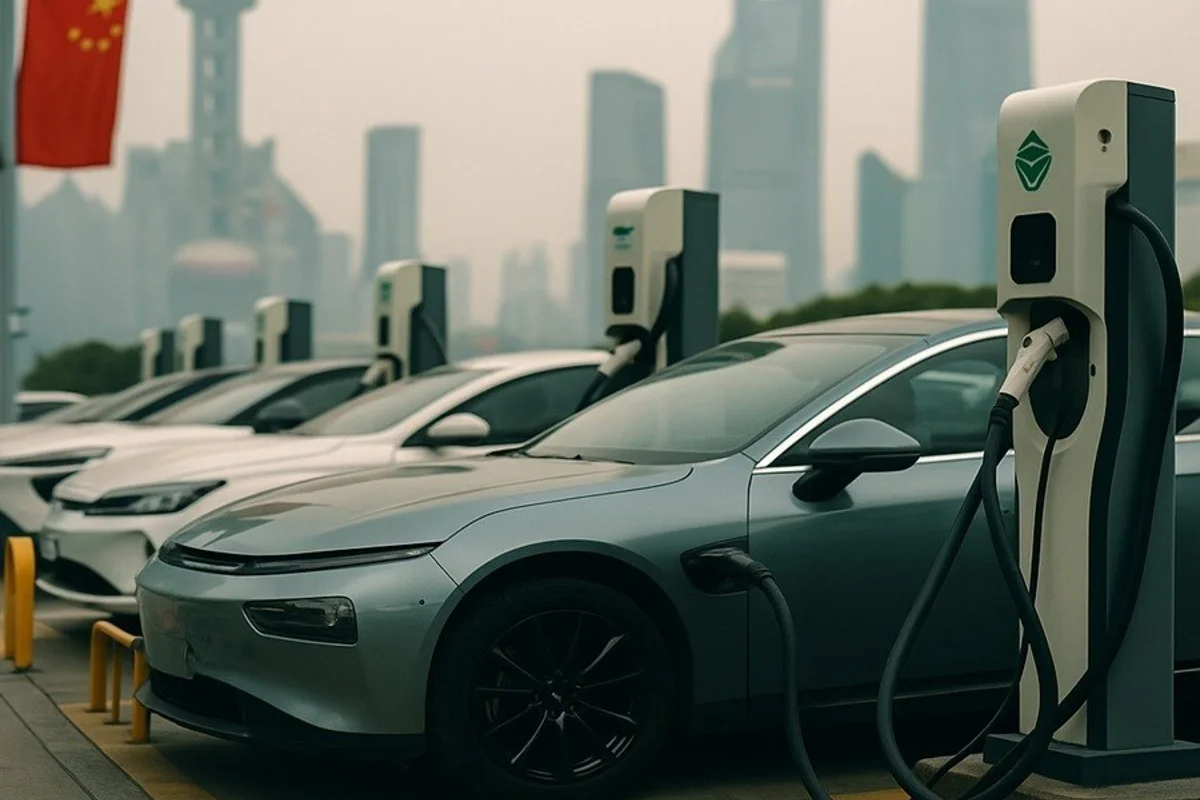
Image for representational purpose
The numbers show how fast the change is happening. In September, China’s carmakers sold a record 826,000 battery-electric vehicles, a 28.5 per cent jump from a year earlier, according to data from the China Passenger Car Association (CPCA). It’s the highest monthly figure yet, breaking the record set last December.
A rush before the clock runs out
The jump wasn’t a surprise to anyone in the business. Car showrooms across big cities have been crowded for weeks as buyers try to make use of subsidies that are about to end.
“People don’t want to miss out,” said Zhao Zhen, sales director at Wan Zhuo Auto in Shanghai. “Many were waiting for new models, and when they saw the tax breaks expiring, they moved fast. The momentum will last till year-end.”
Under Beijing’s current policy, buyers of electric cars don’t pay the 10 per cent sales tax that applies to petrol vehicles. From January 2026, they’ll pay 5 per cent, and by 2028, the rate returns to normal. On top of that, anyone trading in an old combustion car for an EV gets Yuan 20,000 (about USD 2,811). Petrol buyers still get a smaller bonus — Yuan 15,000.
The government says it’s gradually phasing out the benefits to prevent market overheating, but analysts say it’s having the opposite effect — people are rushing to buy early.
Car companies have been quick to seize the moment. Tesla’s Shanghai Gigafactory reported its best month of 2025 with 90,812 deliveries, up 2.8 per cent year-on-year. Much of that was thanks to its new Model Y L, a longer, six-seat version that costs Yuan 339,000, roughly 30 per cent more than the basic one.
Not to be outdone, Dongfeng Motor’s Voyah brand started taking orders for its Taishan hybrid SUV, which can travel 1,400 kilometres on a full charge and tank — 370 kilometres of that purely electric. But while EV sales climbed, plug-in hybrid demand actually fell 2.7 per cent, according to CPCA data.
Electric and hybrid vehicles made up 57.8 per cent of all passenger car sales in September. Total sales — petrol and electric combined — rose 6.3 per cent to 2.23 million units.
Smog, climate and urgency
This boom in cleaner cars comes as China faces mounting environmental costs. In the first nine months of 2025, extreme weather disasters caused an estimated Yuan 217 billion (USD 30.5 billion) in damage. Air pollution, though improved since 2013, still takes a heavy toll — nearly two million premature deaths a year, and more than 40 per cent of Chinese cities still exceed safe air limits.
Beijing has promised to cut total emissions by 7–10 per cent by 2035 and end severe air pollution by the end of 2025. PM 2.5 levels have fallen 40 per cent since 2013, but there’s a long way to go.
With over 360 million vehicles on the road — the world’s largest fleet — the government knows it can’t reach its goals without transforming transport.
Cars at the centre of the plan
This year’s trade-in programme has already drawn huge interest. It offers up to Yuan 20,000 (≈USD 2,730) for drivers who scrap old petrol cars and buy EVs. Within six months, four million people had applied.
Draft rules for the next two years go even further — by 2026, nearly half of all new cars sold must be electric or hybrid, rising to 58 per cent in 2027. The goal is clear: make electric vehicles the default.
The policy is already making a dent. Researchers estimate that EV adoption has cut fine particulate pollution (PM 2.5) by 3.1 per cent, saving roughly Yuan 175 billion in health and clean-up costs. By 2024, over half of all new cars sold were electric, reducing China’s dependence on oil and moving it closer to its 2060 carbon-neutral target.
Still, there’s one major challenge: most of China’s electricity still comes from coal. The government is racing to expand solar, wind, and energy-storage capacity to make sure electric mobility doesn’t simply shift emissions from tailpipes to power plants.
China’s EV policies have been in constant motion. Since 2020, Beijing has replaced blanket subsidies with a credit-based system that rewards cleaner production. Automakers must now meet rising “new energy vehicle” (NEV) credit targets — 12 per cent in 2020, 18 per cent by 2023 — and can trade credits to balance shortfalls.
By 2022, most direct subsidies were gone, and only cars under Yuan 300,000 qualified for remaining aid. That same year, foreign automakers like Tesla, BMW and Volkswagen were allowed to operate without local partners, breaking the joint-venture model that had shaped the industry for decades.
The 10 per cent purchase-tax exemption — worth up to Yuan 30,000 (USD 4,170) per car — will stay until 2027, then taper off. The Automotive Industry Green and Low-Carbon Roadmap 1.0, released in late 2023, sets ambitious goals: 45 per cent of new cars electric by 2025, 60 per cent by 2030, plus a fleet-renewal programme to phase out older combustion cars through 2027.
The bigger global picture
Globally, China’s green transition mirrors a larger trend. Since the 2015 Paris Agreement, solar capacity has more than doubled and EV sales have soared 34 times, according to former US Vice President Al Gore. China alone accounts for over half of all EV sales worldwide.
Al Gore has warned that delaying action could displace up to two billion people by 2050 and cost the global economy USD 178 trillion. He argues that ending USD 4.4 trillion in fossil-fuel subsidies could fund the entire global energy transition and cut emissions by a third in just five years.
He also pointed out that developing countries receive less than 19 per cent of clean-energy investment, while nearly half of global funding still supports fossil fuels.
China’s automakers are adjusting fast. BYD, the country’s EV champion, plans to reach carbon neutrality across its supply chain by 2045 and to halve its operational emissions by 2030. It sold 4.3 million EVs in 2024 and continues to refine LFP and sodium-ion battery technologies.
Geely and Changan are betting on solid-state batteries and connected smart vehicles, with Geely aiming to launch commercially by 2026. Both have steadily narrowed the gap with BYD.
Premium players like Nio and XPeng are taking a different route, focusing on innovation. Nio’s 150 kWh semi-solid-state battery promises record energy density, while both brands are investing heavily in autonomous driving and battery-swapping stations as they expand abroad.
For Beijing, the shift to electric vehicles isn’t just a technological upgrade — it’s a survival strategy. Clean transport now sits at the centre of the country’s response to air pollution, energy security, and climate risk.
Backed by policy, powered by innovation, and driven by consumer enthusiasm, China’s electric-vehicle revolution is becoming the blueprint for how industrial reform can double as environmental recovery.












_md.webp)
_md.webp)
_md.webp)







