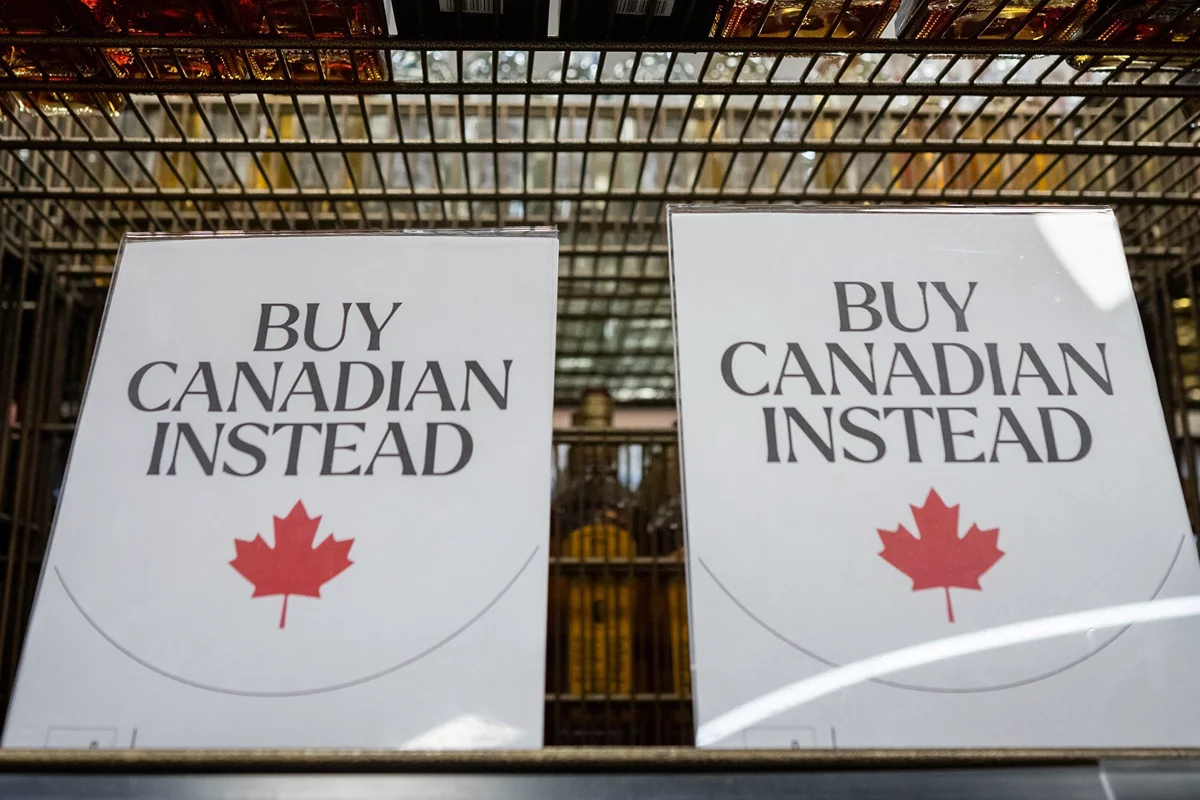
With the United States slapping a steep 50 per cent tariff on Canadian steel and aluminium imports, Ottawa is now fast-tracking a self-sufficient economic response potent to reshape North America’s metals supply chain. At the centre of this pivot is a proposed ‘Buy Canadian’ policy, an industrial safeguard designed to protect Canadian producers and preserve jobs by mandating the use of domestic metal in government procurement contracts.
Image for representational purposes only (Source: https://policyoptions.irpp.org/)
Industry Minister Mélanie Joly confirmed this week that the government is actively considering procurement requirements for both infrastructure and defence projects that would prioritise Canadian-made metals. “These decisions are being taken as we speak,” Joly said, emphasising the policy’s fast-track implementation, adding, “I’m convinced that this will help create greater demand within Canada and therefore protect jobs.”
The move mirrors the United States’ own protectionist measures under Donald Trump’s first term (2018), where “Buy American, Hire American” became a key plank of industrial policy. However, with President Trump now doubling down on metal tariffs as part of his 2025 economic agenda, Canada is fighting fire with fire.
Even in 2024, Canada remained the primary source for the US aluminium value chain. According to USGS, the leading source of total aluminium imports to the US in 2024 was Canada (61 per cent). The country’s exports to the United States were unparalleled, as exporters like the United Arab Emirates (6 per cent) and Mexico (5 per cent) were left far behind. For crude metal and alloy imports, the leading sources in 2024 were again led by Canada (76 per cent), followed by the United Arab Emirates (10 per cent) and Argentina (5 per cent).
While for semi-fabricated products, again Canada (18 per cent) led, the Republic of Korea (15 per cent), and China, including Hong Kong (13 per cent) followed. For scrap, the leading exporters were the US’ two neighbours: Canada (58 per cent) and Mexico (32 per cent).
Losing ground in the US market
The new US tariff (starting with 25 per cent and then moving up the ladder with 50 per cent) regime has effectively restricted the border to Canadian metals. “The 50 per cent levy is basically shutting out Canadian producers from the US market,” earlier warned Marty Warren, national director for the United Steelworkers union in Canada. Alongside, he has informed, “We still need some short-term relief so the industry can keep its head above water.”
Aluminium, in particular, is feeling the heat. Jean Simard, CEO of the Aluminum Association of Canada, also shared that the new tariffs are already suppressing demand across North America, threatening both upstream smelters and downstream users. Maine Governor Janet Mills publicly criticised the tariff after craft brewers in her state reported higher costs for aluminium cans, an indirect consequence of the Canada-US standoff.
The Canadian metals industry supports more than 23,000 direct jobs in steel and over 10,000 in primary aluminium, with indirect employment estimates pushing totals well above 100,000. The economic exposure is massive and immediate.
Faced with the grim reality of market loss, Canada is not just responding with policy rhetoric. Officials are reviewing loopholes that allow non-FTA countries, especially China, to offload excess capacity into the Canadian market.
“We will not tolerate unfair practices in the steel and aluminium sector, or in any other sector, period,” Joly stated, alluding to trade measures that could include new tariffs, quotas, or country-specific import caps. Ottawa has already imposed 25 per cent retaliatory duties on select US goods in earlier trade disputes and may extend such measures if negotiations falter.
The United Steelworkers have been pushing Ottawa to go further for quite some time, calling for mandatory use of Canadian steel and aluminium in all publicly funded projects. There’s also growing momentum around implementing tax credits to incentivise the private sector to choose Canadian metals over foreign alternatives.
Where aluminium (in one form or the other) is essential
Canada is progressing with a slate of large-scale infrastructure and defence projects that may underpin its proposed ‘Buy Canadian’ policy for steel and aluminium. These projects, spanning transportation, energy, and military sectors, are collectively valued at over CAD 150 billion (USD 110 billion) and could drive significant demand for domestically sourced metals.
In transport infrastructure, the CAD 3.9 billion (USD 2.85 billion) Quebec-Ontario high-speed rail corridor is expected to add CAD 35 billion (USD 25.5 billion) to GDP and create 51,000 jobs. Montreal’s REM (Réseau express métropolitain) is nearing completion, with full service due in 2025, while Toronto’s CAD 12 billion (USD 8.76 billion) Eglinton Crosstown LRT is expected to launch this year. Other active transit developments include the CAD 5.6 billion (USD 4.1 billion) Hurontario LRT and the binational Gordie Howe International Bridge, which is expected to open in late 2025.
Energy infrastructure includes the CAD 16 billion (USD 11.7 billion) Site C Dam in British Columbia, which will generate 1,100 MW upon completion in 2025. Ontario’s Darlington and Bruce Power nuclear refurbishments, at CAD 12.8 billion and CAD 13 billion (USD 9.3 billion and USD 9.5 billion), respectively, are underway through the decade. The CAD 40 billion (USD 29.2 billion) LNG Canada terminal in Kitimat is also set to come online in 2025. Additionally, CAD 1 billion (USD 730 million) is being allocated to develop the mineral-rich Ring of Fire corridor in northern Ontario.
In defence, Canada is purchasing 88 F-35A fighter jets under a CAD 19 billion (USD 13.9 billion) deal, alongside CAD 6.7 billion (USD 4.9 billion) in infrastructure upgrades to airbases in Quebec and Alberta. The ageing CF‑18 fleet is being maintained through a CAD 1.3 billion (USD 950 million) programme. Naval procurement includes the CAD 56-60 billion (USD 41-44 billion) Canadian Surface Combatant program with construction starting in 2025 and six Arctic patrol ships under a CAD 5 billion (USD 3.65 billion) initiative, with all deliveries expected by 2025.
Submarine capabilities are being extended with CAD 1 billion (USD 730 million) in Victoria-class upgrades and a new diesel-electric submarine program, targeting delivery from 2028 to 2035. Two heavy polar icebreakers worth CAD 8.5 billion (USD 6.2 billion) are also under procurement for delivery by 2030. Other assets include Joint Support Ships, CH‑146 Griffon and CH‑149 Cormorant helicopter upgrades (CAD 2.28 billion / USD 1.66 billion), and CP‑140 Aurora aircraft modernisation programs running through the next five years.
High-stakes negotiations underway
At the recent G7 summit in Kananaskis, Alberta, Prime Minister Mark Carney and President Trump reportedly agreed to a 30-day window to negotiate a broader economic and security agreement that would include lifting the 50 per cent tariff. The stakes are high: failure to resolve could mean months of industrial disruption, while a successful deal could recalibrate North American supply chains.
According to the Bank of Canada, the tariffs are already showing early signs of inflationary pressure. Governor Tiff Macklem noted that if the tariffs persist, up to 75 per cent of the additional cost could be passed on to consumers within 18 months, further straining household budgets and corporate margins. The central bank also flagged reduced business investment as a secondary risk if policy uncertainty continues.
While Carney has remained tight-lipped about Canada’s negotiation strategy, Joly’s statements hint at a dual-track approach: keep diplomatic doors open but be ready to act unilaterally if talks fail.













_md.webp)
_md.webp)







