Asia’s alumina exports jump 27%: Is an 8Mt H2 shipment within reach?
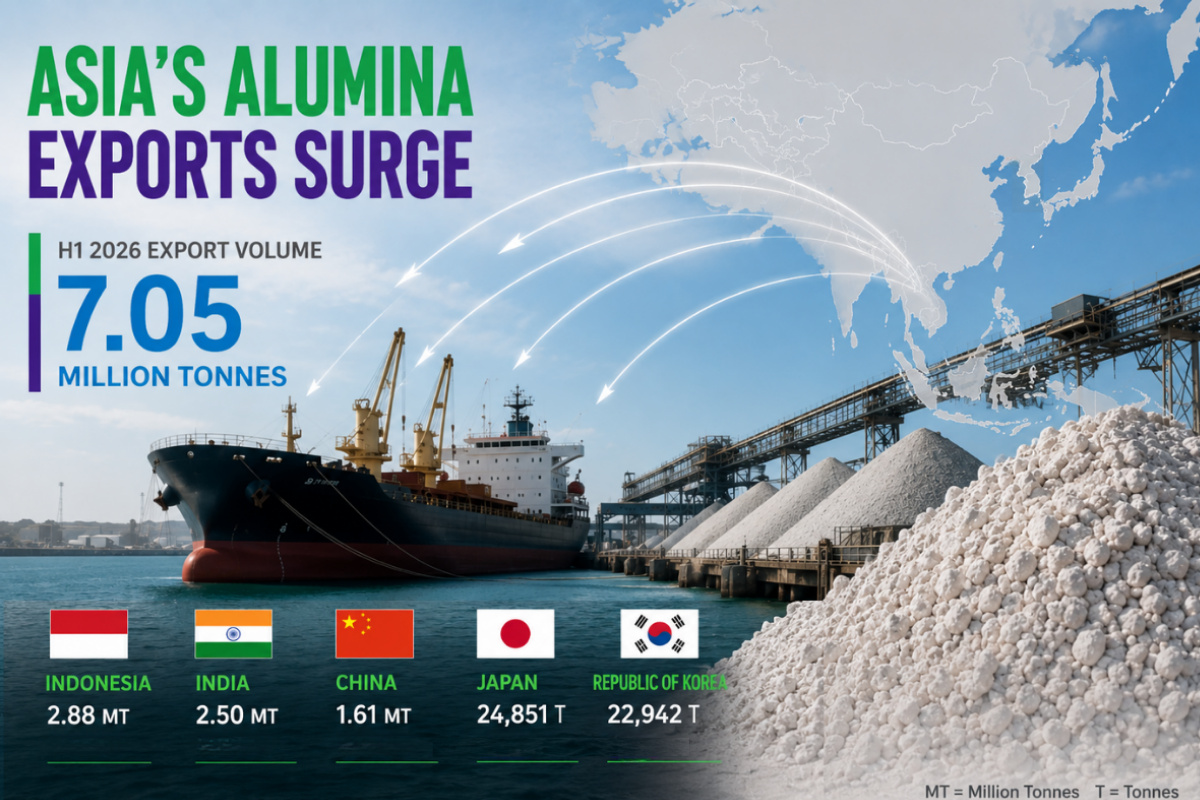
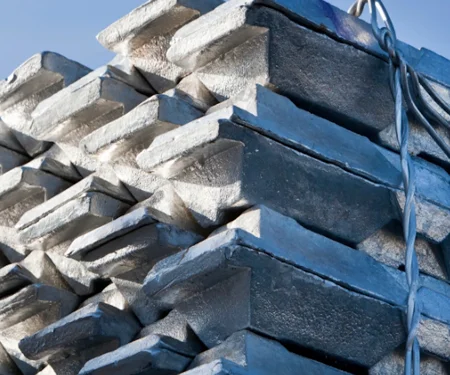
The image used in this article is generated with an AI tool and does not depict any real-time moment
Asia’s alumina exports entered 2026 on a strong footing, with shipments to global markets reaching 7.05 million tonnes worth USD 2.76 billion in H1 2026, up 27.36 per cent year-on-year. The sharp rise in H1 was driven by a quarter-on-quarter surge by a considerable margin. This indicates an acceleration in aluminium production, translating into an increased demand for alumina in the market.
The key question for H2 2026 is whether Asia can maintain this pace despite geopolitical disruptions, evolving refinery capacity and changing market demand.
H1 2026 sets a strong export benchmark
Comparing the H1 export graphs of Asia across 2026, 2025 and 2024, the Y-o-Y improvement remains consistent.
- H1 2026 – 7.05 million tonnes, up 27.36 per cent Y-o-Y from H1 2025
- H1 2025 – 5.54 million tonnes, up 26.34 per cent Y-o-Y from H1 2024
- H1 2024 – 2024 4.37 million tonnes
The consistency of growth is significant. The Y-o-Y growth from H1 2025 to H1 2026 has been slightly modest but stable. Asia has added more than 1.1 million tonnes to its H1 export volume in each of the past two years, suggesting that the region’s role in global alumina trade has been strengthening over the years.
To know the future market and value proposition of red mud, explore the report A Comprehensive Analysis of Bauxite Residue (Red Mud): Sustainability, Resource Recovery and Strategic Recommendations
Quarterly surge graph
The quarterly numbers provide the clearest indication of the potential direction for H2.
As of Q2, Asia exported a cumulative volume of 3.7 million tonnes. Q1 reported an export volume of 3.36 million tonnes, which indicates a Q-o-Q surge of 10.04 per cent.
The export value has also jumped from USD 1.34 billion to USD 1.42 billion, marking a 6.59 per cent improvement.
This matters because the acceleration came despite disruption from the Middle East conflict, which began on February 28 and affected regional logistics and aluminium production. The blockade of the Strait of Hormuz and damage to the aluminium facilities operated by Emirates Global Aluminium (EGA) and Aluminium Bahrain (Alba) created additional uncertainty for the regional aluminium and alumina supply chain.
The improvement in Q2 therefore suggests that the disruption did not derail Asia’s export momentum completely.
Another factor supporting the Q2 recovery was the expansion of refinery capacity in Indonesia, which helped strengthen regional supply as the conflict-related pressures began to ease.
Top 5 exporters
Throughout H1 2026, the following nations have been the top 5 Asian exporters of alumina to the rest of the world:
- Indonesia – exported 2.88 million tonnes (40.88 per cent)
- India – exported 2.5 million tonnes (35.4 per cent)
- China – exported 1.61 million tonnes (22.82 per cent)
- Japan – exported 24,851 tonnes (0.35 per cent)
- Republic of Korea – exported 22,942 tonnes (0.33 per cent)
Explore buying & selling leads of alumina and trade opportunities on AL Biz
The top 3 countries have retained their position from 2025, with their export volumes rising Y-o-Y.
Indonesia’s shipment volume surged Y-o-Y by 21.13 per cent from 2.38 million tonnes, while India’s export volume jumped by a staggering 51.27 per cent Y-o-Y from 1.65 million tonnes. China’s shipment volume gained 19.8 per cent Y-o-Y from 1.34 million tonnes.
As regards the fourth and fifth exporters, Japan climbed from its fifth position in 2025 to the fourth position in H1 2026, its export volume rising by a modest but significant 1.54 per cent Y-o-Y from tonnes in H1 2025.
Saudi Arabia, which had exported 106,638 tonnes in H1 2025, did not appear on the top 5 list in H1 2026.
The Republic of Korea, holding the fifth position in H1 2026, occupied the sixth position in H1 2025. Its shipment volume jumped Y-o-Y by 28.85 per cent from 18,375 tonnes.
H2 outlook: strong, but increasingly dependent on stability
The straightforward outlook is for Asia’s alumina exports to remain elevated in H2 2026, with H2 volumes potentially around or above the H1 level, i.e., around 10 to 11 per cent, if refinery output remains strong and regional logistics continue to normalise. That would take the H2 export volume to an approximate of 8.55 million tonnes.
Unlock key insights from leading companies and experts across the aluminium ecosystem with our e-Magazine - Mine to Market: ALuminium Producers & Manufacturers 2026
Three factors will determine how close exports come to the upside scenario.
First, regional production capacity will remain crucial. The Indonesian refinery expansion has already contributed to the Q2 improvement.
In February 2026, Indonesia’s sovereign wealth fund BPI Danantara launched Phase I of six downstream projects worth about USD 7 billion across 13 locations. The aluminium-focused programme includes a USD 2.4 billion smelter and a USD 890 million smelter-grade alumina refinery in Mempawah, West Kalimantan. The aluminium facility, developed with MIND ID, INALUM and ANTAM, is planned with an annual capacity of around 600,000 tonnes.
The projects come with Indonesia’s push to move beyond raw-material exports and strengthen domestic mineral processing. For the regional alumina market, the expansion could gradually alter trade patterns as Indonesia develops greater capacity to convert bauxite into alumina and aluminium domestically, thereby changing its future role as an exporter.
Second, geopolitical stability will be important. The Middle East conflict demonstrated how quickly shipping routes, refinery operations and regional supply chains can be affected. A sustained improvement in conditions would support export flows, while renewed disruption could limit the H2 increase.
Third, demand from the global aluminium industry will determine how much available alumina actually moves into export markets. The H1 surge indicates that alumina demand and supply kept pace for international trade. The trend in the London Metal Exchange (LME) alumina price graph, which has been largely on the upward swing since the start of H2, jumping by 6.39 per cent to USD 330.00 per tonne on July 1 from USD 310.19 per tonne of alumina on June 30, reiterates a hint towards rising demand. Therefore, continued demand from overseas buyers would be a requisite for maintaining the export pace.
Note: This is exclusive coverage by AL Circle and may not be reproduced, republished or shared without prior permission.

Ireland withholds Aughinish Alumina correspondence over commercial sensitivity concerns
Next articleRUSAL seeks Kremlin aid four bauxite and alumina plants face mothballing risk
Grow with
AL Circle