The global aluminium industry is at a crossroad, caught between rapidly rising demand from the clean energy transition and the urgent need to decarbonise. As nations scale up solar farms, wind turbines, and electric vehicles, appetite for the lightweight metal is soaring — but producers are under pressure of decarbonising one of the most energy-intensive industries in the world.
A study released in September 2025 by Eurasia Group and Alcoa paints a mixed picture. On one hand, aluminium use is set to rise by 40 per cent by 2030 and by 80 per cent by 2050 compared with 2020 levels, cementing its place in the clean energy economy.
On the other, the industry is still far off the pace needed for net zero. Aluminium is responsible for about 3 per cent of global industrial emissions, and over the last decade companies have only managed to trim emissions intensity by 2 per cent a year. The pathway to net zero demands double that rate. Without new technologies such as inert anodes or large-scale carbon capture, emissions could soon plateau.
Regional splits in the transition
The report shows sharp contrasts across regions. Europe is leading the charge, with the help of mature carbon market, firm policies like the Net-Zero Industry Act, and support measures such as the EU Clean Industrial Deal and the Carbon Border Adjustment Mechanism (CBAM). Most European smelters already run on renewable power.
Latin America and Australia also enjoy a natural advantage from hydroelectricity, which powers much of their aluminium output.
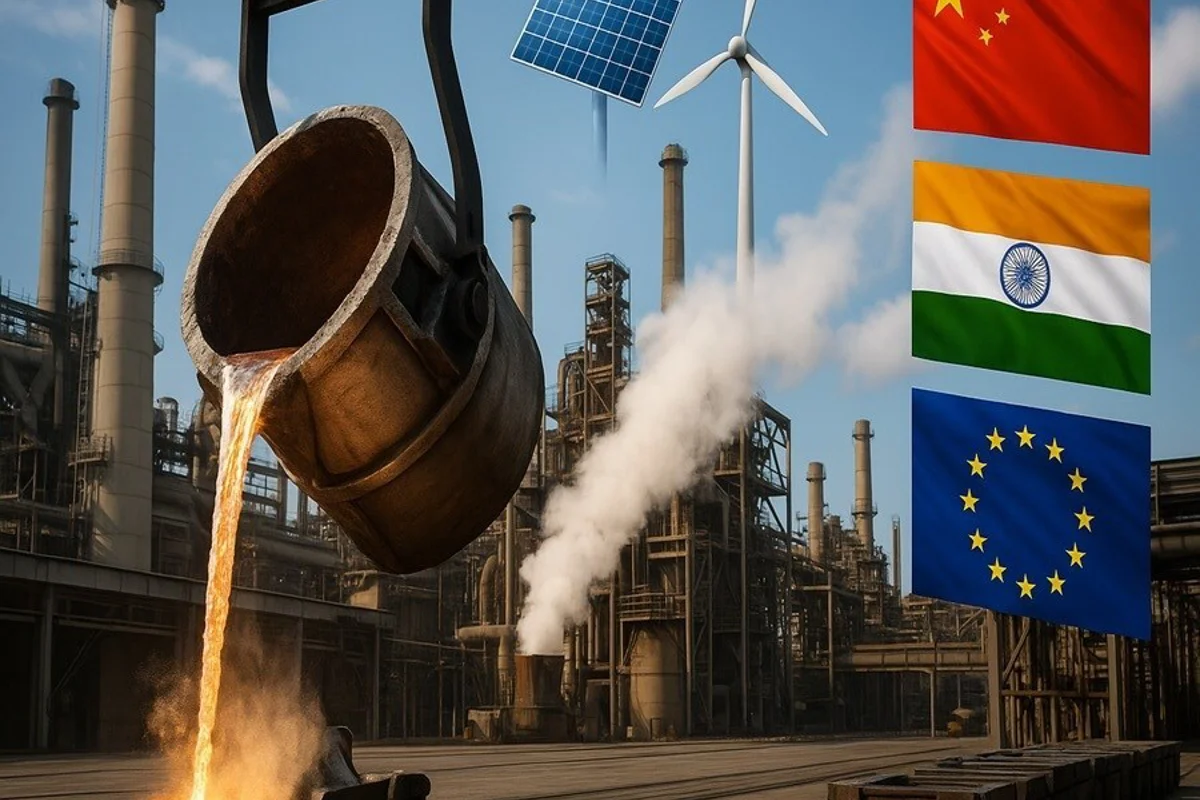
Asia tells a different story. The region dominates global production, with China and India together accounting for more than half of all primary aluminium. But both still rely heavily on coal. In China, more than 80 per cent of smelting depends on coal, and India faces similar hurdles with captive coal plants. China has started moving smelters to hydropower-rich regions and rolling out renewables, but progress is too slow to close the gap with Europe.
In the Gulf states, investment in solar power is growing as part of economic diversification plans, yet the shift to genuinely low-carbon aluminium remains tentative.
Europe’s edge versus Asia’s struggles
Europe’s advantage lies in renewables and regulation. Emissions from smelters are expected to fall by 2–4 per cent annually, while Asia is hampered by weaker policy and slower adoption of breakthrough technologies.
China’s emissions trading system is still too generous, offering free allowances and easy benchmarks that dilute its impact. Recycling is another sticking point. Only around 20 per cent of Chinese aluminium comes from scrap, well below global averages, with India showing similar numbers.
Both also lag when it comes to commercial-scale carbon capture and next-generation smelting methods, leaving them exposed once CBAM takes full effect.
CBAM and the coming trade sake-up
Europe’s CBAM, due for full rollout in 2026, is set to change the rules of global aluminium trade. The scheme will impose carbon tariffs on imports, penalising high-carbon products from Asia unless producers switch more quickly to renewables or increase their use of scrap.
The idea is to reward genuinely low-carbon aluminium, though critics warn of flaws such as the “scrap loophole,” which could allow carbon leakage. Even so, the policy is already fuelling accusations of “green protectionism” and sparking trade tensions. Producers in regions powered by renewable energy, such as Brazil and Canada, look best placed to benefit.
Aluminium’s strategic weight
Beyond climate, aluminium is increasingly being seen as a critical mineral, vital for both energy transition and defence. But production is uneven. China accounts for nearly 60 per cent of global supply, producing about 43 million tonnes a year. India produces around 4.2 million tonnes, while Europe—including Russia—makes only about 4–4.5 million tonnes. Few NATO members rank among the top producers, raising fresh geopolitical concerns.
How producers are responding
Aluminium makers are not standing still. Alcoa says 86 per cent of the electricity used in its smelters now comes from renewables. Industry coalitions like the Mission Possible Partnership and the First Movers Coalition are working to accelerate projects aligned with net-zero goals.
In China, companies are beginning to link smelters to renewable clusters. Yunnan Aluminium has launched more than 175 MW of solar projects across six industrial parks. Facilities in Inner Mongolia and Henan have added 80 MW and 40 MW respectively. By the end of 2025, regions tied to smelting could see as much as 6 GW of renewable power capacity, lifting the share of clean energy from 27 per cent in 2023 to above 30 per cent by 2027.
Elsewhere in Asia, Indonesia’s INALUM already uses 98 per cent hydropower, far ahead of its peers. China Hongqiao Group and others report renewable shares ranging from 16 to 48 per cent.
In India, Hindalco aims to raise renewable use in its smelters from 15 to 30 per cent by 2027, alongside research into green hydrogen and carbon tracking tools. NALCO has over 40 per cent hydropower in its energy mix and is targeting a 10 per cent emissions cut by 2026 through efficiency upgrades.
Vedanta and BALCO (Bharat Aluminium Company Limited) are also expanding renewable projects, pushing India’s overall renewable share, now about 20 per cent, steadily higher.
The report points to three main priorities for the industry’s next phase
First, it calls for a clear, global definition of what qualifies as low-carbon aluminium, with a standard emissions threshold of around four tonnes of CO₂e per tonne of metal. At present, carbon accounting methods are fragmented, making it difficult to compare producers on a level playing field.
Second, it stresses the need for stronger digital traceability, including product passports and transparent reporting systems. These tools would give buyers more confidence, improve emissions monitoring, and make sustainability claims easier to verify.
Finally, the study argues that companies should treat today’s patchwork of regional policies as a chance to adapt their strategies. By tailoring investments to local regulations while also pressing for faster permitting of renewable projects and modernisation of power grids worldwide, producers can turn policy fragmentation into a competitive edge.
In the first half of 2025, global primary aluminium output reached 36.46 million tonnes. Yet with coal still dominant in Asia, the region risks losing ground in markets that value low-carbon output.
The report’s message is clear: competitiveness and decarbonisation are not mutually exclusive. Recycling, which uses only 5 per cent of the energy of primary production, will be central, as will clearer global standards for low-carbon aluminium, better supply chain transparency, and stronger public-private collaboration.
The industry’s future will come down to pace. Producers that push hardest into renewables, recycling, and breakthrough technologies will not only cut carbon but also win market share. Those that hesitate risk being left behind as tariffs rise, customers demand cleaner products, and scrutiny grows sharper.













_md.webp)
_md.webp)







