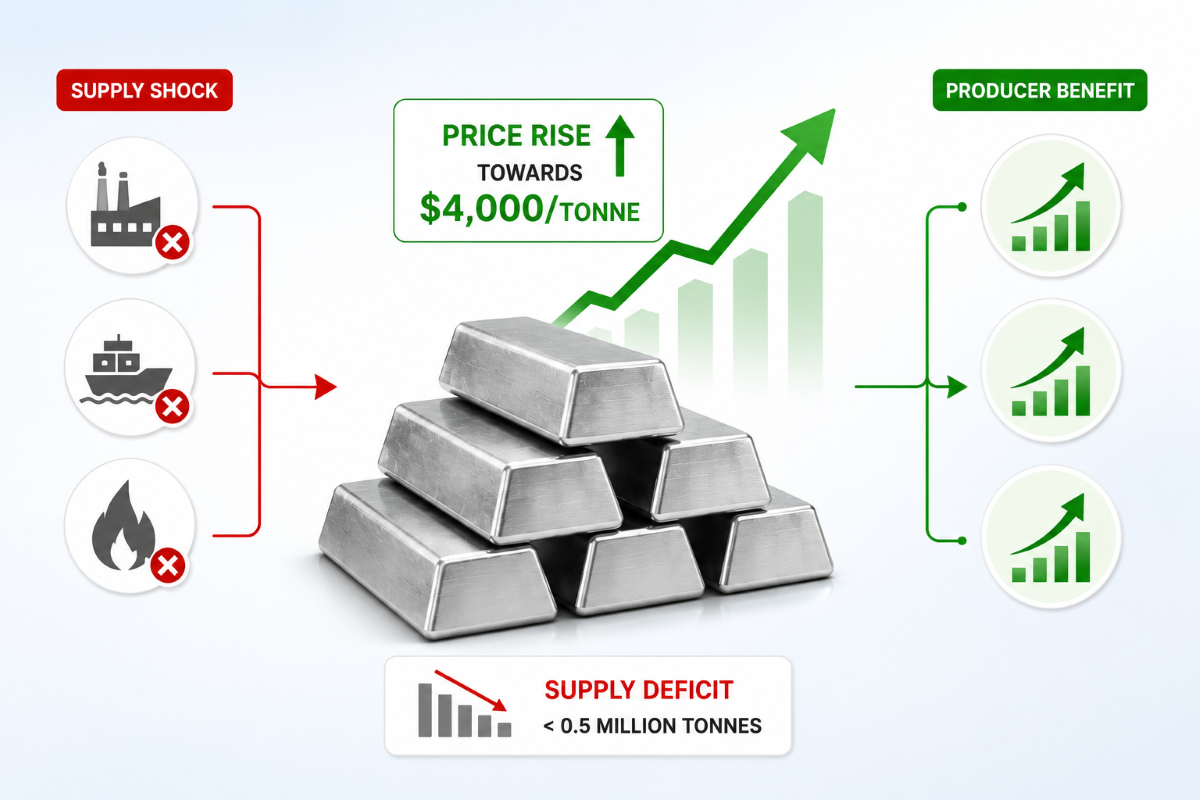
A supply shock in West Asia is reshaping the global aluminium market. Disruptions to smelters, shipping routes and regional energy supplies have tightened aluminium availability and pushed London Metal Exchange prices to a four-year high, bringing the market closer to the USD 4,000-per-tonne threshold.
The disruption comes at a time when the global aluminium market has averaged a supply deficit of less than 0.5 million tonnes over the past five years. Also, the 45 million tonne cap on China's primary aluminium output leaves limited room for the country to increase production and offset any shortfall from the Gulf Cooperation Council (GCC) region.
While consumers grapple with higher costs and supply uncertainty, aluminium producers are benefiting from higher prices. Improved realised prices have strengthened margins and supported earnings across the sector.
The impact is already evident in the Q1 2026 results of several industry giants, which you can explore below.
Aluminium hits a four-year high
The London Metal Exchange (LME) aluminium market is edging closer to rewriting its record books. At the close of trading on June 2, 2026, aluminium prices reached a four-year high and continued their march towards the USD 4,000-per-tonne mark.
The LME aluminium cash bid rose from USD 3,795 per tonne on June 1 to USD 3,854 per tonne on June 2, an increase of 1.55 per cent. The offer price climbed from USD 3,795.5 per tonne to USD 3,855 per tonne, gaining 1.57 per cent. In doing so, aluminium surpassed its previous four-year high of USD 3,851 per tonne recorded on March 4, 2022.
The rally has been underpinned by tightening physical availability, with declining stocks and warrants signalling growing supply concerns across global markets.
West Asia disruptions tighten the market
Much of the recent price momentum can be traced to disruptions across West Asia. The effective closure of the Strait of Hormuz since February 28 has disrupted aluminium exports from the UAE, a country that accounts for around 20 per cent of global aluminium exports, raising concerns among buyers in Europe and the United States.
Supply risks intensified further on March 29, 2026, when the region's two largest aluminium smelters were affected by attacks. Emirates Global Aluminium's Al Taweelah smelter in the UAE, with annual capacity of 1.5 million tonnes, and Aluminium Bahrain's Alba smelter, with capacity of 1.6 million tonnes per year, were both impacted.
Together, the facilities represent 3.1 million tonnes of annual production capacity, equivalent to approximately 44 per cent of West Asia's aluminium output. EGA has indicated that full recovery at Al Taweelah could take up to a year.
Meanwhile, Qatar's Qatalum smelter has begun shutting down due to natural gas shortages and may require six to twelve months to restart. Before these disruptions, Macquarie had estimated regional production losses of 800,000-900,000 tonnes in 2026. With additional capacity now affected, actual losses are expected to be significantly higher.
This supply-driven price rally has strengthened margins and profitability for several aluminium companies worldwide. Read Global Bauxite & Alumina Market Forecast to 2036: Supply–Demand, Trade Flows & Price Outlook report for an indepth analysis.
Alcoa entered 2026 facing softer volumes but stronger market pricing. The company reported first-quarter revenue of USD 3.2 billion, down from USD 3.4 billion in the fourth quarter of 2025. Despite the decline in revenue, profitability improved substantially.
Net income rose to USD 425 million, or USD 1.60 per share, compared with USD 213 million in the previous quarter. Adjusted net income reached USD 373 million, while adjusted EBITDA stood at USD 595 million.
Higher aluminium prices, which averaged around USD 3,600-3,680 per tonne, played a central role in boosting earnings. Results also benefited from a USD 158 million gain related to the company's investment in Saudi mining company Ma'aden. However, weaker bauxite prices, lower shipment volumes and the absence of gains recorded in late 2025 partially offset.
Century Aluminum's first quarter reflected two contrasting realities: stronger aluminium prices and significant operational disruption. Net sales increased 2.4 per cent quarter-on-quarter to USD 649.2 million from USD 633.7 million. However, aluminium shipments declined 12.4 per cent to 122,865 tonnes from 140,257 tonnes.
The reduction was largely attributed to the full-quarter impact of the Grundartangi Line 2 equipment failure in Iceland.
Even with lower shipments, profitability improved dramatically. Net income attributable to the company surged to USD 337.5 million from just USD 1.8 million in the previous quarter. The increase was primarily driven by a one-time gain of USD 287.9 million from the sale of the Hawesville smelter, together with USD 33 million in insurance proceeds linked to the Iceland equipment failure.
Kaiser Aluminum reported a robust start to 2026, supported by both higher shipments and improved pricing. Net sales rose 41.6 per cent year-on-year to USD 1.1 billion from USD 777 million in the first quarter of 2025.
Adjusted operating income more than doubled to USD 98 million from USD 43 million, while adjusted EBITDA increased 76.7 per cent to USD 129 million from USD 73 million.
Total shipments reached 294.4 million pounds, up 6.8 per cent from 275.6 million pounds a year earlier.
National Aluminium Company
National Aluminium Company Limited (NALCO) closed FY2025-26 with its strongest financial performance on record. During the fourth quarter, net profit increased to INR 1,718 crore from INR 1,601 crore in the preceding quarter, representing growth of 7 per cent. Revenue from operations rose to INR 5,103 crore from INR 4,731 crore.
For the full financial year, NALCO surpassed the previous record achieved in FY2024-25. Net profit reached an all-time high of INR 5,816 crore, compared with INR 5,325 crore a year earlier, reflecting year-on-year growth of 9.22 per cent. Revenue from operations also climbed to a record INR 17,843 crore, up from INR 16,788 crore in FY2024-25.
Hindalco Industries delivered its highest-ever consolidated revenue and EBITDA for both the fourth quarter and the full year ended March 31, 2026. The company's performance was supported by record earnings from its India business and a steady recovery at Novelis.
Consolidated EBITDA for the fourth quarter rose 9 per cent year-on-year to INR 11,197 crore. Profit after tax before exceptional items increased 10 per cent to a record INR 5,796 crore.
Reported net profit for the quarter stood at INR 2,597 crore, compared with INR 5,284 crore in the corresponding period last year. The decline reflected the impact of the Oswego disruption, although this was partly offset by cost-efficiency gains at Novelis and record quarterly profitability from the India operations.
Norsk Hydro delivered a resilient operational performance despite several earnings headwinds. Adjusted EBITDA for the first quarter of 2026 reached NOK 8.67 billion (USD 928.88 million), compared with NOK 9.5 billion (USD 1.02 billion) in the corresponding quarter of 2025.
Net income declined to NOK 4.34 billion (USD 465.18 million) from NOK 5.86 billion (USD 628 million) a year earlier, largely due to derivative losses and one-off items.
Nevertheless, stronger aluminium prices and improved recycling margins helped support the company's underlying operational performance.
Vedanta emerged as one of the biggest beneficiaries of the favourable pricing environment. The company reported an 89 per cent increase in consolidated profit after tax to INR 9,352 crore for the quarter ended March 2026, compared with INR 4,961 crore in the same period a year earlier.
Revenue from operations rose 29 per cent to INR 51,524 crore from INR 39,789 crore.
According to the company, fourth-quarter consolidated revenue increased 29 per cent year-on-year and 12 per cent quarter-on-quarter, driven by higher LME prices, stronger volumes, improved premiums and foreign exchange gains. The sharp rise in profitability received significant support from favourable LME aluminium price trends.
Press Metal Aluminium Holdings
Press Metal Aluminium Holdings continued its impressive earnings momentum in the first quarter of FY2026. The company posted a record net profit of MYR 624.5 million for the quarter ended March 31, 2026, representing growth of 35.2 per cent from MYR 461.77 million in the same period last year.
This marked the third consecutive quarter of record earnings. Revenue increased 5.2 per cent to MYR 4.1 billion, supported by stronger delivery volumes and firmer realised aluminium prices. The company also cited lower input costs as a contributor to earnings growth.
Arab Aluminum Company returned to profitability in the first quarter of 2026, reporting a net profit after tax of EGP 2.243 million (USD 45,300), compared with a net loss of EGP 6.003 million (USD 121,200) in the corresponding period of 2025. Sales increased 8% year-on-year to EGP 137.906 million (USD 2.79 million), up from EGP 127.162 million (USD 2.57 million) a year earlier.
Aluminium Corporation of China (Chalco)
Aluminium Corporation of China (Chalco) delivered a strong start to 2026, supported by higher aluminium prices. Net profit attributable to shareholders rose 56.35 per cent year-on-year to RMB 5.53 billion in the first quarter, while revenue increased 4.85 per cent to RMB 58.49 billion.













_md.webp)