您想继续阅读英文文章还
是切换到中文?
是切换到中文?

THINK ALUMINIUM THINK AL CIRCLE

While global attention remains fixed on China, a quieter transformation is unfolding across Africa and Asia. Across Africa and Asia (excluding China), metallurgical alumina production climbed from 13.8 million tonnes in 2024 to 14.5 million tonnes in 2025. That’s a gain of around 700,000 tonnes, or about 5 per cent year-on-year. On paper, it looks steady. In reality, it reflects a shift that’s being built piece by piece.
{alcircleadd}2025: A year of steady build-up
What stands out in 2025 is not just the total output, but how it evolved through the year. Production averaged around 39,800 tonnes per day, but the path to that number was far from linear. The year opened quietly. Q1 came in at 3.4 million tonnes, weighed down by a softer February. Things began to turn in March, and that recovery carried forward. By Q2, output climbed to 3.5 million tonnes-a 2.9 per cent jump from the previous quarter and the sharpest increase of the year. May, in particular, reflected improving refinery stability.
Growth didn’t slow, but it did become more measured. Q3 reached 3.6 million tonnes, up 2.8 per cent, with strong performances in July and August balancing a dip in September. Then came Q4, the strongest quarter in absolute terms at 3.84 million tonnes. A late-year push drove output higher, with December alone hitting 1.3 million tonnes-the peak monthly level for 2025.
2024: A volatile base year
The contrast with 2024 helps explain why 2025 feels more stable. Total production that year stood at 13.8 million tonnes, averaging 37,900 tonnes per day, but the pattern was uneven.
Q1 was relatively firm at 3.5 million tonnes. That strength didn’t hold. Output dropped to 3.27 million tonnes in Q2, down 6.5 per cent, largely due to a sharp slowdown in April. The second half of the year told a different story. Production recovered to 3.46 tonnes tonnes in Q3, up 5.8 per cent, helped by better output in July and August, even though September softened slightly.
By Q4, the recovery had settled in. Output rose to 3.59 million tonnes, a 3.7 per cent increase and the highest quarterly level of the year, signalling that operations were stabilising.Also read: Alumina output nears the 143.3MT 2025 target, with a 2.58% rise expected in 2026.
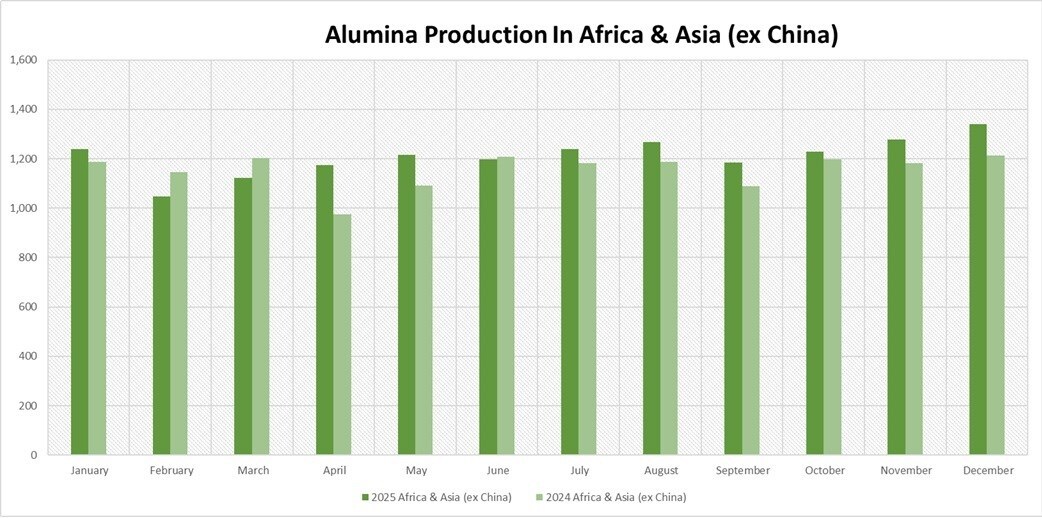 Image source: AL Circle
Asia’s push: From stability to expansion
In Asia, growth has come from both ends-better utilisation and new capacity. Vedanta, for instance, reported record alumina production of 2.421 million tonnes in FY2025, up 2.11 per cent year-on-year. Its refineries, including Lanjigarh, maintained steady operations, while expansion projects progressed despite supply chain disruptions, reaching 5 million tonnes per annum (MTPA) capacity by late 2025.
Indonesia emerged as the central driver of regional growth. Policy support and downstream ambitions have pushed a wave of refinery projects into operation. PT Borneo Alumina Indonesia brought its Mempawah refinery online in late 2024, reaching full capacity of 1 million tonnes per year by Q1 2025, processing locally sourced bauxite for domestic smelting.
PT Bintan Alumina Indonesia followed with a two-phase expansion that added 2 million tonnes per year, fully operational by December 2025, lifting total capacity to 4 million tonnes.
Between 2024 and 2025, Indonesia brought online around 8.5 million tonnes of new or restarted capacity across several projects.
Jinjiang Group’s PT BAP also entered production, commissioning a 1 million tonne phase in January 2025, with further expansion lined up.
To know more about the global primary aluminium industry 2026 outlook, read our report “Global Aluminium Industry Outlook 2026”.
Africa’s story: abundant resources, limited refining
Africa’s numbers are moving in the right direction, but for different reasons. The increase has been driven by existing refineries operating more consistently. In simple terms, alumina output in Africa rose in 2025 as plant reliability improved, new projects-particularly in Guinea and Ghana-entered the construction phase, and governments strengthened policies encouraging local refining instead of exporting raw bauxite.
The numbers back up the above statement. Capacity has remained flat at 0.65 million tonnes, while production declined until 2023 before recovering to 0.338 million tonnes in 2024, a 23.8 per cent rise from the previous year’s low. Output is expected to increase further to 0.350 million tonnes in 2025, up another 3.6 per cent.
Guinea sits at the centre of it. Despite being one of the world’s largest bauxite producers, it has just one operating alumina refinery-RUSAL’s Friguia plant, with a capacity of around 600,000 tonnes per year. Most of its bauxite continues to leave the country unprocessed.
That imbalance defines not just Guinea, but much of the continent. Africa holds 29 per cent of global bauxite reserves, yet less than 1 per cent of alumina refining capacity.
What comes next?
Indonesia’s expansion pipeline continues to build momentum. The Smelter Grade Alumina Refinery (SGAR) in Mempawah, West Kalimantan, is set to add another 1 million tonnes per year under Phase 2, taking total capacity to 2 million tonnes annually. This phase is expected post-2025, likely around 2028, as part of the country’s broader push to scale up domestic refining through sustained investment and infrastructure development.
Nanshan Aluminum’s Indonesia operations have already reached 2 million tonnes of capacity, with production at 1.91 million tonnes in 2023, accounting for a 34.9 per cent share of the Southeast Asian market. A further 2 million tonne expansion is underway and is expected to come online in 2026.
Meanwhile, East Hope Group is developing a large integrated project in West Kalimantan, combining 6 million tonnes of alumina capacity with 2.4 million tonnes of aluminium production. Located in Pontianak, the project is designed around a “mine-to-metal” model, supported by dedicated port and power infrastructure. It will be developed in three phases, with the first 2 million tonnes of alumina capacity targeted for commissioning in 2028, alongside plans for low-emission, technology-driven operations and the creation of 3,000–3,500 jobs.
Africa’s pipeline is slower but significant. Guinea has started building a USD 1.2 billion refinery in Boké, with capacity of about 1.2 million tonnes per year, expected to ramp up between 2026 and 2030. Other projects remain uncertain-EGA’s Boké refinery is stalled, and Global Alumina’s 3.3 million tonne proposal is still at an early stage. Additional proposals, totalling roughly 2 million tonnes, are under discussion but not yet committed.
The ambition, however, is clear. Guinea is targeting five to six refineries by 2030, aiming for around 7 million tonnes of capacity. If that happens, it could begin to close the long-standing gap between mining and refining.
More than just a 4.8% increase
Seen together, the 4.8 per cent rise in 2025 is only part of the picture. Asia is scaling quickly, driven by policy and investment. Africa is recovering, with signs of future capacity taking shape but not yet realised. The trajectories are different, but they are moving in the same direction.
Don’t miss out- Buyers are looking for your products on our B2B platform
Responses








_0_0.jpg/500/0)