As China edges closer to its self-imposed primary aluminium production cap of 45 million tonnes, a set of billion-dollar questions is reverberating in air. Is the global market counting days for supply deficit? Will anybody step in to bridge the gap? If yes, then who can do so at scale? While these questions seem obvious, answers may appear to be far less aligned with prevailing assumptions. However, before exploring the possibilties, let us check how the market is already reacting to the early signals of supply deficit amidst steady demand growth.
How is primary aluminium responding to today’s market condition?
Already the rising demand and supply deficit is making its presence felt in prices. Primary aluminium on the London Metal Exchange has climbed to USD 2,932 per tonne (as of December 24), up 15.4 per cent over the year from USD 2,541 per tonne. On the supply side, China’s primary aluminium production has reached 40.44 million tonnes by November 2025, maintaining its monthly output between 3.65 and 3.75 million tonnes. If December output follows the same trajectory, annual production will stand at roughly 44.2 million tonnes - placing the country just a short step away from its long-standing ceiling.
Alternatives like the US, Europe, and Australia give very less assurance at this moment to take care of the primary aluminium supply gap because of the operational challenges they face due to electricity constraints and high energy costs. Then remain the Asian countries where new primary aluminium projects are gathering momentum, backed by capital investments and improved infrastructure.
With India and Malaysia’s established leadership with 4.2 million tonnes and 1.08 million tonnes annual capacity, Indonesia’s new capacity addition of 705,000 tonnes, and Vietnam’s market entry through the Dak Nong Project, Asia is all geared up to take the charge. According to an official source, aluminium production in Asia (ex-China) has increased at a CAGR of 3.26 per cent over the years.
India’s production trajectory and future plans
Among all, India’s aluminium industry happens to be most ambitious with a goal of reaching 37 million tonnes per annum by 2047. While Asia (ex-China) has seen an overall growth of 3.26 per cent in production, India has witnessed an increase of 8.68 per cent. However, the country’s 2047 production target is phase-wise, intending to achieve 12 million tonnes per annum by FY2030, 25 million tonnes per annum by 2040, and 37 million tonnes per annum by 2047.
Indian aluminium giants like Vedanta and NALCO have already charted and declared their capacity expansion plans for the next few years. Some of the major plans include Vedanta’s investment of INR 13,226 crore (USD 1.47 million) to ramp up its capacity from 2.4 million tonnes per annum to 3.1 million tonnes by FY2028. NALCO also announced to pump in INR 30,000 crore (USD 3.34 million) for its expansion drive in five years. As part of the plan, the company eyes to add 1 million tonnes of capacity by June 2026, bringing the total capacity to 3.1 million tonnes. Out of INR 30,000 crore, INR 18,000 crore will be earmarked from smelting capacity and the remaining INR 12,000 for a coal-fired power plant.
Vietnam’s plans to become a global supplier
As global demand for aluminium reaches new heights, Vietnam also emerges as a strong contender to become a key production hub. Thanks to its abundant resources of raw materials, the country under national mineral planning for 2021-30 aims to achieve annual bauxite output of 114-118 million tonnes and 11.6-18.6 million tonnes of alumina, and 120,000-150,000 tonnes of primary aluminium. Beyond 2030, the country plans to increase primary aluminium output to 225,000–245,000 tonnes per year.
For longer term, Vietnam is coming up with its first major primary aluminium electrolytic plant in Đắk Nông Province, having an annual production capacity of 450,000 tonnes per year once fully operational. Phase 1 of the project is expected to begin around Q2 2026.
To know more about aluminium projects scheduled in 2026 and the market dynamics, prebook our report: Global Aluminium Industry Outlook 2026
Indonesia joins the race too
Indonesia’s primary aluminium sector has historically been small compared to global leaders, yet the country is rapidly expanding its capacity to catch up the supply gap. By the end of 2025, a new smelter project backed by PT Adaro Minerals Indonesia (ADMR) is likely to commence its Stage 1 primary aluminium ingots production with a capacity of 500,000 tonnes per annum. Over subsequent phases, the facility aims to produce around 1.5 million tonnes per annum in the future.
INALUM also plans significant capacity increase, targeting around 900,000 tonnes by 2029. But in 2026, it is expected to keep its output at around 280,000 tonnes or raise it slightly to about 285,000 tonnes.
Malaysia – ready to strengthen its capacity
Led by Southeast Asia’s largest integrated aluminium producer Press Metal Aluminium Holdings, Malaysia’s aluminium industry has a smelting capacity of 1.08 million tonnes per annum. However, Press Metal is actively expanding its smelting operations at its ongoing Samalaju Industrial Park to attain 760,000 tonnes of output and potentially more as additional phases complete, supported by new power supply agreements for up to 500 MW of electricity.
However, for 2026, the forecast is having a stable capacity level of 1.08 million tonnes, with utilisation rate close to 100 per cent.
Overall growth prospect in Southeast Asia – will that offset supply deficit?
According to Argus, primary aluminium output in Southeast Asia is expected to increase to 2.7 million tonnes by 2026, with the addition of 780,000 tonnes of new capacities. But since the commissioning of new capacities will be gradual, supply deficit will persist through at least the first quarter of the year.
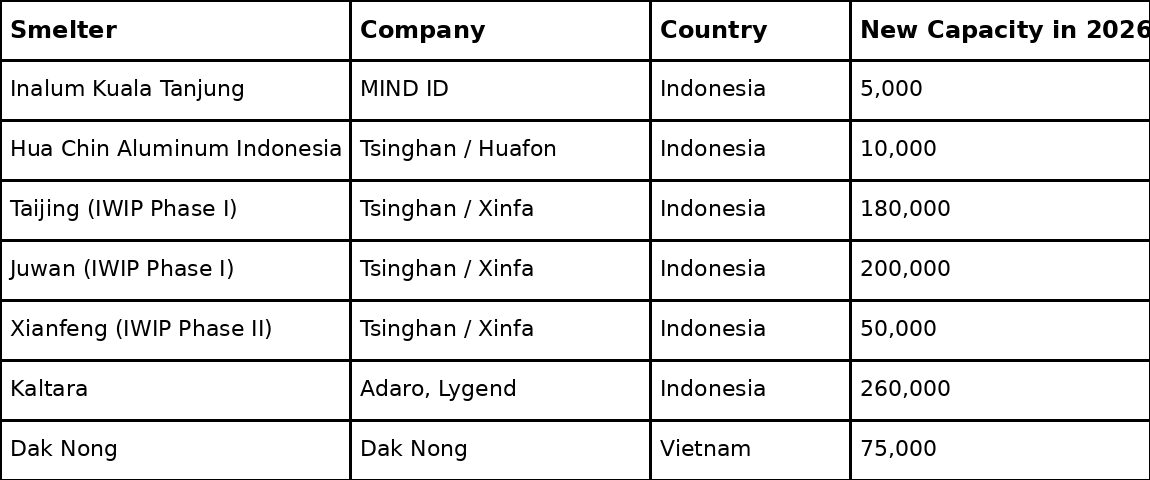
Here are the capacities that are scheduled to be commissioned in 2026:
From the data revealed in the above chart, Indonesia will primarily drive the capacity expansion in 2026, by alone adding 705,000 tonnes. The remaining 75,000 tonnes of the projected expansion will be contributed by Vietnam.
Now, the question is – will this expanded capacity offset the anticipated shortfall in supply chain? Indonesia exports more than 70 per cent of its primary aluminium production and China is the top destination. From January-October 2025, Indonesia exported 414,600 tonnes of primary aluminium, of which China received 191,500 tonnes, or 46 per cent of total volumes. Going forward, if China’s import volume increases from Indonesia, given the limited expansion opportunity in China due to cap, then meeting supply deficit by Indonesia remains a question.
Moreover, majority of the key projects in Indonesia has investments from China. For instance, Taijing and Juwan, jointly developed by Chinese companies Tsingshan and Xinfa, are expected to bring new capacity on line in 2026. While Taijing plans to start production in Q3 2026 with expected output of around 180,000 tonnes, Juwan aims to reach its full capacity of 250,000 tonnes per year in Q1 2026.
Adaro’s Kaltara project is also co-owned by Chinese firm Lygend. It plans to ramp up to its full phase one capacity of 500,000 tonnes per year by October 2026.
This means despite the waves of expansions and new projects scheduled for 2026, a significant share of the capacities is backed by Chinese capital, carrying strong potential for output to be channeled back into China. Two conclusions follow – 1) the aluminium supply chain is likely to remain firmly anchored to China and 2) production capacity is geographically spreading across Asia but control remains with China. In short, neither investment flows nor production power in primary aluminium is moving beyond Asia (essentially China). Reinforcing this trend is Russia’s aluminium trade, which is increasingly oriented towards China. Within the first five months of 2025, China secured 1 million tonnes of the metal, compared to about 1.13 million tonnes of imports through the entire year of 2024.
Explore our B2B market place: AL Biz















_md.webp)








