










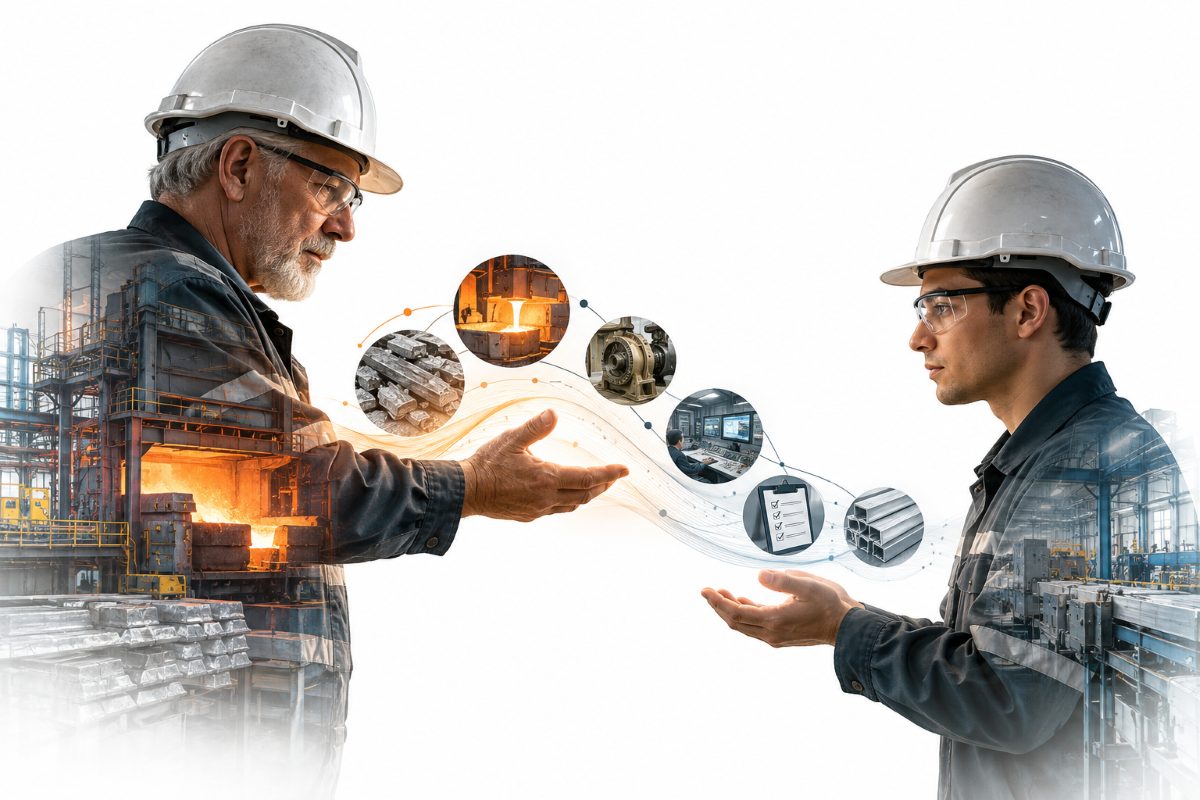
For decades, the aluminium industry has talked about labour shortages. We need more operators, maintenance technicians, metallurgists, electricians, engineers and people willing to work in industrial environments and build careers inside plants.
All of that is true. But I believe we are describing the problem incorrectly. The aluminium industry is not simply losing workers; it is losing knowledge and that may ultimately be a much bigger problem.
Walk through almost any aluminium plant in the United States today and you will probably find someone who has been there for twenty, thirty, sometimes forty years. They know the furnace, the scrap, the alloys, the casting line, the sounds, temperatures, colours, vibrations and behaviours of equipment that are difficult to describe in an operating manual.
Ask an experienced operator why he changed a burner setting, modified a charging sequence or delayed a transfer and sometimes the first answer will simply be: “Something didn’t look right.”
That sentence contains more technology than we sometimes realise. Behind it may be decades of accumulated experience: thousands of heats, hundreds of abnormal situations, dozens of equipment failures and years of observing how small changes affect metal recovery, dross generation, energy consumption and product quality.
Then one day that person retires. The company replaces the employee. But did it replace the knowledge? In many cases, the answer is no. That is the real workforce challenge facing our industry.
We tend to think of knowledge as something contained in drawings, manuals, SOPs, PLC programs, maintenance records and quality procedures. Those things are extremely important, but they represent only part of what actually makes an aluminium plant operate. The other part lives inside people. It is the maintenance technician who knows that a certain vibration usually appears two weeks before a bearing fails.
It is the furnace operator who knows that one type of scrap behaves completely differently from another even when both are technically classified under the same purchasing category. It is the metallurgist who understands how a particular combination of temperature, residence time and agitation affects magnesium recovery. It is the casting operator who recognises instability before the instrumentation generates an alarm. It is the production manager who knows which operating parameter can be pushed and which one should never be pushed, regardless of what the theoretical limit says.
This is tacit knowledge: knowledge developed through experience that is difficult to document because, in many cases, the person possessing it does not even consciously recognise everything he or she knows. And we are losing it.
The retirement problem is actually a knowledge-transfer problem
The obvious response is to hire younger workers because we need them. But hiring solves the headcount problem. It does not automatically solve the knowledge problem.
A new engineer can understand thermodynamics. A new technician can understand electrical systems. A new operator can learn an SOP. But none of them can instantly inherit thirty years of operating experience. Experience cannot simply be recruited; it has to be transferred. That distinction becomes particularly important in aluminium because our processes combine science with enormous amounts of accumulated operational knowledge.
Consider melting. On paper, melting aluminium sounds relatively straightforward: introduce energy until the metal reaches the liquid state. Anyone who has spent time around a casthouse knows how incomplete that description is. Scrap geometry, surface area, moisture, coatings, organic contamination, charging sequence, bath movement, furnace atmosphere, metal temperature and Residence time matter. And when dealing with secondary aluminium, the problem becomes even more complex because the raw material itself changes constantly.
One truck is not necessarily identical to the next one. That variability means the plant depends not only on equipment but also on the ability of people to interpret what is happening inside the process. Now multiply that reality across shredding, sorting, decoating, melting, metal treatment, casting, maintenance and quality control. The result is an enormous body of industrial knowledge that has accumulated over decades.
Much of it has never been systematically captured and that should concern us. Because once that knowledge leaves the building, rebuilding it can take years. And sometimes we only discover what we lost when something stops working.
We are automating at exactly the moment we are losing experience
There is another interesting contradiction developing. At the same time that experienced workers are retiring, the aluminium industry is investing aggressively in automation.
Plants are installing more sensors, cameras, automated charging systems, robotic equipment, advanced sorting technologies, process controls, energy monitoring systems and increasingly sophisticated software.
Artificial intelligence is now entering that conversation as well, which is a positive development. But automation alone does not solve the knowledge problem. In fact, badly implemented automation can hide it.
A sensor can measure temperature, but it does not necessarily understand why that temperature changed. A PLC can execute a charging sequence, but it does not necessarily know whether the material entering the furnace today behaves differently from the material processed yesterday.
A dashboard can tell us that metal recovery dropped, but it does not automatically explain whether the cause was scrap contamination, oxidation, excessive residence time, poor submergence, operator practice, furnace condition or some combination of them.
Data is not knowledge. It becomes knowledge when we understand the relationships behind it. This is where I believe the industry has an extraordinary opportunity.
Instead of thinking about automation and artificial intelligence primarily as tools to replace people, we should begin thinking about them as tools to capture, preserve and multiply industrial knowledge. That changes the conversation completely.
The question is no longer: “How many operators can we eliminate?” A much more interesting question is: “How much of our best operators’ knowledge can we preserve?”
Imagine capturing thirty years of experience before it walks out the door
Suppose one of the most experienced furnace operators in a plant plans to retire three years from now. Traditionally, the company might ask him to train another operator. They work together for several months. The younger employee observes what he does. Some procedures are documented. Eventually, the experienced operator retires. Some knowledge is transferred, but not a lot.
Now imagine approaching those three years differently. Every important intervention made by that operator becomes an opportunity to capture knowledge.
- Why did you change that parameter?
- What did you observe?
- What normally causes this condition?
- What would happen if you did nothing?
- Have you seen this before?
- What indicators do you look at first?
- What combination of variables concerns you?
The objective would not be to create another thousand-page operating manual nobody reads. It would be to connect human experience with operating data. This may include temperature histories, burner conditions, energy consumption, scrap classification, alloy chemistry, dross generation, metal recovery, maintenance events, production interruptions and operator interventions.
Now we are no longer documenting only what happened. We are beginning to capture why experienced people believed it happened and what they did about it. That difference is enormous. Over time, patterns begin to emerge. And this is where artificial intelligence becomes much more interesting for industrial applications.
Not as a magical system that suddenly understands aluminium metallurgy, but as a tool capable of organising enormous amounts of historical information and helping future operators access the experience of the people who came before them.
Imagine a young operator facing an unusual furnace condition five years from now. Instead of searching through manuals, maintenance reports and hundreds of spreadsheets, he could ask the plant’s knowledge system: “When have we seen this combination of temperature instability and increased gas consumption before?”
The system could retrieve similar historical events, operating conditions, maintenance observations and corrective actions. Suddenly, thirty years of experience has not disappeared; rather, it has become accessible. That is a completely different model of industrial knowledge transfer.
But first we need to capture the knowledge
This is where I think many companies are making a mistake. They are waiting for artificial intelligence to solve a problem for which they have not yet collected the necessary information. AI cannot preserve knowledge that was never captured.
And the clock is already running. The people with the greatest accumulated industrial experience are not going to remain in our plants forever. So, the first step is surprisingly simple: Identify the knowledge that the company cannot afford to lose.
Not every piece of experience has the same strategic value.
- Which employees understand processes that very few others understand?
- Which machines depend heavily on operator experience?
- Which troubleshooting decisions are not adequately documented?
- Which quality problems are routinely solved through experience rather than formal procedures?
- Which operating conditions cause the greatest losses in metal, energy, productivity or safety when handled incorrectly?
Once those areas are identified, companies can begin systematically converting tacit knowledge into institutional knowledge. That could involve structured interviews, video documentation, operator commentary attached to process events, digital troubleshooting libraries, recorded maintenance interventions, failure histories and training simulations based on actual plant situations.
The second step is connecting that knowledge to data. Modern plants generate enormous quantities of information, but much of it remains fragmented. This is because production has one system, whereas maintenance and quality have another. Energy data may be somewhere else. Scrap purchasing may classify incoming material differently from production. Operator observations may never leave a handwritten logbook. The value appears when these pieces begin talking to each other, because a furnace does not understand departmental boundaries.
Neither does an aluminium atom. A change in incoming scrap can affect melting behaviour, energy consumption, metal recovery, chemistry, dross generation, casting performance and ultimately product quality. The plant must therefore learn to see the process as a system.
The third step is creating a new relationship between experienced workers and technology. The person who has operated a furnace for thirty years should not be viewed as someone whose knowledge is becoming obsolete because the plant is becoming automated. It is quite the opposite.
That person may be one of the most valuable resources available for teaching the automated plant what matters. Technology can capture thousands of variables, but experience helps us determine which relationships are meaningful. That partnership is where the real opportunity exists.
The next generation of operators will be different
This transition will also change what it means to work in an aluminium plant. The operator of the future may spend less time manually controlling equipment and more time interpreting processes. The maintenance technician may move increasingly from reactive repair toward predictive intervention.
The metallurgist may work with much larger datasets connecting chemistry, energy, scrap characteristics and operating conditions. And production managers may increasingly make decisions based on digital models that combine historical experience with real-time plant information.
That does not make people less important; it makes their role different. We should therefore be careful with the idea that the “factory of the future” is simply a factory with fewer people. That is an incomplete vision.
The “factory of the future” should be a factory in which each person has access to more knowledge. That is a far more powerful productivity multiplier.
Imagine the difference between two plants ten years from now. Both have modern furnaces, automated charging, advanced process controls and similar sensors and software. But one plant spent the previous decade systematically capturing its operating knowledge while the other allowed that knowledge to disappear every time an experienced employee retired.
Those plants may own similar equipment. But they will not possess the same capability. And that difference will eventually appear in metal recovery, energy consumption, uptime, quality, safety and profitability.
The long-term impact goes far beyond individual plants
There is another reason this matters. The United States is talking seriously again about rebuilding industrial capacity. We discuss domestic aluminium production, recycling capacity, critical materials, supply-chain resilience, reshoring and advanced manufacturing. All of those ambitions require equipment and capital. But they also require something much harder to manufacture: industrial know-how.
A country can build a new plant relatively quickly. Building the human ecosystem capable of operating, maintaining and continuously improving that plant takes much longer. Once industrial knowledge disappears, rebuilding it is expensive.
Problems that previous generations already solved have to be solved again. Commissioning takes longer, maintenance becomes more reactive, production becomes less stable, metal losses increase and energy efficiency suffers.
Organisations become increasingly dependent on a small number of external specialists because the internal knowledge base has weakened. Eventually, what began as a workforce issue becomes a competitiveness issue. That is why knowledge preservation should be treated as infrastructure.
- We invest in furnaces because they are productive assets.
- We invest in casting lines because they are productive assets.
- We invest in automation because it is a productive asset.
- We should begin treating accumulated industrial knowledge the same way.
It is an asset, but the difference is that this asset can walk out the door.

 Voyagerman Technology


