











Hedging is often associated with traders, financial markets and sophisticated risk desks. In an aluminium recycling business, however, its relevance can be much closer to everyday commercial decisions.
A recycler is constantly making decisions around what to buy, when to buy it, how long to hold material, when to fix a price and when to sell. Each decision can have a different relationship with the underlying aluminium market. This is where hedging can move from being a financial-market concept to a practical risk-management tool.
Start with the exposure, not the instrument
Before considering futures or options, recyclers need to understand where their business is actually exposed. A scrap purchase may be agreed at one point, while the recovered aluminium is sold later. Inventory may remain on the books while market prices change. A customer contract may involve price fixation at a different time from the purchase of the underlying material.
These gaps between commercial decisions can create exposure. The first step, therefore, is not deciding whether to use a future or an option. It is identifying when a price movement could change the economics of a transaction and understanding the scale and timing of that exposure.
Where can hedging fit?
Once exposure is identified, hedging can potentially be considered at different points in the recycling cycle. For procurement teams, it can be relevant when purchase commitments create future exposure to aluminium prices. For commercial teams, it can matter when sales are agreed before the underlying price is fixed. For businesses carrying significant inventories, it can provide a way to manage the financial impact of adverse market movements.
The appropriate approach will depend on the underlying physical position, pricing mechanism, timing and risk appetite. There is no single hedging strategy that fits every transaction. This is also why understanding the mechanics of hedging matters the most. Futures can be used to manage price exposure, while options can provide greater flexibility, including the ability to protect against adverse movements while retaining some upside potential.
Hedging is not about predicting aluminium prices
One of the most important distinctions is that hedging does not require a business to know where aluminium prices are heading. The objective is to manage an existing commercial exposure rather than make a directional market bet.
That means the quality of a hedging strategy depends not only on the financial instrument used, but also on how well it corresponds with the physical transaction. Mismatch, timing differences and non-performance can all affect the outcome. Understanding these practical considerations is therefore just as important as knowing how futures and options work.
From individual hedges to a company-wide approach
For recyclers looking to make risk management more structured, the bigger opportunity may be to connect hedging with procurement, commercial and finance processes. This means identifying exposure points, defining internal controls and establishing a risk-management policy that helps teams make consistent decisions. The aim is not to remove market uncertainty, but to make the business better prepared to manage it.
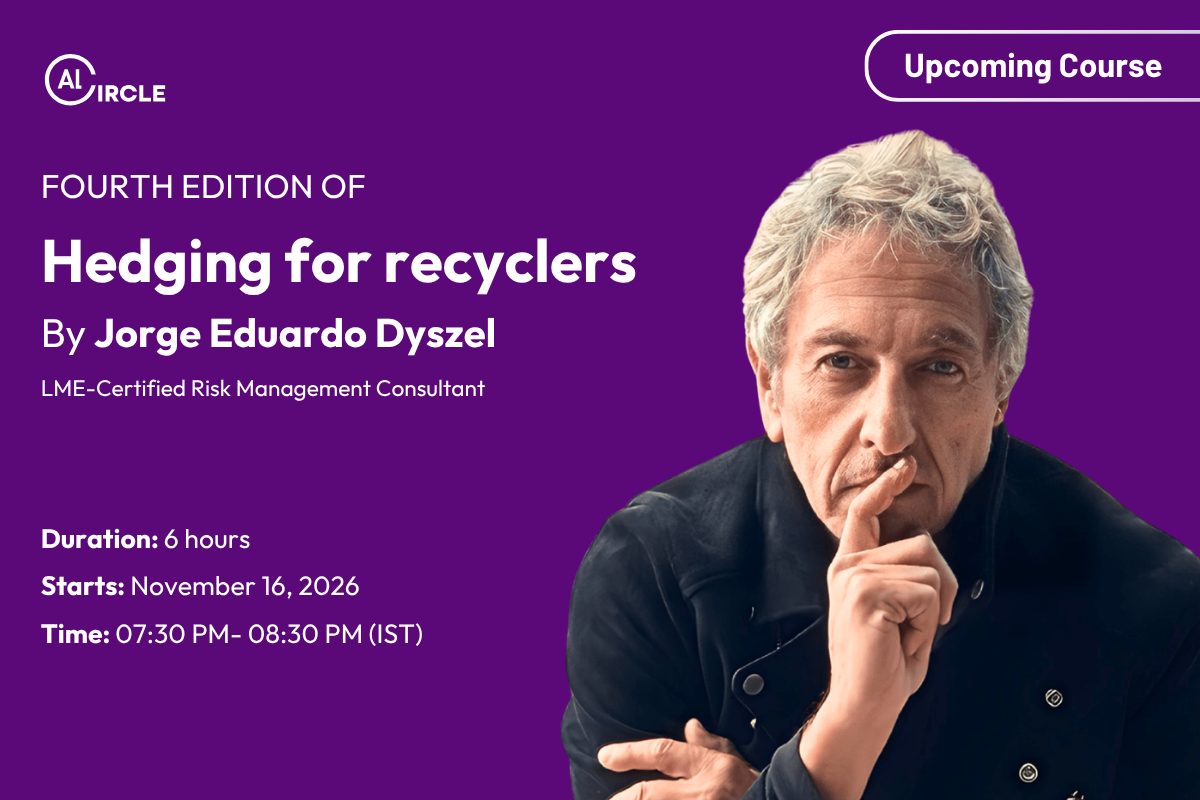
That is the focus of the fourth edition of “Hedging for Recyclers: Become an Expert in 6 Hours”, which will be led by LME-certified Risk Management Consultant Jorge Eduardo Dyszel. The six-session online programme covers recycler exposure, price fixation, futures, practical hedging scenarios, options and integrated risk-management policies, with no prior hedging experience required.
Planning to manage price risk with hedging?
The fourth edition offers a practical route into the subject by focusing on real recycling business scenarios rather than theory alone.
Duration: 6 hours across six sessions
Dates: 16, 18, 20, 23, 25 and 27 November 2026
Time: 2:00 PM to 3:00 PM UTC
Key takeaways: Identify critical exposure points, understand price fixation and currency risks, explore futures and options strategies, work through practical aluminium hedging scenarios, and understand how to build an internal risk-management policy.
No prior hedging experience is required, making the programme relevant not only for risk professionals, but also for recyclers, scrap traders and professionals across procurement, commercial and finance functions. Click here to register and grab early bird discounts of 20% for individual bookings and 25% for group bookings.