








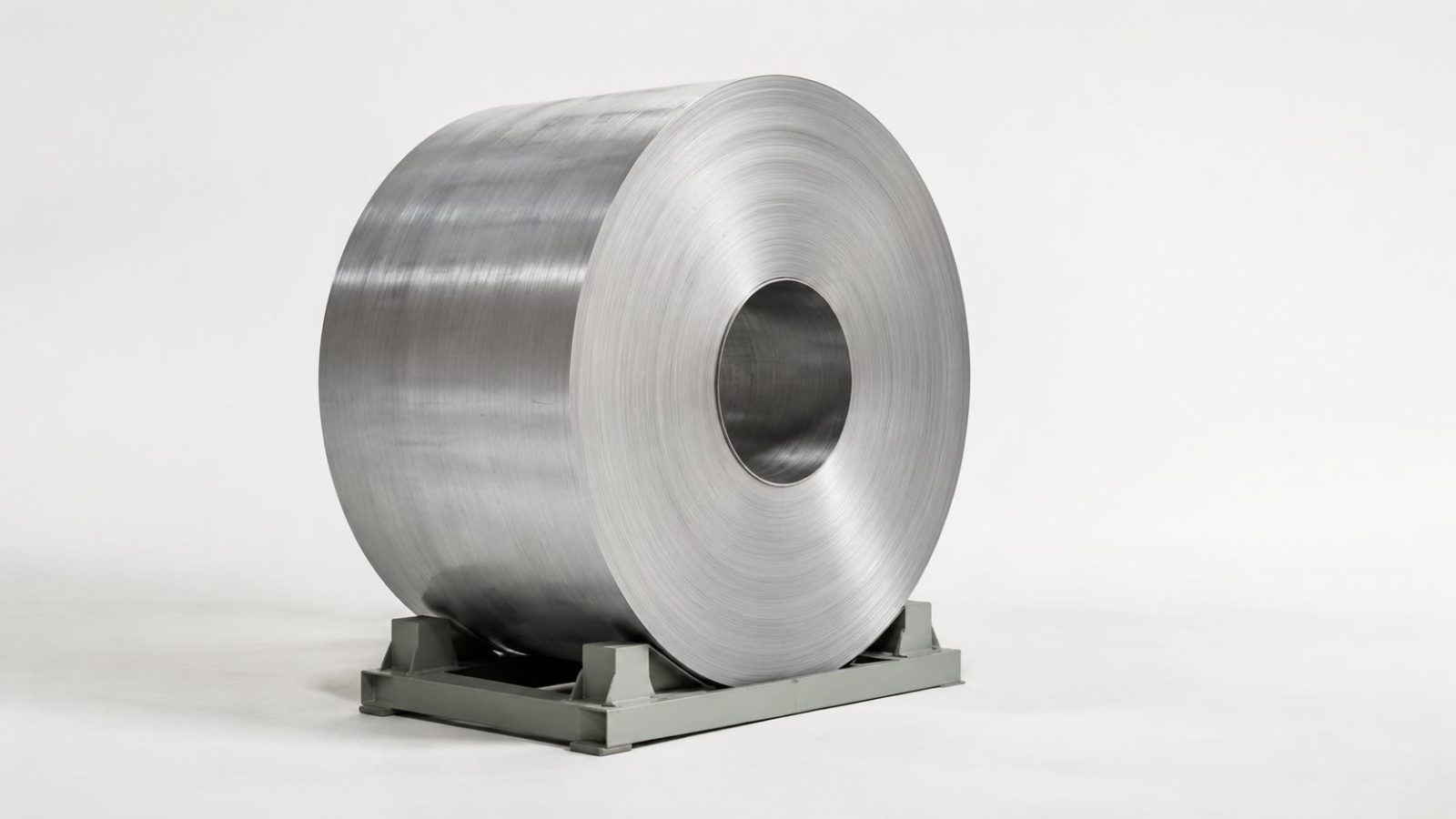
Selecting the right aluminium coil is not simply a matter of comparing prices. The rolling route affects thickness tolerance, mechanical properties, surface quality, formability and downstream processing performance. For procurement teams evaluating cold rolled vs hot rolled aluminium coil, the correct choice depends on the final application and production-line requirements.
How are hot-rolled aluminium coils produced?
Hot rolling begins with an aluminium slab heated above its recrystallisation temperature. The heated slab passes repeatedly through rolling mills, reducing its thickness and converting it into a coil. Because the aluminium remains highly workable at elevated temperatures, manufacturers can achieve substantial thickness reduction efficiently.
Common hot rolled aluminium coil properties include good formability, relatively low internal stress and suitability for thicker gauges. Hot-rolled material is widely used for heavy-duty fabrication, transportation components, marine structures, industrial equipment and applications where an ultra-smooth surface is not the primary requirement.
Hot rolling is also frequently an intermediate stage. The resulting coil may subsequently undergo cold rolling, annealing, surface treatment or finishing to meet tighter specifications.
What is cold-rolled aluminium coil manufacturing?
In cold-rolled aluminium coil manufacturing, aluminium is reduced further at or near room temperature. The input material may be a hot-rolled coil or a cast coil, depending on the producer’s manufacturing route and the required product properties.
Rolling at lower temperatures produces more precise thickness control, improved flatness and a smoother surface. Cold working also increases strength and hardness through strain hardening, although it can reduce ductility. Manufacturers can use annealing and tempering treatments to achieve the required balance between strength and formability.
Cold-rolled coils are commonly selected for automotive panels, appliance bodies, electronics, roofing, packaging, heat exchangers, architectural products and other applications requiring thin gauges or consistent visual quality. Buyers can explore available industrial aluminium coils across different alloys, dimensions and finishes.
Aluminium coil surface finish comparison
Surface condition is one of the clearest differences between the two products. Hot-rolled aluminium generally has a less refined mill finish and may display minor surface variations caused by high-temperature processing. This is acceptable for structural parts, hidden components or products that will undergo additional machining or coating.
Cold-rolled coil typically offers a cleaner, smoother and more uniform appearance. It is therefore better suited to exposed panels, decorative products, painted surfaces and precision-formed components.
However, an aluminium coil surface finish comparison should not rely on the labels “hot rolled” and “cold rolled” alone. Buyers should specify surface roughness, visual acceptance criteria, coating compatibility, oil level, edge quality and protection requirements. A poorly specified cold-rolled coil can still fail on an appearance-critical line.
Key differences at a glance
| Selection factor | Hot-rolled aluminium coil | Cold-rolled aluminium coil |
| Processing temperature | Elevated temperature | At or near room temperature |
| Typical gauge | Medium to thick | Thin to medium |
| Thickness tolerance | Moderate | Tighter |
| Surface finish | Less uniform | Smoother and more consistent |
| Strength and hardness | Generally lower | Generally higher after cold working |
| Formability | Good | Depends on temper and annealing |
| Typical cost | Usually lower | Usually higher due to added processing |
| Common uses | Structural and heavy-duty components | Precision, decorative and thin-gauge products |
Which coil fits your production line?
Choose hot-rolled aluminium coil when your operation requires thicker material, good workability and cost efficiency, while minor surface variations are acceptable. It is a practical option for welded assemblies, heavy fabrication, industrial flooring, transport structures and components requiring further processing.
Choose cold-rolled aluminium coil when your line depends on tight gauge control, flatness, smooth surface quality or repeatable stamping and forming performance. It is usually the stronger choice for high-speed automated lines where inconsistent thickness can cause feeding, forming or rejection problems.
Do not choose solely by application name. Alloy, temper, thickness, width, coil weight, inside diameter, edge condition and mechanical-property limits can matter more than the rolling route.
B2B aluminium coil sourcing guide
A reliable B2B aluminium coil sourcing guide should begin with a complete technical specification. Ask potential suppliers to confirm:
- Alloy and temper
- Rolling route, including direct-chill or continuous-cast input
- Thickness, width and tolerances
- Tensile strength, yield strength and elongation
- Surface finish and flatness
- Coil inside and outside diameters
- Maximum coil weight
- Edge condition and protective packaging
- Mill test certificate and applicable standards
- MOQ, production lead time and claims procedure
Before accepting a large shipment, use an aluminium flat-rolled product inspection checklist and request samples or trial coils. Buyers can also compare specifications and connect with aluminium coil suppliers on AL Biz.
The right choice is straightforward: hot-rolled coil prioritises economical processing and thicker gauges, while cold-rolled coil prioritises precision, strength and surface consistency. Match the material to your line, not merely to the lowest quotation.


 Voyagerman Technology


