








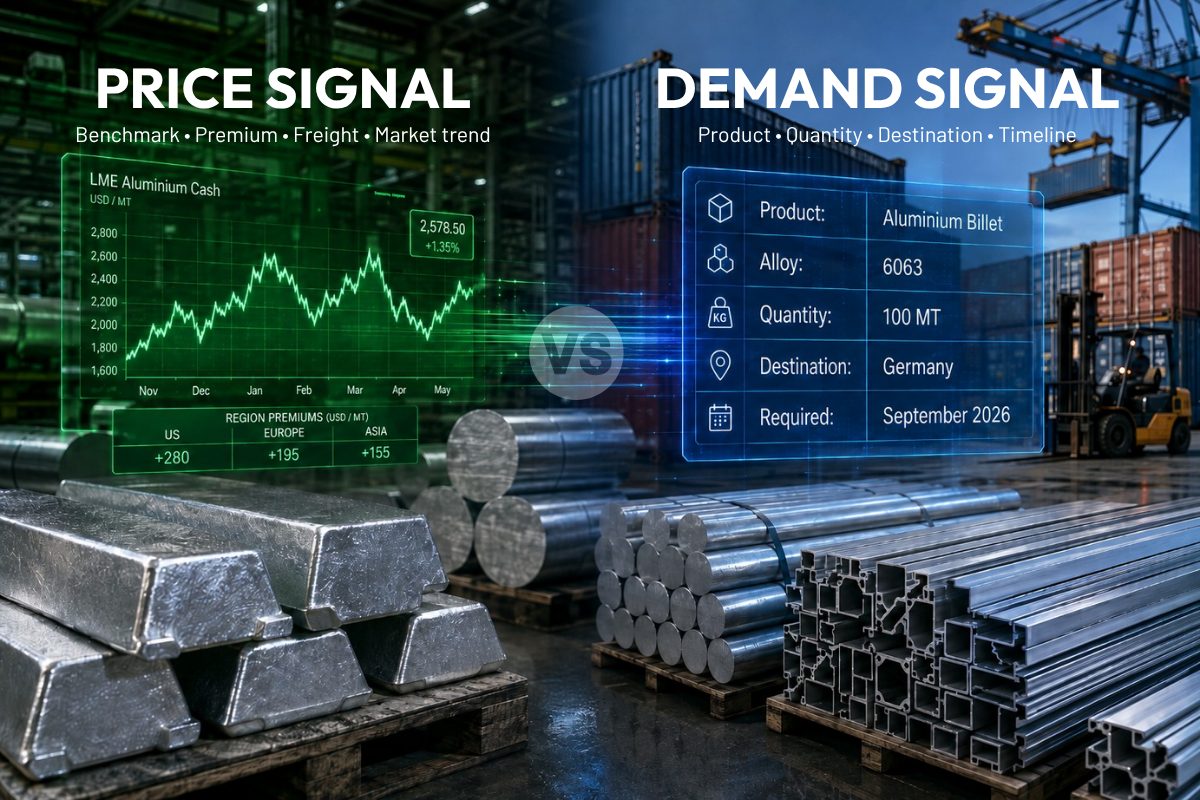
Aluminium sellers watch prices closely. LME aluminium prices move. Regional premiums change. Scrap costs rise and fall. Freight rates shift. Each move can affect the price a seller is willing to offer.
But aluminium price signals answers only one part of the question.
It can tell a seller what aluminium may be worth in the market. It does not tell them who wants to buy aluminium right now, what they need, how much they need or where they need it delivered.
For aluminium producers, traders, recyclers and distributors, both signals matter.
Aluminium price signals give a view of the market. Buying requirements show where real demand may be forming.
The better approach is to read them together.
Aluminium prices tells sellers what metal is worth, not where demand is
Most aluminium sellers follow a fairly familiar chain.
LME price → premium → raw material cost → processing cost → selling price
Each part matters.
A primary aluminium seller may track the LME aluminium price and regional premiums. A recycler may pay more attention to scrap prices and spreads. An extrusion producer may also need to consider billet costs, conversion charges and energy costs.
These numbers help sellers decide whether a proposed selling price makes commercial sense.
But none of them answers, “Who is ready to buy?”
Some buyers may hold purchases because they expect prices to fall further. Others may enter the market quickly because their inventories are low. A manufacturer may need material even when prices are high because production cannot stop.
This is why aluminium price signals and aluminium demand need to be read separately before they are read together.
What LME and historical aluminium price signals can tell a seller
Price data remains one of the first tools an aluminium seller should check.
The LME aluminium price provides a widely followed reference for primary aluminium. Sellers may then look at premiums, regional market conditions and product-specific costs before setting their own commercial terms.
Why the same LME price can mean very different regional costs
The LME may provide a common benchmark, but aluminium does not reach every buyer at the same price.
A buyer in the US, Europe or Asia can face a very different final metal cost even when the underlying LME price is the same. Regional premiums, import duties, freight, insurance, local supply and carbon-related costs all sit on top of, or influence, the benchmark.
This gap became especially clear in 2026.
- In the United States, high Section 232 tariffs and tight physical supply pushed the Midwest aluminium premium sharply higher.
- In Europe, regional premiums were affected by tighter supply as well as the cost of the EU’s CBAM (Carbon Border Adjustment Mechanism).
- Asian buyers also faced higher physical premiums as concerns around Middle Eastern supply increased.
Shipping risk added another layer. Disruption around the Strait of Hormuz affected cargo flows and raised war-risk insurance costs, while supply interruptions at aluminium smelters tightened availability in some markets.
For sellers, this matters because an LME price alone does not show the commercial value of aluminium in a particular destination.
The more useful question is:
LME price + regional premium + freight + duties and compliance costs = what does the buyer actually face in that market?
This regional view can help sellers judge whether their offer is competitive, which destinations may offer better opportunities and how much room there is for negotiation.
Historical prices add another layer.
Looking at the price today tells you where the market stands now. Looking at historical data helps show how that price reached the current level.
Sellers can use aluminium price and historical price to follow price signals across the aluminium market.
Historical price trends can help answer questions such as:
- Has aluminium been rising or falling over recent weeks?
- Is the current price unusual compared with recent months?
- Has volatility increased?
- Are premiums moving in the same direction as the base price?
- Is the cost of scrap or another raw material changing faster than finished aluminium prices?
This information helps sellers prepare quotations and decide how long a price should remain valid.
It can also help with negotiations. If prices have moved sharply, a seller has a clearer basis for explaining why a previous quotation may no longer be workable.
But price signals only describes the market. It does not describe an individual buyer or give any insights on buyers’ demand.
What price charts cannot tell you
A price chart cannot tell you that a buyer in India needs 100 tonnes of aluminium ingot next month. It cannot tell you that an extrusion company is looking for a certain billet alloy. And it cannot tell you that a recycler needs UBC scrap at a specific destination under CIF terms.
These are demand details.
For a seller, they can be just as important as the aluminium price itself. A real buying requirement may contain information such as:
- Product:
or another product
- Grade or alloy: A7, 6063, 6061, ADC12 or another specification
- Quantity: Trial order, monthly volume or one-time purchase
- Destination: Country, port or plant location
- Delivery terms: FOB, CIF, CFR or another Incoterm
- Timeline: Immediate, monthly or scheduled requirement
- Payment terms: Advance, LC, credit or negotiated terms
This information changes how a seller views an opportunity.
A buyer looking for 25 tonnes of scrap for immediate delivery is very different from a buyer planning a 1,000-tonne monthly contract. The aluminium may be similar. The business opportunity is not.
Read about the difference between RFQ and RFP to manage aluminium sourcing, negotiation and delivery.
Buying requirements are another form of market intelligence
Buying leads are often treated only as sales enquiries. However, a buying requirement can also act as an aluminium demand signal. If several buyers begin looking for the same product, alloy or destination, sellers may start to see a pattern.
For example, repeated requirements for extrusion billets from one region may suggest stronger activity among local extruders.
More buying enquiries for aluminium scrap may point to stronger secondary aluminium production or tighter local scrap supply. A rise in requests for particular aluminium grades may also show where specific end-use demand is building.
One enquiry does not prove that a market trend exists. Sellers should not draw big conclusions from a single lead. But a steady flow of relevant aluminium buying requirements can add useful context to traditional market data.
Our B2B marketplace, AL Biz, allows sellers to explore aluminium business leads across different parts of the aluminium value chain.
This gives sellers something price charts cannot provide: a view of specific commercial requirements.
That does not replace market research. It adds another layer to it.
Price intelligence shows what is happening to value. Buying leads show where someone may be ready to transact.
Which aluminium buying leads should sellers respond to first?
Not every aluminium buying lead deserves the same amount of attention.
A seller may see several enquiries in one day. Responding to all of them in the same way can waste time. A simple lead-priority model can help.
1. Product fit
Can you actually supply what the buyer wants?
A request for aluminium extrusion scrap is not useful to a primary aluminium producer unless that company also trades scrap.
The grade, specification, dimensions and quality requirements should match what the seller can supply.
2. Quantity
Check whether the requested volume fits your business.
A producer built around large orders may not want a five-tonne requirement. A local distributor may be well placed to serve it.
The biggest order is not always the best order. The right quantity is the one that fits production, stock and logistics.
3. Destination
Distance affects freight, delivery time and sometimes duty.
A competitive ex-works price can become uncompetitive after international freight is added. Sellers should therefore judge the opportunity using the delivery destination, not only the buyer’s requested product.
4. Urgency
A buyer needing material within seven days may value stock availability more than a small price difference. A buyer planning purchases three months ahead may have more time to compare suppliers and negotiate terms.
5. Commercial viability
Finally, ask whether the trade can work.
Consider price, payment terms, freight, credit risk, inspection requirements and expected margin.
A lead may look attractive because of its volume but still make little commercial sense once all costs are included. Good lead selection is not about chasing every aluminium buyer. It is about finding requirements that fit what you can supply.
Quote timing matters when aluminium prices are volatile
Suppose an aluminium seller sends a quotation based on today’s LME price. The buyer responds five days later.
During those five days, LME may have moved. Currency rates may have changed. Freight may have increased. The physical premium may also be different.
The original quotation could now leave the seller with a much smaller margin. This is why quotation terms matter.
Sellers should be clear about:
- quotation validity;
- the benchmark used;
- whether the price is fixed or floating;
- the applicable premium;
- currency;
- freight validity; and
- the point at which the price becomes final.
For some transactions, a fixed price may be suitable. For others, an LME-linked structure may make more sense.
For example, a quotation might use an agreed LME pricing period plus a fixed premium. The exact structure will depend on the product, buyer, market and contract.
There is no single pricing method that works for every aluminium trade.
What matters is that both sides understand how the final price will be calculated.
Price signals and demand signals should be read together
Consider two situations.
In the first, aluminium prices are rising sharply but a seller sees very few relevant buying enquiries. That may suggest buyers are delaying purchases, using existing inventory or waiting for prices to settle.
In the second, prices are stable but the seller sees more buyers asking for the same product. That could point to improving physical demand even though the benchmark price has not moved much.
Neither signal should be used alone.
Price movements can be driven by many factors, including supply, inventories, energy costs, macroeconomic news, currency movements and financial-market activity.
Buying requirements are more specific. They show that a company is looking for material, but they do not automatically prove that a transaction will happen.
The useful insight comes from combining both.
A seller who sees a favourable price environment and relevant buyer demand has more information on which to act.
Check out our entire library of industry reports and industry news that can help you make the right business decision.
Turn market intelligence into an actual business opportunity
Watching aluminium price trends is useful. But sellers ultimately need to move from information to action.
A simple process can look like this:
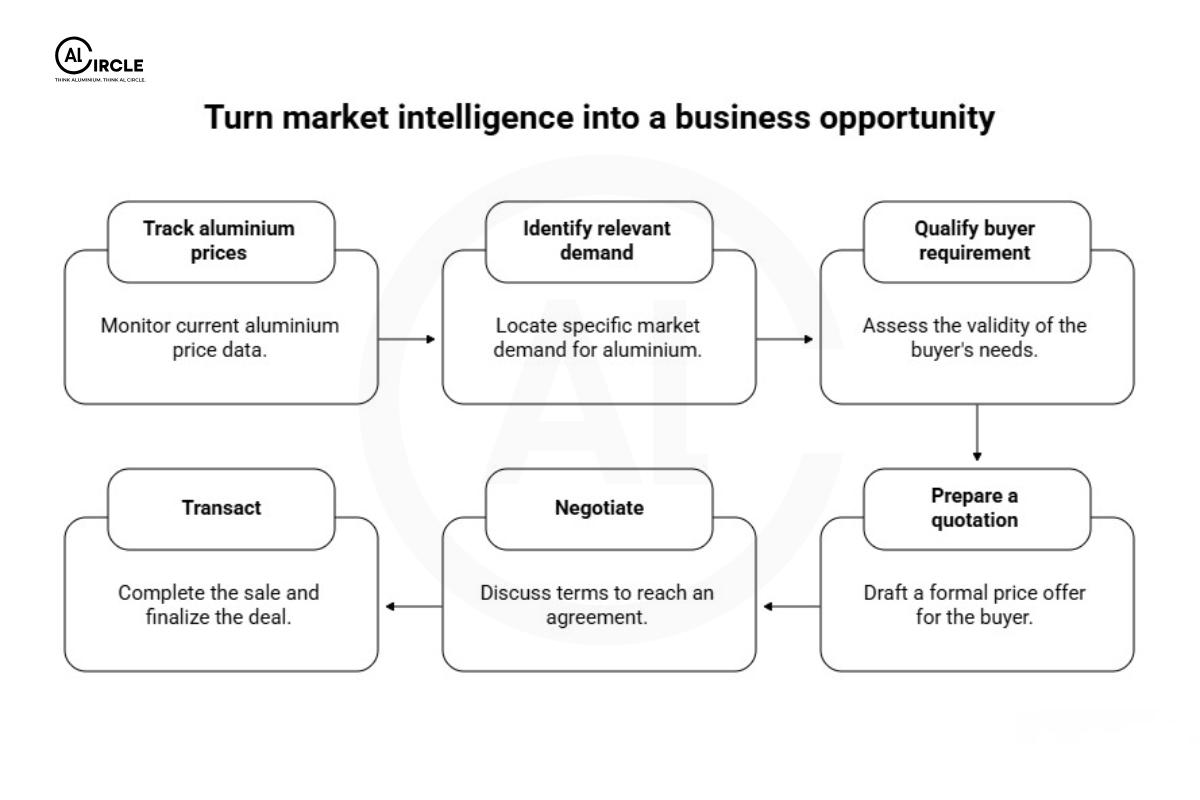
- Start with market conditions.
- Use current and historical aluminium price signals to understand the pricing environment.
- Then look for aluminium buying requirements that match the products you sell.
- Check the alloy, quantity, destination, delivery schedule and commercial terms before deciding whether the opportunity deserves a response.
- Once the requirement looks suitable, prepare a quotation that reflects both current market conditions and the needs of that buyer.
Sellers can check out business leads on our marketplace to find buying requirements and respond to relevant opportunities.
Buyers can also post an RFQ, creating another route for suppliers to connect with active procurement requirements.
The bottomline: The market price is only half the picture
Aluminium sellers need price intelligence. There is no sensible way around it.
LME aluminium prices, premiums, scrap costs and historical trends help sellers understand the value of the metal and the risks behind a quotation.
But knowing the price does not tell you where the next order will come from. For that, sellers need demand signals.
Buying requirements can show which products buyers are looking for, how much they need, where they need it and when they plan to purchase.
So the better sales question is not just: “Where is aluminium trading today?”
It is: “Where is aluminium trading today and who is actually buying?”
For producers, traders, recyclers, distributors and other aluminium suppliers, reading both signals can lead to better lead selection, better quotations and more informed sales decisions.
You can post both your buying and selling requirements on our marketplace and also get in touch with our expert assisted trade team for support.
Contact our trade desk:
Call: +91 8100108283
Email: info@alcirclebiz.com


 Voyagerman Technology


