








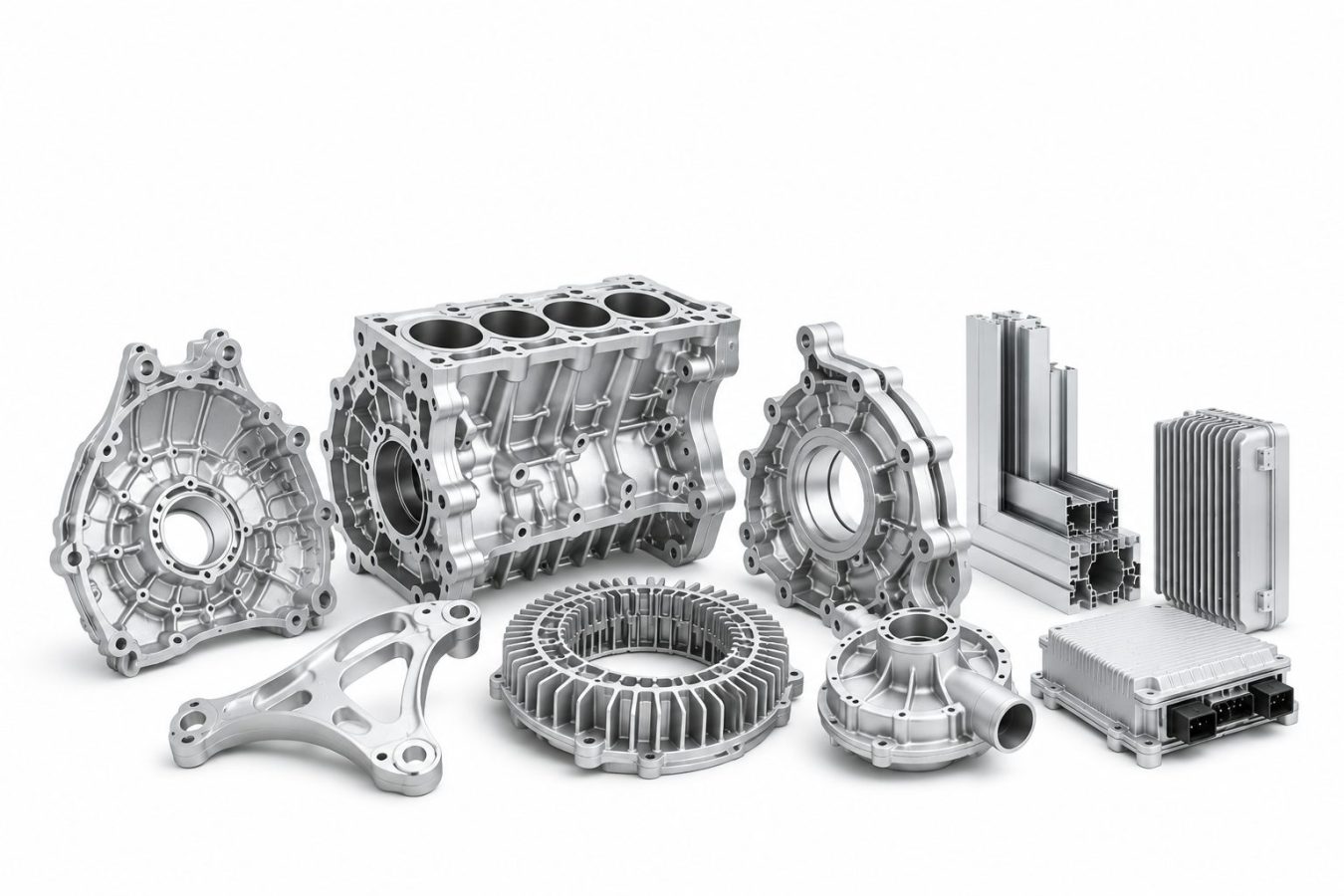
Across various end-use sectors like automotive, construction, electrical, electronics and industrial applications, aluminium casting is becoming increasingly important as economies accelerate electrification, infrastructure development and manufacturing expansion. The lion’s share is still held by automotive and transportation, but the latest regional consumption outlook points to faster growth across several non-automotive applications.
According to AL Circle’s report, “Global Aluminium Casting Market 2026-2032”, aluminium casting consumption is set for notable growth across major economies and end-user sectors. In the Rest of Asia-Pacific (ROAP), the consumption is projected to increase by 35.9% by 2030 and 53.4% by 2032 from 2025 levels, while the Middle East & Africa is expected to record a rise of 55.7% by 2030 and 56.6% by 2032.
Automotive remains the anchor for aluminium casting demand
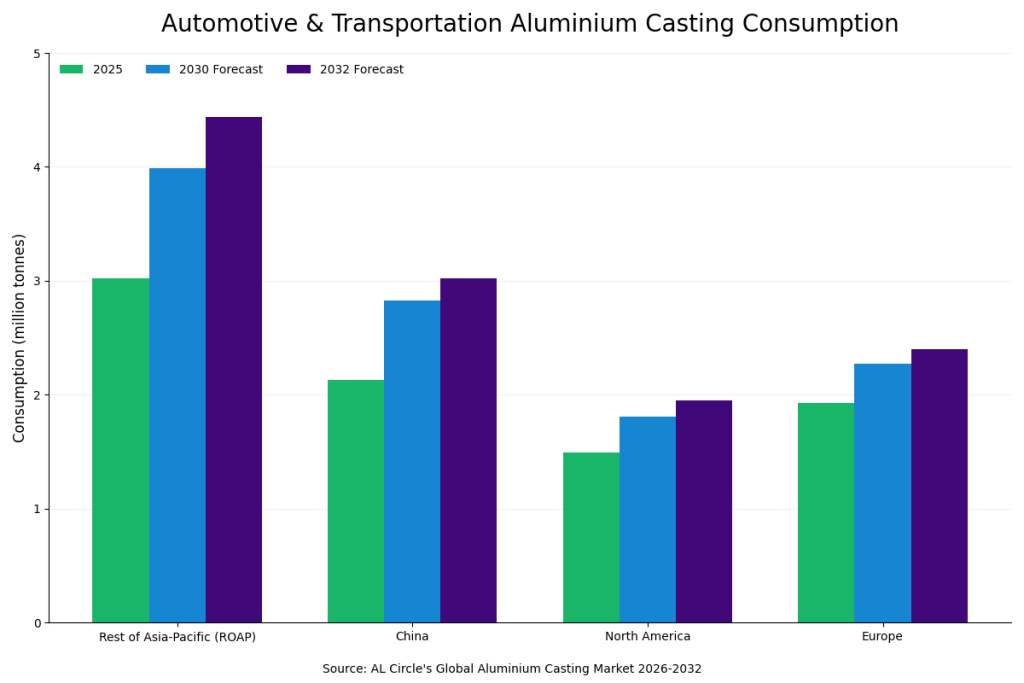
It has already been discussed that automotive and transportation account for the largest share of aluminium casting consumption. The sector benefits from vehicle lightweighting, electrification and the increasing use of cast aluminium in structural and powertrain-related applications.
Regionally, in the ROAP, the sector’s consumption stands at 3.02 million tonnes in 2025 and is projected to increase by 32.1% by 2030 and 47.0% by 2032. Followed by China, with casting consumption in 2025 standing at 2.13 million tonnes and expected to rise by 32.9% by 2030 and 41.8% by 2032.
After this come North America and Europe, with the casting demand projected to increase 21.5% by 2030 and 30.9% by 2032 from 2025, while Europe is expected to record growth of 17.6% and 24.4%, respectively.
Building & Construction gains momentum across regions
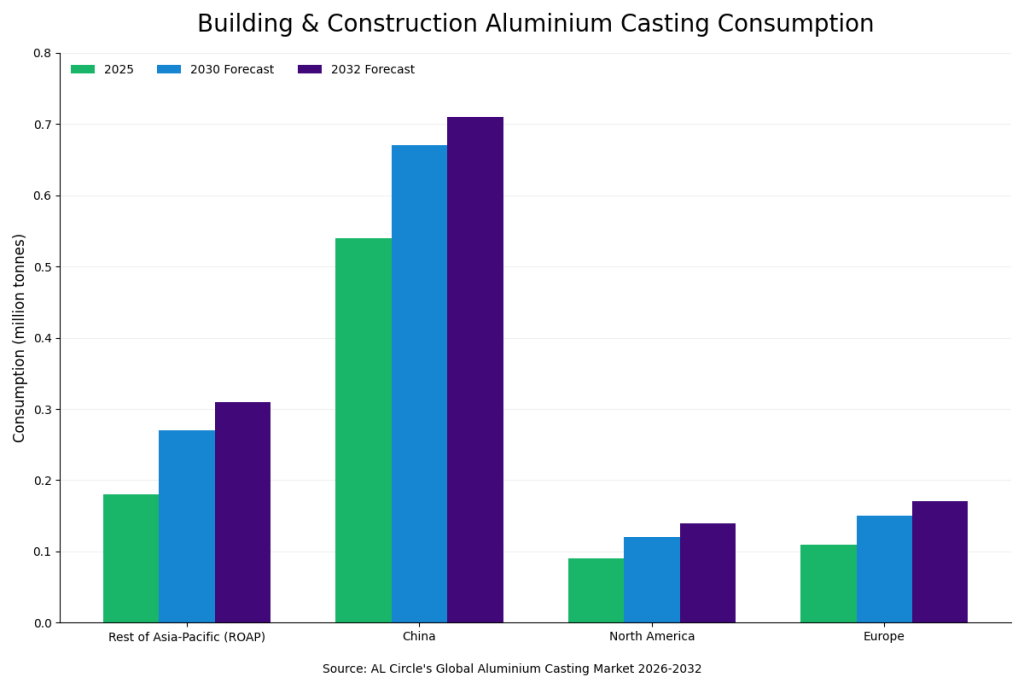
Building & Construction is emerging as an important contributor to aluminium casting consumption, supported by infrastructure development, renewable energy deployment, industrial facilities and transportation modernisation.
Regionally, in the ROAP, the sector’s consumption stands at 0.18 million tonnes in 2025 and is projected to increase by 50.0% by 2030 and 72.2% by 2032. China follows with consumption of 0.54 million tonnes in 2025, expected to rise by 24.1% by 2030 and 31.5% by 2032.
North America and Europe are also set for notable growth, with demand projected to increase by 33.3% and 55.6%, respectively, in North America, and 36.4% and 54.5% in Europe by 2030 and 2032 from 2025 levels.
Electrical & Electronics demand accelerates with industrial expansion
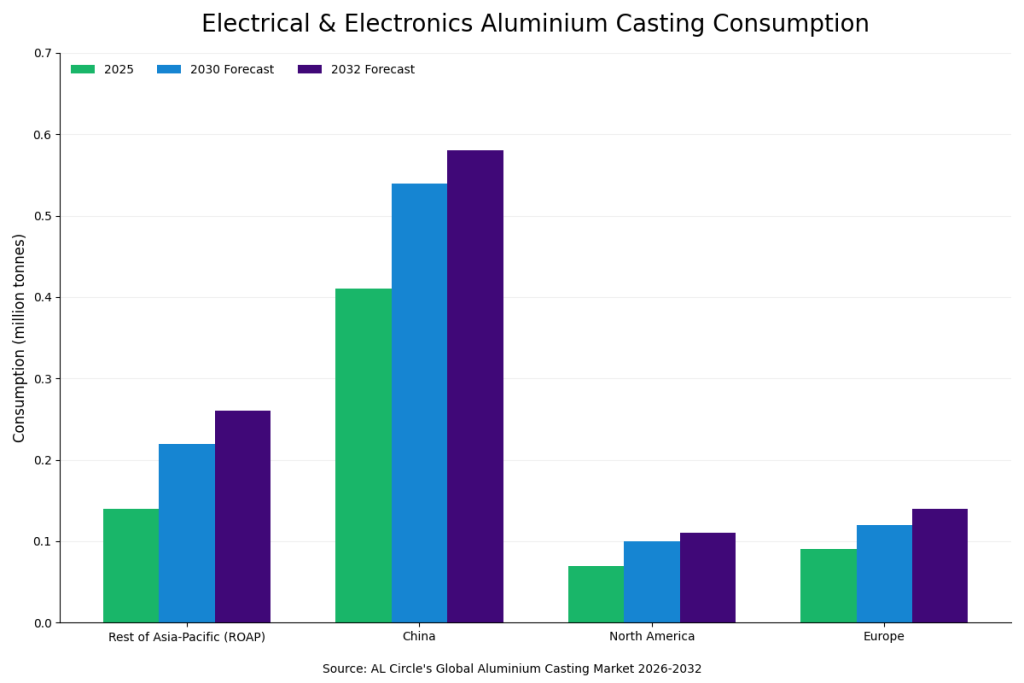
Electrical & Electronics is another key end-use sector contributing to the growth of aluminium casting consumption, with demand increasing across major regional markets. In the ROAP, consumption stood at 0.14 million tonnes in 2025 and is expected to grow by 57.1% by 2030 and 85.7% by 2032.
China recorded consumption of 0.41 million tonnes in 2025, with the sector projected to expand by 31.7% by 2030 and 41.5% by 2032. North America is expected to see growth of 42.9% by 2030 and 57.1% by 2032, while Europe is projected to record increases of 33.3% and 55.6%, respectively.
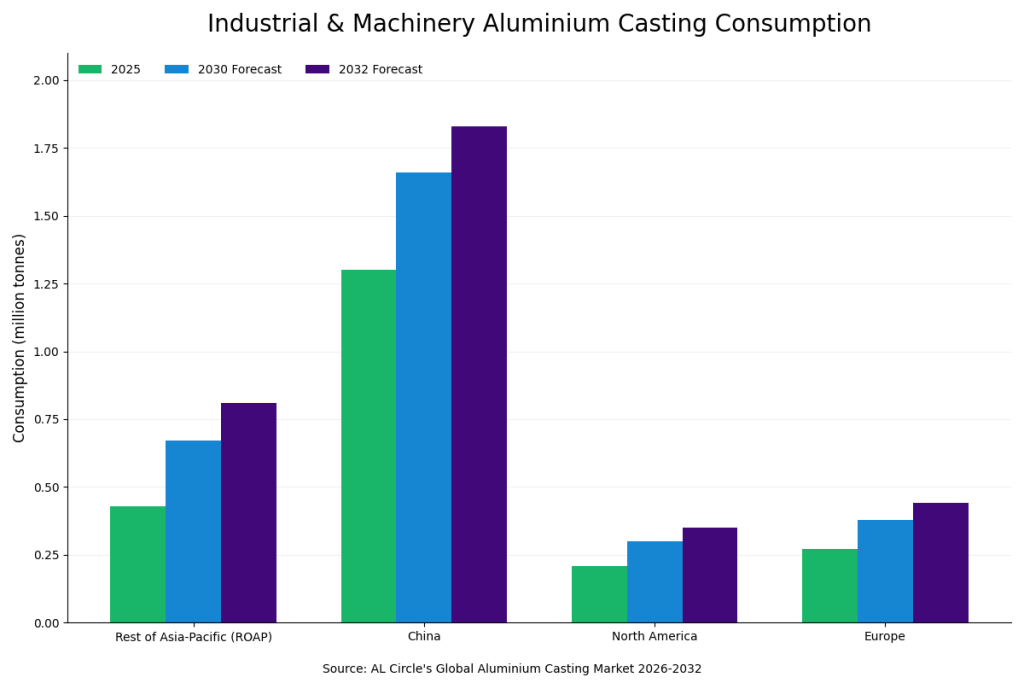
Industrial & Machinery emerges as a strong growth segment
Industrial & Machinery is showing particularly strong growth potential across the regional aluminium casting market. In the ROAP, consumption stood at 0.43 million tonnes in 2025, with demand projected to increase by 55.8% by 2030 and 88.4% by 2032.
China, which recorded 1.30 million tonnes in 2025, is expected to see consumption rise by 27.7% by 2030 and 40.8% by 2032. North America and Europe are set to record stronger growth rates, with Industrial & Machinery casting demand projected to increase by 42.9% and 66.7% in North America and 40.7% and 63.0% in Europe by 2030 and 2032, respectively.
Other applications continue to add to aluminium casting demand
Beyond the major end-use segments, other applications also contribute significantly to regional aluminium casting consumption. The ROAP recorded 0.63 million tonnes in 2025, with consumption expected to increase by 31.7% by 2030 and 47.6% by 2032.
China remains the largest market, with consumption of 1.90 million tonnes in 2025, projected to grow by 7.9% by 2030 and 11.1% by 2032. North America and Europe are expected to see more moderate increases, with demand rising by 22.6% and 32.3% in North America and 17.5% and 25.0% in Europe by 2030 and 2032, respectively.
Overall, the regional data shows that while automotive & transportation remains the dominant end-use sector, the growth trajectory of industrial & machinery, electrical & electronics and building & construction is strengthening the broader demand base for aluminium casting across major markets.
Conclusion
Aluminium casting demand is becoming increasingly diversified, with automotive & transportation remaining the dominant end-use sector while industrial & machinery, electrical & electronics, and building & construction emerge as strong growth areas. Regional trends also point to expanding opportunities across major economies as electrification, infrastructure development and industrial investment accelerate.
AL Circle’s report “Global Aluminium Casting Market 2026-2032” offers deeper insights into consumption trends, helping businesses assess emerging demand pockets, identify high-growth end-use sectors and make informed decisions on market opportunities.

 Voyagerman Technology


