您想继续阅读英文文章还
是切换到中文?
是切换到中文?

THINK ALUMINIUM THINK AL CIRCLE

https://news.metal.com/newscontent/103865440-Unwrought-Aluminum-Alloy-Imports-Declined-in-Q1-While-Exports-Increased-SMM-Analysis
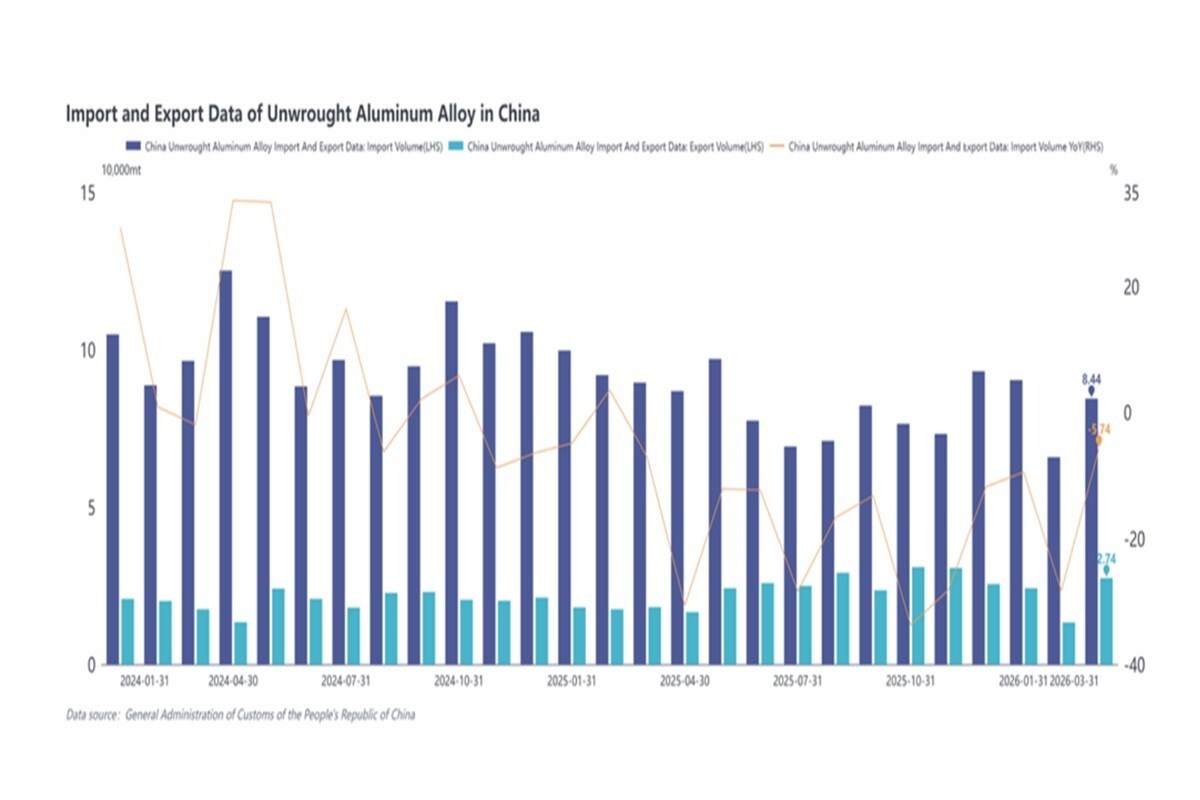
The General Administration of Customs released import and export data for March 2026 today. Customs data showed: Imports of unwrought aluminium alloy in March 2026 were 84,400 tonnes, down 5.7 per cent y-o-y and up 28.2 per cent M-o-M. Cumulative imports from January to March 2026 were 240,500 tonnes, down 14.4 per cent y-o-y.
{alcircleadd}Exports of unwrought aluminium alloy in March 2026 were 27,400 tonnes, up 50.8 per cent y-o-y and up 106.3 per cent M-o-M. Cumulative exports from January to March 2026 were 64,900 tonnes, up 20.7 per cent y-o-y.
Import source structure, the concentration of import origins for unwrought aluminium alloy in China remained relatively high in Q1 2026, with the top five sources accounting for approximately 76 per cent combined. Among them, Malaysia continued to rank first with imports of 64,400 tonne (27 per cent); Russia ranked second (47,500 tonne, 20 per cent); Thailand ranked third (40,400 tonne, 17 per cent); Vietnam and South Korea ranked fourth and fifth, with imports of 18,900 tonne (8 per cent) and 11,900 tonne (5 per cent), respectively.
Export destination structure, China's unwrought aluminium alloy exports in Q1 also exhibited a concentrated pattern. The top three export markets were Japan (32,900 tonnes, 51 per cent), India (8,000 tonnes, 12 per cent), and Mexico (4,500 tonnes, 7 per cent), while the remaining markets collectively accounted for approximately 30 per cent, indicating a relatively stable overall export structure.
Trade mode, processing trade continued to dominate, with processing trade with supplied materials accounting for 41 per cent and processing trade with imported materials accounting for 24 per cent, together exceeding 60 per cent of the total.
Overall, China's unwrought aluminium alloy continued the pattern of "shrinking imports and strengthening exports" that began in 2025 throughout Q1 2026. On the import side, disrupted by the Chinese New Year holiday, imports in February pulled back to below 70,000 tonnes; after the holiday, as enterprises resumed work and production, imports quickly recovered to above 80,000 tonnes in March. Considering that the import window had remained open for an extended period earlier and orders were arriving at ports in a concentrated manner, imports in April are expected to remain at around 80,000 tonnes.
However, it should be noted that since March, geopolitical conflicts in the Middle East have significantly strengthened expectations of global aluminium supply tightening, driving LME aluminium prices to rise rapidly, while overseas aluminium alloy ingot prices also increased in tandem. In particular, regions such as Japan and South Korea experienced localised supply tightening due to transportation disruptions, with aluminium alloy ingot prices continuing to climb, pushing ADC12 export quotes from Southeast Asia (such as Malaysia and Thailand) up to the USD 3,330–USD 3,400 per tonne range. As a result, the price spread between domestic and overseas markets remained inverted, with the theoretical loss on importing ADC12 into China currently exceeding RMB 2,000 per tonne, and the import window has closed.
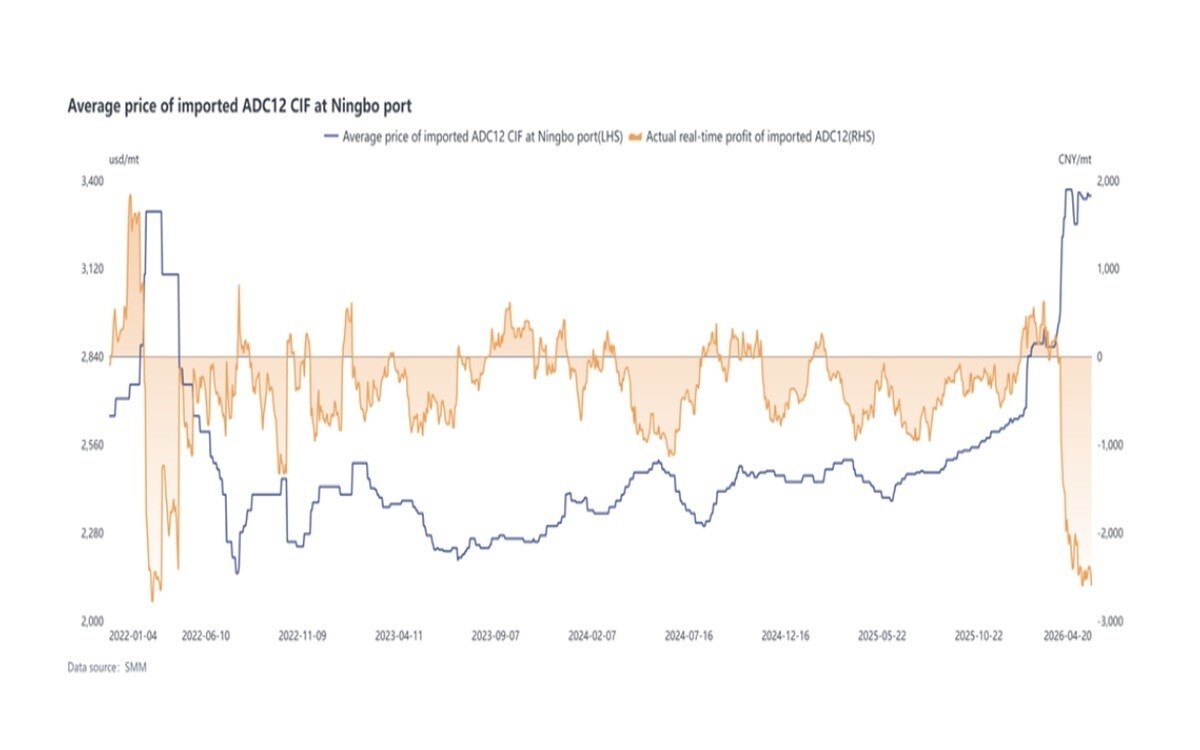
Against this backdrop, China's aluminium alloy ingot imports are expected to pull back notably from May onward. On the export side, the strong momentum continues, with sustained demand growth in markets outside China such as Japan, South Korea and India. High overseas market prices provide effective support, and combined with relatively ample domestic supply, the cost-effectiveness of China's aluminium alloy exports continues to improve, with export volumes expected to sustain a growth trajectory going forward.
Note: This article has been issued by SMM and has been published by AL Circle with its original information without any modifications or edits to the core subject/data.

Responses







_0_0.jpg/500/0)