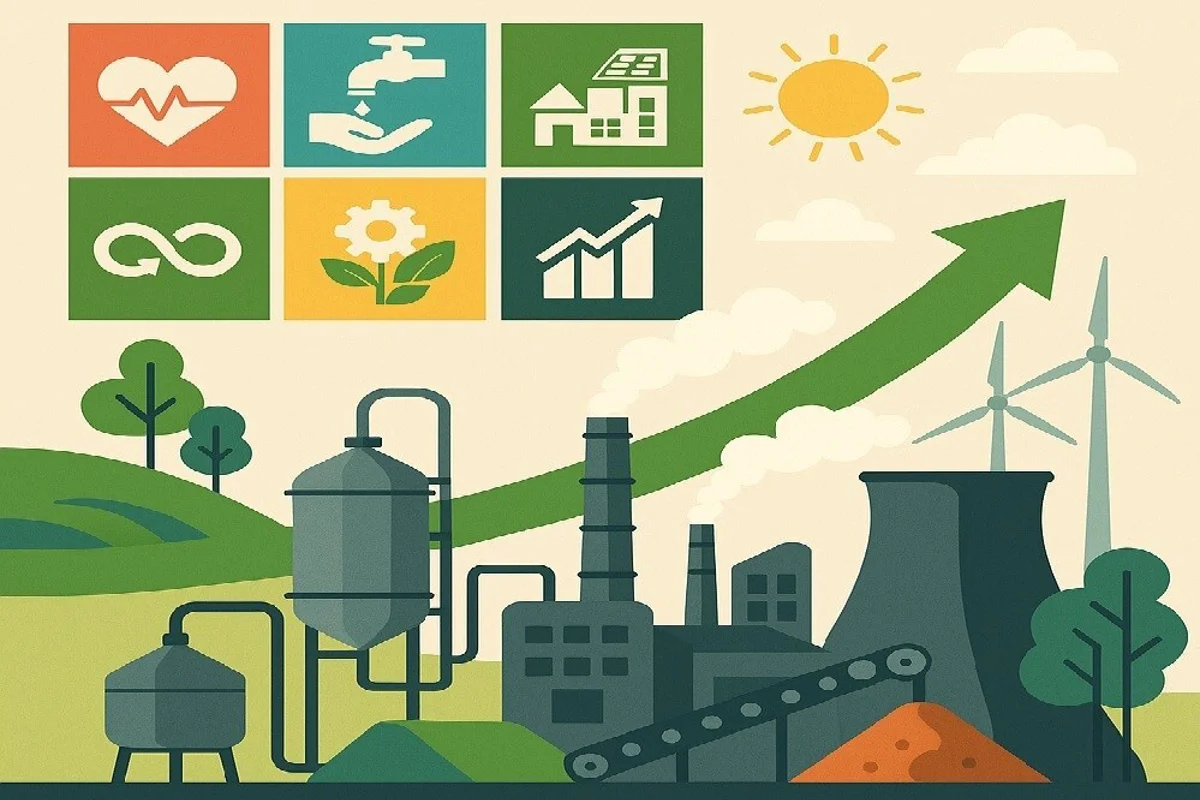
The updated ILTD (UILTD) process and the Sustainable Development Goals (SDGs). The 17 SDGs were adopted at the UN Sustainable Development Summit in New York in September 2015. “United Nations, 2015” Since that time numerous conferences, and publications were organised and prepared most of them connected with the 2030 Agenda for Sustainable Development. The UILTD Process comprises significant improvements in processing efficiencies and cost reductions, with the major focus on sustainability and alignment 6 SDGs. This paper presents significant potential, especially within materials science, industrial ecology and environmental engineering.
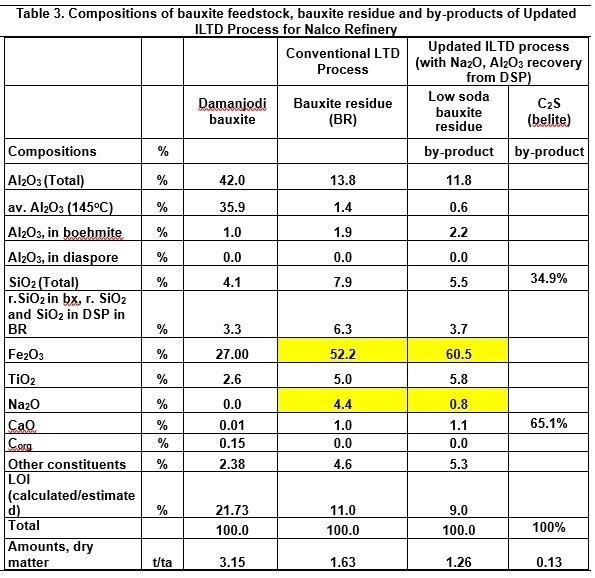
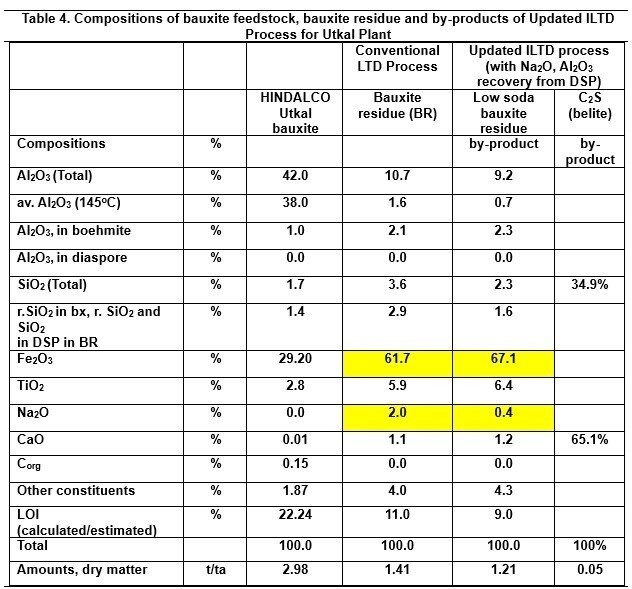
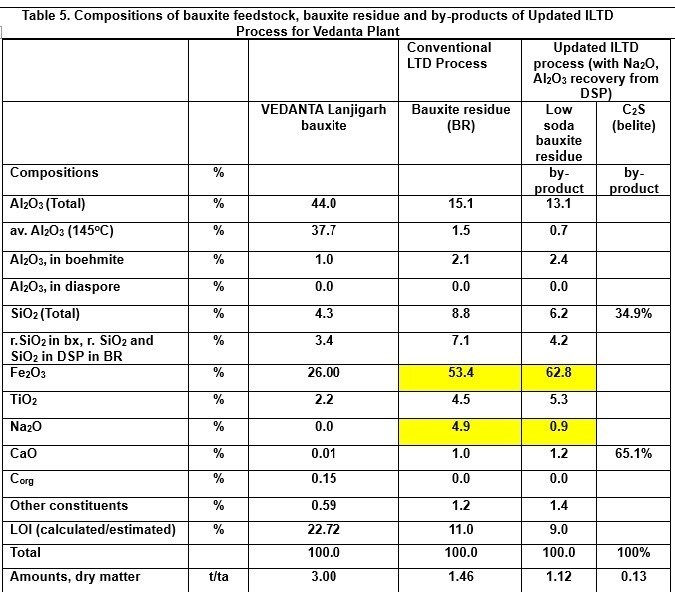
The amount and composition of the bauxite feedstocks, the bauxite residues, the same for the dicalcium-silicate (C2S, belite) by-products were calculated and presented for Conventional Low Temperature Digestion (CLTD) and compared with the Updated ILTD Process. The calculation results are shown in Table 3 to 5 for the NALCO Damanjodi, Hindalco Utkal and Vedanta Lanjigarh alumina refineries, respectively.
Commercialisation of the updated ILTD proces
Status of the updated ILTD process
A largely equivalent solution with the ILTD digestion step operated in the Sumitomo Ehime refinery in Japan for 7 years „Ogava et al. (2005)”. These processes are commonly called as Differential Extraction Processes „Smith, P. (2009)”. The so-called Sumitomo New Bayer Process (SNBP) is reasonably considered to be a proof of concept of the ILTD Process „Harato, T. et al. (1996)”
The pressure decanter technology has been in operation in five alumina refineries „Doucet, J. et al. (2002)” (two in India, one in the USA, Australia and Japan).
The Hi-Bar (Hyperbaric) filters have been in operation in other industries at temperatures of up to 160 oC, and at one place for bauxite residue below the atmospheric boiling point in Indonesia „Bott, R. and Langeloh, T. (2015)”.
The sintering-leaching process has been in operation for several decades in about 12 plants in Russia, China and Slovakia for processing nepheline or low-quality bauxites “Sine Bøgh Skaarup et al. (2013)”.
The seeded pressure desilication has been operated in the same plants.
Therefore, all the unit operations of the UILTD Process that are different from the CLTD have been in operation on commercial scale in some or other alumina refineries.
A summary of the status of the updated ILTD process
The status of the Updated ILTD Process concept is summarized here.
- Economic viability: proven
- All major steps feasible on a commercial scale: proven
- Process concept: ready for commercialization
- Pilot scale demonstration: this is required before the commercialization.
Some fine-tuning and optimisation of the separation of bauxite residue and the seeded liquor desilication unit operation would be required in the course of the suggested pilot scale implementation. Having completed the pilot scale demonstration of the Updated ILTD Process, the commercialization can take place with the shortest possible time with maximum confidence.
The Updated Improved Low Temperature Digestion (UILTD) Process is a novel way to increase the economic and environmental effectiveness of the alumina production. The UILTD Process makes possible to extend processing of bauxites to subeconomical ore and even to aluminious laterites. Paradoxically the shortest Return of Investment (ROI) was found to be 1.3 years in an earlier Case Study for an Eastern Ghats aluminous laterite whilst 1.9, 2.5 and 3.0 years for three alumina refineries located at the Eastern part of India. The coverage, i.e. difference of the selling price and the Cost of Production has been found higher by 30, 64 and 77 per cents for the UILTD Process depending on the quality of the bauxite feedstock.
It is well proven that with the increasing reactive silica content in the bauxite, this process will be more effective and economical compared to the Conventional Low Temperature Digestion alumina refineries.
All the unit operations of the UILTD Process that are different from the CLTD have been in operation on commercial scale in some or other alumina refineries. In order to achieve the maximum confidence and the shortest implementation time, the pilot scale demonstration is required.
It is suggested to have a pilot plant to demonstrate this UILTD technology for the low temperature alumina refineries of India.
Bánvölgyi, G., 2024, April. Updated Improved Low Temperature Digestion (ILTD) process in the face of the sustainable development goals. In Proceedings of Alumina 2024, the 12th AQW Conference (paper #45)
Bott, R. and Langeloh, T., 2015. Process options for the filtration and washing of bauxite residue. In Bauxite Residue Valorization Conference, Leuven (pp. 62-70).
Doucet, J., Hendriks, C., Patz, E., Forté, G., Kumar, S., Paradis, R. and Puxley, D., 2002, September. Pressure decantation technology: the Kaiser Gramercy experience. In Proc. of the Sixth Int. Alumina Quality Workshop, 8-13 September, 2002, Brisbane, Australia (pp. 94-99).
Harato, T., 1996. The Development of a New Bayer Process that Reduces the Desilication Loss of Soda by 50% Compared to the Conventional Process. In Fourth Int. Quality Workshop, Darwin, Australia, 2-7 June, 1996, (pp. 311-320)
Ogava, T., Nishimura, A., Sasaki, H. and Ishida, T.H., 2005, October. Effect of acid cleaning using inhibitor in a tubular digestion and in a vapour recompressor evaporator at Sumitomo’s Alumina Refinery. In Proceedings of the 7th International Alumina Quality Workshop, 17-20 October, 2005, Perth, WA (pp. 41-45)
Skaarup, S.B., Gordeev, Y.A., Volkov, V.V. and Sizyakov, V.M., 2014. Dry sintering of nepheline—a new more energy efficient technology. In Light Metals 2014 (pp. 111-116).
Smith, P., 2009. The processing of high silica bauxites—review of existing and potential processes. Hydrometallurgy, 98(1-2), pp.162-176.
United Nations, 2015. Sustainable development goals [online].
To learn exclusive industry data, download our reports here
This article is credited to György Bánvölgyi, Senior Process Consultant, and Dr. Ashok Nandi, President of the International Bauxite, Alumina & Aluminium Society (IBAAS).