Vedanta Aluminium opens post-demerger chapter with 205% profit surge and record 632 KT output
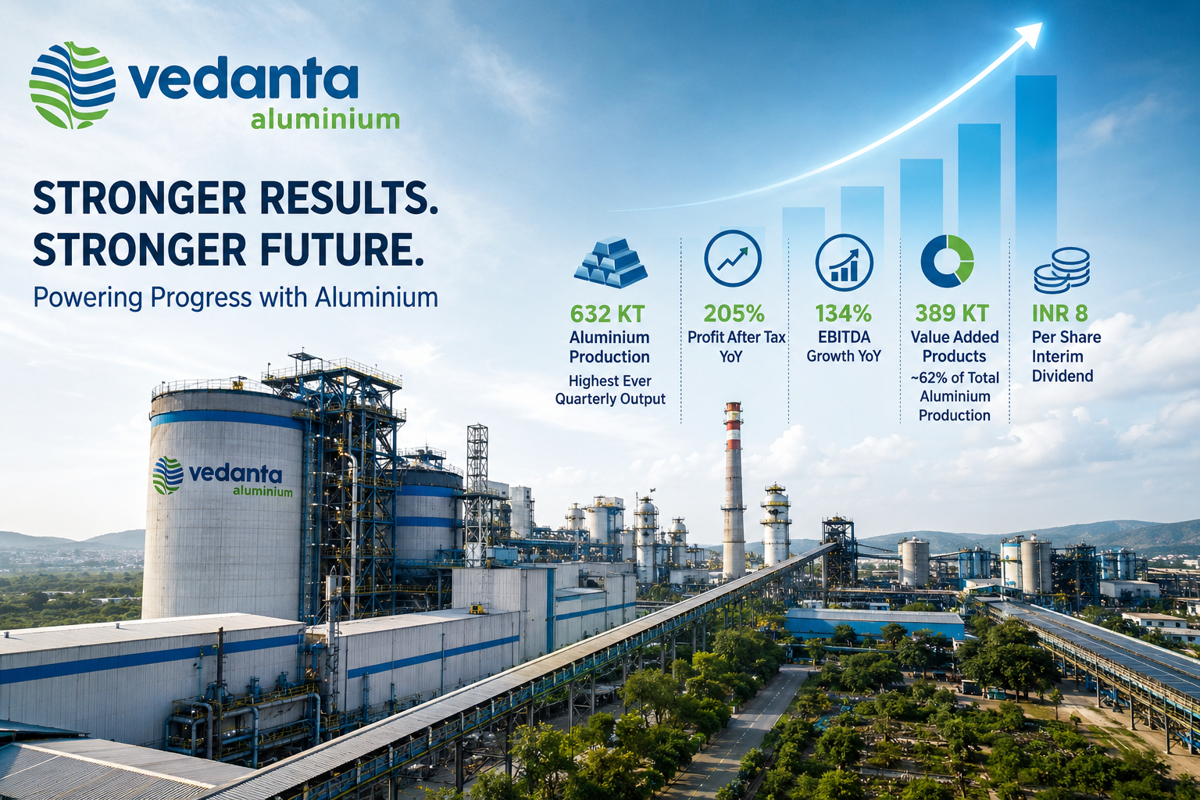
The image used in this article is generated with an AI tool and does not depict any real-time moment
Vedanta Aluminium Metal Limited has opened its first full reporting chapter as an independent listed aluminium producer with record production and sharply higher earnings. For the quarter ended June 30, 2026 (Q1 FY27), the company reported profit after tax (PAT) of INR 65.97 billion, up 205 per cent year-on-year and 33 per cent sequentially, alongside its highest-ever quarterly aluminium production.
The numbers put both scale and profitability at the centre of Vedanta Aluminium’s post-demerger story. Revenue climbed 45 per cent year-on-year and 13 per cent quarter-on-quarter, supported by higher volumes and improved realisations.
EBITDA more than doubled from the year-ago period, surging 134 per cent. Compared with Q4 FY26, EBITDA increased 24 per cent. The company’s EBITDA margin consequently expanded to a record 50 per cent.
The results come shortly after Vedanta Aluminium Metal Limited began trading independently following the restructuring of Vedanta Limited, giving investors direct exposure to the group’s aluminium business.
To know the production, demand and consumption forecasts on bauxite and alumina, explore the report "Global Bauxite & Alumina Market Forecast to 2036: Supply–Demand, Trade Flows & Price Outlook"
Production records add operational weight to the earnings jump
The financial performance was accompanied by new production highs across the aluminium portfolio.
Vedanta Aluminium produced 632,000 tonnes of aluminium during Q1 FY27, its highest quarterly output to date. This compares with around 605,000 tonnes in Q1 FY26, representing year-on-year growth of approximately 5 per cent.
More importantly for the company’s downstream and margin strategy, value-added product (VAP) production reached a record 389,000 tonnes during the quarter.
That means value-added products accounted for roughly 62 per cent of quarterly aluminium production, based on the reported production figures. The growing contribution of VAPs is significant because these products generally serve more specialised applications across industries such as automotive, electrical, renewable energy, infrastructure, packaging and advanced manufacturing.
The upstream side of Vedanta Aluminium’s integrated chain also expanded considerably.
Alumina production increased 41 per cent year-on-year to 826,000 tonnes in Q1 FY27, backed by expanded refining capacity and improved asset utilisation. Higher captive alumina availability is particularly relevant for an integrated aluminium producer because alumina represents a critical raw-material input for primary aluminium smelting.
The combination of higher alumina production, record metal output and rising value-added production therefore indicates that the company’s Q1 performance was not confined to stronger aluminium prices or realisations alone; operational volumes also moved higher.
Explore primary aluminium suppliers, product listings and trade opportunities on AL Biz
The quarter also unfolded against a supportive aluminium pricing environment. Reuters reported that elevated aluminium prices contributed to the sharp improvement in Vedanta Aluminium’s quarterly earnings.
The company itself attributed its record revenue to the combination of higher volumes and improved realisations.
Balance sheet strengthens as leverage drops to 0.9x
The quarter was not only about production and earnings.
Vedanta Aluminium’s Net Debt-to-EBITDA ratio improved to 0.9x, compared with 1.3x in the previous quarter, giving the newly independent company a stronger balance-sheet position as it pursues its next phase of expansion.
Credit rating agencies CRISIL and ICRA have also upgraded the company’s credit rating to AA+ with a Stable outlook.
The improvement follows the broader restructuring of Vedanta’s businesses. The demerger became effective on May 1, 2026, creating independent sector-focused entities spanning aluminium, power, oil & gas and iron & steel alongside the residual Vedanta Limited business.
Eligible Vedanta shareholders received one equity share of Vedanta Aluminium Metal Limited for every Vedanta share held on the record date. The aluminium company subsequently began independent trading in June.
The restructuring was designed to provide each business with greater operational and strategic independence, while allowing investors to assess the individual businesses separately rather than through Vedanta’s previous conglomerate structure.
Unlock key insights from leading companies and experts across the aluminium ecosystem with our Mine to Market e-Magazine
Vedanta Aluminium declares INR 8 per share interim dividend
Alongside the Q1 results, Vedanta Aluminium’s Board approved the company’s first interim dividend of INR 8 per equity share.
According to the company, this takes the cumulative dividend payout for the quarter to more than INR 30 billion.
The payout arrives unusually early in Vedanta Aluminium’s life as an independently listed company and coincides with the sharp improvement in profitability and leverage recorded during the quarter.
Rajesh Kumar, Whole-Time Director & CEO of Vedanta Aluminium Metal Limited, said, “Our first quarter as an independent company reflects disciplined execution, operational resilience and a clear long-term strategy. Our focus on resource security, integrated operations and value-added products continues to strengthen our competitive position and support sustainable growth.”
Chief Financial Officer Anup Agarwal added, “We begin this new phase with record financial performance, a stronger balance sheet and an improved credit profile. These provide a solid foundation to pursue growth opportunities and meet rising global demand for aluminium across energy transition, infrastructure, transportation, packaging and advanced manufacturing.”
Why the 389 KT VAP figure deserves attention
For the aluminium industry, perhaps one of the more strategically important numbers within Vedanta Aluminium’s Q1 performance is the record of value-added product output.
Primary aluminium producers globally are increasingly looking beyond commodity metal volumes towards differentiated products capable of addressing specific requirements in automotive lightweighting, electrical applications, renewable-energy infrastructure, packaging and other advanced manufacturing sectors.
Vedanta Aluminium’s VAP production during Q1 FY27 was equivalent to about 61.6 per cent of its total aluminium output for the quarter. Maintaining and expanding this mix could become increasingly important as the company attempts to capture more value from every tonne of metal produced rather than relying solely on primary aluminium price movements.
At the same time, the 41 per cent rise in alumina output provides another piece of the integration equation. Greater internal alumina availability can strengthen raw-material security as the company scales aluminium production, although future margins will continue to be influenced by aluminium prices, raw-material and energy costs, operating performance and broader market conditions.
A strong first test for the standalone aluminium business
Vedanta Aluminium’s first quarterly scorecard following the demerger has therefore delivered several records simultaneously: INR 211.05 billion in revenue, INR 104.99 billion in EBITDA, INR 65.97 billion in PAT, record aluminium production and 389,000 tonnes of value-added product output.
For the global aluminium market, the operational numbers may ultimately matter as much as the earnings headline.
The company serves customers across more than 60 countries and operates an integrated aluminium and alumina portfolio. Its ability to increase alumina availability, raise primary metal production and move a larger proportion of that metal towards value-added applications will determine how effectively the newly independent company converts its scale into longer-term competitiveness.
Q1 FY27 has provided Vedanta Aluminium with a record-heavy start. The next question is whether the company can sustain that momentum as its standalone strategy moves from its first quarter into a full financial year.
NALCO Q1 revenue climbs 39% as higher aluminium prices lift PAT to ₹20.02b
Next articleSHFE aluminium opened lower but rebounded, though positions declined significantly; alumina continues to consolidate on a weak note
Grow with
AL Circle