Dollar strength weighs on base metals valuations, SHFE aluminium consolidates at lows with moving average resistance
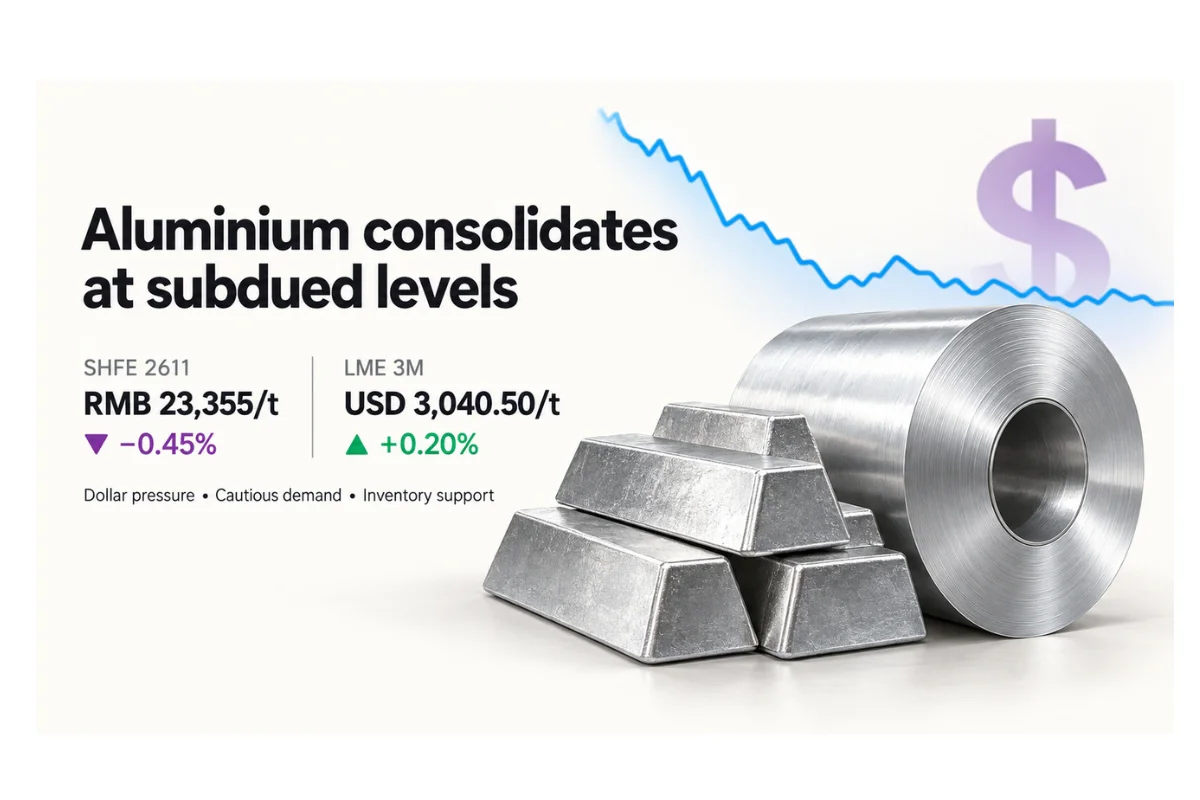
The image used in this article is generated with an AI tool and does not depict any real-time moment
Futures: The most-traded SHFE aluminium 2611 contract closed at RMB 23,355 per tonne, down RMB 105 or 0.45 per cent from yesterday's settlement price. It opened at RMB 23,300.00 per tonne during the day and fluctuated within a range of RMB 23,300-23,400 per tonne. Trading volume was 41,990 lots, and open interest was 240,121 lots, down 826 lots on the day. During the consolidation at lows, both bulls and bears reduced positions slightly. Prices ran below the MA5 (23,399.00), MA10 (23,720.00), MA30 (24,036.17), and MA60 (23,825.58), continuing the low-level consolidation and repair after drifting lower, with the moving averages above forming key resistance pressure. The MACD DIF (-167.5673) was below the DEA (-57.5398), and the MACD green bar stood at -220.0549. Bearish momentum remained relatively strong. The suggested core trading range for SHFE aluminium is RMB 23,100-23,700 per tonne. The LME aluminium 3M contract closed at USD 3,040.50 per tonne, up 0.20 per cent. It opened at USD 3,031.00 per tonne during the day and fluctuated within a range of USD 3,031.00-3,041.00 per tonne. Prices ran below the MA5 (3,044.20), MA10 (3,082.80), MA30 (3,209.38), and MA60 (3,221.64), showing a slight low-level repair after continued declines. A low-level weak consolidation structure emerged, with the moving averages above forming clear resistance. The MACD DIF (-58.0074) was below the DEA (-43.2079), and the MACD green bar was -29.5991. Bearish momentum still held the upper hand. The suggested core trading range for LME aluminium is USD 2,900-3,150 per tonne.
Macro front: Fed's Williams said one more rate hike this year is appropriate; he currently sees no need for rate hikes in 2027. There are no signs that the labour market is driving inflation, and apart from AI and the energy sector, he does not see widespread price pressures in other areas. Fed's Collins said the future path of monetary policy will depend on data, and she expects the Fed to raise rates further before the end of the year; she expects inflation to gradually decline to 2 per cent; data center construction is putting pressure on inflation data. US President Trump said a decision on Iran will be made soon. Trump accused Yemen's Houthi forces of striking Saudi Arabia by "very vicious" means and likely deliberately pushing up oil prices ahead of the US midterm elections. Trump said he has spoken with Saudi Crown Prince and Prime Minister Mohammed and may ask Turkey to participate in actions against Yemen's Houthi forces. The Houthis called Saudi Aramco facilities "legitimate targets" and warned that if the US joins Saudi Arabia's military operations against the Houthis, they will respond "swiftly and painfully" against the US and its interests in the region.
Fundamentals: Low inventory is the core support for aluminium prices, with LME aluminium inventory falling to 241,000 tonnes at end-September. On the supply side, production resumptions in the Middle East and production ramp-up at new projects in Indonesia, Vietnam, and India pushed daily average production higher. On the demand side, the September-October peak season lifted the comprehensive operating rate MoM, but processing fees for some processed products came under pressure, leading to production cuts and halts, with the proportion of liquid aluminium falling to 78.2 per cent. In terms of domestic aluminium ingot social inventory, as of Monday this week, China's aluminium ingot social inventory stood at 651,000 tonnes, destocking by 35,000 tonnes from last Thursday and building up by 13,000 tonnes from pre-holiday levels, with aluminium destocking resuming.
Primary aluminium market: In east China, SHFE aluminium's center fell again yesterday, and as futures declined, downstream buying sentiment improved. The market began quoting spot prices against the SHFE aluminium 2611 contract. At the open, spot prices were at a premium of RMB 200-220 per tonne against the SHFE aluminium 2611 contract, with the price spread between futures contracts in backwardation of RMB 160-180 per tonne at the time. As the spread continued to widen to above RMB 200 per tonne, spot prices against the SHFE aluminium 2611 contract rose to a premium of RMB 240-260 per tonne. In central China, the price spread between SHFE aluminium November contract futures was significant, with spot premiums against futures surging. Yesterday, suppliers in central China showed slightly higher selling sentiment than the previous day, but sentiment to hold prices firm was not strong. Downstream processing enterprises showed mediocre buying sentiment, mainly making just-in-time procurement with notable push for lower prices. Ultimately, actual transaction prices in central China were around a discount to premium of RMB 110-130 per tonne against the SHFE aluminium November contract. In south China, aluminium prices fell sharply yesterday, and the spot market was weak. Long and short funds battled fiercely in futures, with the backwardation structure in SHFE aluminium fully opening up. Even with early contract rollover, the basis for the next month and further months remained extremely high. There was a general intention to sell and cash out first, though at different paces, with mainstream quotes in the discount to parity range and actual circulating discounts in the majority. Buying on dips proceeded steadily to replenish stocks, but apart from just-in-time procurement for delivery obligations, it was difficult to act given the futures spread structure, and transactions were poor.
Aluminium scrap: Yesterday, SMM A00 aluminium price closed at RMB 23,710 per tonne, down RMB 100 per tonne from the previous trading day. Price performance diverged across aluminium scrap categories, with baled UBC down RMB 50 per tonne yesterday and aluminium tense scrap prices down RMB 100 per tonne. In terms of price differences, the price difference between A00 aluminium and mixed aluminium extrusion scrap free of paint in Foshan was about RMB 2,433 per tonne, and the price difference between A00 aluminium and shredded aluminium tense scrap was about RMB 1,101 per tonne. By mid-October, the aluminium scrap market continued to hold up well. On the supply side, aluminium scrap yards have all briefly resumed operations, with some increase in material release, but recycling policies still constrain circulation. Invoice quota limitations are widespread, and the tight invoice supply situation is unlikely to change in the short term, with tight supply continuing to support prices. Demand side, as the traditional peak season for cast aluminium alloy consumption gradually kicks off, enterprises are accelerating their order-taking and procurement pace. Under the tight supply-demand situation for aluminium tense scrap, price support strength is expected to move to a higher level. Demand for wrought aluminium alloy is moderate, and in-factory inventory is relatively sufficient. However, with tax inspection restrictions reducing the expected supply of aluminium scrap, the price uptrend channel will also gradually open up.
Secondary aluminium alloy: Futures: Yesterday, the most-traded AD2612 cast aluminium alloy contract opened at RMB 23,100 per tonne. After briefly shooting up to a daily high of RMB 23,110 per tonne in early trading, it weakened step by step, dipping to a low of RMB 22,880 per tonne in the morning session, then consolidating and rebounding. It closed at RMB 23,045 per tonne at midday, down RMB 285 per tonne or 1.22 per cent from the previous settlement price of RMB 23,330 per tonne. Spot: Yesterday, the ADC12 market was mainly stable with a wait-and-see sentiment. The SMM ADC12 price remained flat from the previous day at RMB 24,500 per tonne, showing some resilience in market prices. Cost side, aluminium scrap raw material prices remained relatively firm, and tax invoice factors continued to affect compliant raw material supply. Enterprise production costs and procurement pressure persisted, providing strong support for ADC12 prices and limiting the downside for spot prices. However, demand-side improvement was limited, with the traditional September-October peak season underperforming expectations. Downstream procurement enthusiasm was insufficient, and upward price momentum was also weak. In the short term, prices are expected to continue consolidating, with attention needed on aluminium price trends, changes in compliant raw material supply, and downstream order improvements.
Comprehensive outlook: Macro dimension, the US dollar remains at elevated levels, and expectations for US Fed interest rate hikes within the year persist, continuing to weigh on valuations in the nonferrous metals sector. Industry dimension, the actual improvement in demand during China's traditional peak season has not fully met earlier expectations. In a high-price environment, downstream procurement has turned more cautious, weakening price support. China's aluminium ingot social inventory has resumed destocking, providing some price support. Overall, bullish and bearish factors are intertwined for aluminium prices in the short term, and prices are expected to maintain a rangebound consolidation on a subdued note in the near term.
Note: This article has been shared by SMM and has been published by AL Circle with its original information without any modifications or edits to the core subject/data.
Grow with
AL Circle