US monthly aluminium scrap imports from Canada plunge by 3.93% in April 2022
Aluminium is a highly durable metal that can be recycled repeatedly without losing any of its original value. Recycling aluminium conserves 95% of the energy required to produce the same quantity of aluminium from scratch. Compared to steel, the use of aluminium in multiple sectors is increasing rapidly. In response, companies are using aluminium packaging instead of conventional metal packaging.
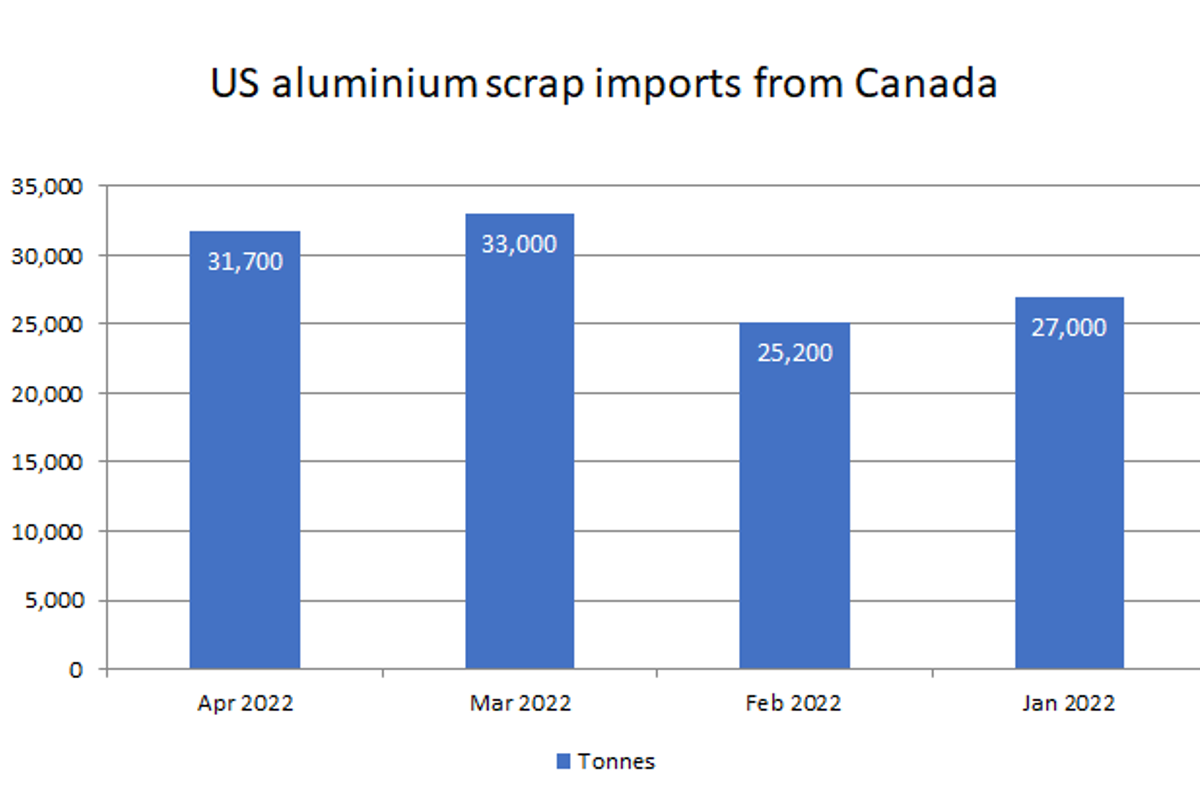
As per the latest USGS statistics, the United States imported 31,700 tonnes of aluminium scrap from Canada in April 2022, which tumbled down by 1,300 tonnes or 3.93 per cent M-o-M from 33,000 tonnes in March. On the other hand, in March, a M-o-M hike of 7,800 tonnes or 30.95 per cent was witnessed from 25,200 tonnes in February. In February, a major drop of 1,800 tonnes or 6.66 per cent was recorded from 27,000 tonnes in January 2022.
On a Y-o-Y calculation, a dropdown of 2,500 tonnes or 7.30 per cent was recorded in April 2022 from 34,200 tonnes in April 2021. In April 2022, the United States imported a total of 55,000 tonnes of aluminium scrap, which went on to decline by 2,800 tonnes or 4.84 per cent M-o-M from 57,800 tonnes in March 2022. However, in March, major growth of 11,600 tonnes or 25.10 per cent was recorded from 46,200 tonnes in February. In February, on the other hand, a dip of 500 tonnes or 1.07 per cent was witnessed, from 46,700 tonnes in January.

Recycling aluminium is therefore crucial to reducing the amount of rubbish that ends up in landfills. Primary aluminium manufacturing has a greater environmental effect than secondary aluminium production because of the high energy consumption and trash generation.
BMW calls for 'Secondary First' to achieve climate neutrality
Next articleCluj-Napoca lures public into plastic or aluminium waste collection in exchange of free bus tickets
Grow with
AL Circle