Researchers discover polymer based electrodes to boost the capacity of aluminium-air batteries
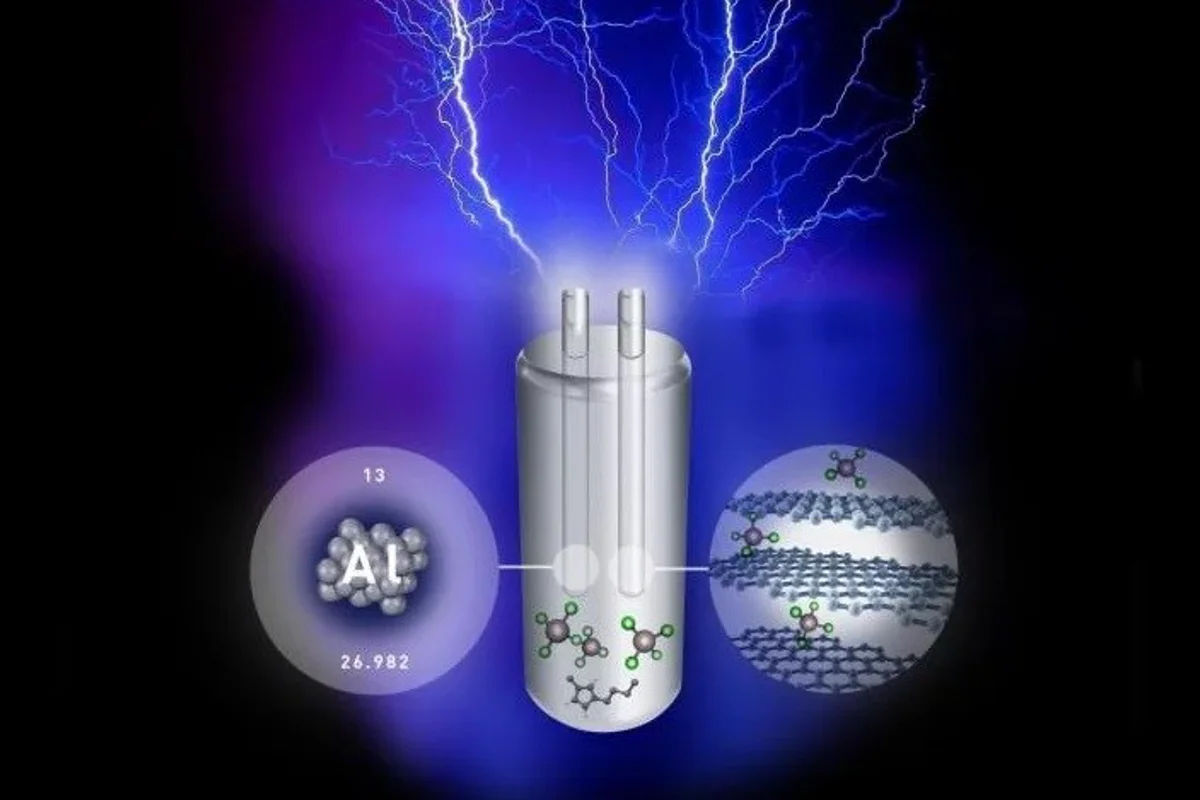
A team of researchers led by Prof. Dr Birgit Esser from the University of Ulm, along with Prof. Dr Ingo Krossing and Prof. Dr Anna Fischer from the University of Freiburg, has developed a positive electrode material made of an organic redox polymer based on phenothiazine. The material can be exclusively used in aluminium-ion batteries for breathtaking performances.
In their experiment, aluminium batteries with this material stored a record-breaking capacity of 167 milliampere hours per gram (mAh/g). This organic redox polymer outperforms graphite, which has been the primary electrode material in batteries so far. Their findings have been published in the journal Energy & Environmental Science.
During charging, the electrode material oxidizes and absorbs complex aluminate anions. The organic redox polymer poly(3-vinyl-N-methylphenothiazine) can reversibly insert two [AlCl4]− anions during charging. The researchers used the ionic liquid ethylmethylimidazolium chloride as an electrolyte with added aluminium chloride.
Research head Gauthier Studer, under whose supervision the mission has been accomplished, remarked: "The study of aluminium batteries is an exciting field of research with great potential for future energy storage systems."
"Our focus lies on developing new organic redox-active materials that exhibit high performance and reversible properties. By studying the redox properties of poly(3-vinyl-N-methylphenothiazine) in chloroaluminate-based ionic liquid, we have made a significant breakthrough by demonstrating for the first time a reversible two-electron redox process for a phenothiazine-based electrode material," he added.
Poly(3-vinyl-N-methylphenothiazine) can deposit the [AlCl4]− anions at potentials of 0.81 and 1.65 volts and provides specific capacities of up to 167 mAh/g. In comparison, the discharge capacity of graphite as an electrode material in aluminium batteries is 120 mAh/g. After 5,000 charge cycles, the battery developed by the research team still retained 88% of its capacity at 10 C, which means a charge and discharge rate of six minutes. At a lower C rate, the battery returned to its original capacities without any alteration.
Professor Birgit Esser exclaimed: "With its high discharge voltage and specific capacity, as well as its excellent capacity retention at fast C rates, the electrode material represents a major advance in the development of rechargeable aluminium batteries and thus of advanced and affordable energy storage solutions."

Aluminium-ion batteries are a potential replacement for traditional batteries that rely on rare and difficult-to-recycle materials like lithium. Aluminium is more common in the Earth's crust, easier to recycle, safer, and cheaper than lithium. However, developing these batteries is still in its early stages due to the lack of suitable electrode materials that can store enough energy.
Gautam Solar debuts N-type TOPCon solar modules featuring black aluminium alloy frame
Next articleBall’s aluminium can and bottle portfolio in display at BevNET Live Summer 2023
Grow with
AL Circle