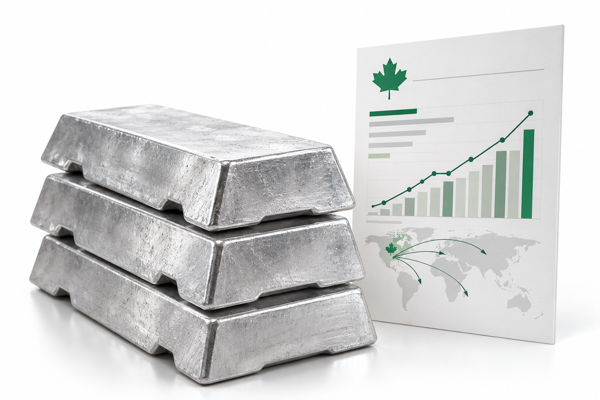
The Aluminum Association of Canada (AAC) welcomes the integration of country of smelt and cast reporting into Canada’s Aluminum Import Monitoring Program (AIM), effective October 1, 2026. This milestone strengthens transparency across aluminium supply chains and equips authorities with better information to monitor trade flows and identify potential circumvention. The new requirements build on Canada’s progressive development of its aluminium import monitoring framework: • September 1, 2019: Canada launched AIM under General Import Permit No. 83, following the Canada–US joint statement on steel and aluminium trade. • Summer 2024: Global Affairs Canada (GAC) consulted stakeholders on collecting and publishing country of smelt and cast information. • July 31, 2025: Under a separate trade...
Futures: SHFE aluminium closed at RMB 23,145 per tonne, edging down 0.19 per cent. Although prices held above MA5 (23,077) and MA10 (23,044), they remained capped by MA30 (23,760) and MA60 (23,767), with the overall market in a consolidation phase following the sharp decline. The MACD indicator's dual lines (DIF=-261.81, DEA=-237.16) operated below the zero axis, with the green bar expanding to -49.29, failing to extend the previous day's bottom divergence repair, indicating fading rebound momentum. Trading volume shrank to 54,800 lots, with market activity turning cautious. The suggested core trading range for SHFE aluminium is 22,700-23,500. LME aluminium closed at USD 3,008 per tonne, edging up 0.07 per cent. Prices barely held above MA5 (3,002.4) but remained pressured by MA10...
Grow with
AL Circle

The first half (H1) of 2026 witnessed a significant slide of nearly 2 per cent in Canada’s export chart of aluminium products. As of H1 2026, Canada’s exports of all aluminium product categories , viz., unwrought, bars, rods and profiles, foil, pipes and tubes, plates, sheets and strips, tube or pipe fittings, and wire, stood at 2.68 million tonnes. Comparing the H1 2026 trade volume with that over the past two years, the year-on-year gap appears to have widened: H1 2026 vs 2025 – 2.68 million tonnes vs 2.73 million tonnes, down 1.86 per cent Y-o-Y H1 2025 vs 2025 – 2.73 million tonnes vs 2.77 million tonnes, down 1.48 per cent Y-o-Y Comparing the annual export volumes, 2025 saw exports of 4.82 million tonnes, marking a Y-o-Y decline of 11.3 per cent from the export volume of 5.42 million...

The London Metal Exchange (LME) aluminium price reported major declines of over 1 per cent across the pricing and contract segments on the August 18 close, continuing the trend reported at the August 17 session . The LME aluminium cash bid dropped by 1.6 per cent day-on-day on August 18, down to USD 3,218.5 per tonne from USD 3,271 per tonne. The offer shifted to USD 3,219 per tonne from USD 3,272 per tonne, marking a difference of 1.62 per cent. Explore- Most comprehensive and forward-looking industry-focused report — Global Bauxite & Alumina Market Forecast to 2036: Supply–Demand, Trade Flows & Price Outlook On August 18, the LME aluminium three-month bid and contract prices contracted by 1.16 per cent. As the bid plunged to USD 3,232 per tonne from USD 3,270 per tonne, the offer price...

The future of Bell Bay Aluminium smelter in Tasmania remains dependent on the outcome of negotiations over its electricity supply agreement. Federal Industry Minister of Australia Tim Ayres has stopped short of committing federal funding similar to the support extended to the Tomago aluminium smelter in New South Wales. While Canberra has acknowledged the strategic importance of Bell Bay and its employment base, Ayres has stressed that the immediate priority is securing a commercially sustainable power agreement between Hydro Tasmania and Rio Tinto. To know the production, demand and consumption forecasts on bauxite and alumina, explore the report “ Global Bauxite & Alumina Market Forecast to 2036: Supply–Demand, Trade Flows & Price Outlook ” Bell Bay faces a different challenge from...

China is helping cushion Western aluminium markets after production losses in the Gulf caused by the Iran conflict. Yet the export surge could come with a longer-term cost: more aluminium processing activity may shift from Western manufacturers to Chinese producers. China, the world’s largest aluminium producer, has increased exports of primary metal, alloy and semi-finished aluminium products as Western supply chains adjust to reduced Gulf output. The additional material has helped reduce the market’s immediate supply stress. Alloy and semis drive exports China’s export pattern is strongly shaped by its tax system. Primary aluminium exports face a 30 per cent tax, while aluminium alloy and semi-finished products, known as semis, can be exported at a zero tax rate. As a result, much of...

A women’s shelter in New South Wales has reportedly received an extraordinary financial boost after the Australian Government allegedly mistook it for an aluminium smelter. According to the humorous report, the government had recently approved AUD 2.5 billion (USD 1.76 billion) in taxpayer support for Rio Tinto’s Tomago aluminium smelter near Newcastle. When a women’s shelter later applied for AUD 2,500 (USD 1,760) in assistance, officials supposedly confused the two applications. The mix-up turned a modest request for support into a multibillion-dollar package because apparently, the difference between a shelter and a smelter is just one letter and several billion dollars. A very expensive misunderstanding In the report, Prime Minister Anthony Albanese explains that the wording of the...

Chuangxin Industries Holdings Limited recorded a robust financial performance in the first half (H1) of 2026, with revenue rising 32.4 per cent year-on-year to RMB 11.53 billion (USD 1.71 billion) and net profit jumping 166.1 per cent to RMB 2.32 billion (USD 344.19 million). The Chinese aluminium producer benefited from higher electrolytic aluminium selling prices, lower production costs supported by a greater share of green electricity, and reduced finance costs, while its aluminium and alumina businesses delivered stronger profitability during the six months ended June 30, 2026. Financial snapshot: H1 2026 vs H1 2025 Comparing the financial metrics recorded in H1 2026 with those in H1 2025, the Y-o-Y improvement chart looks like this: Revenue – RMB 11.53 billion (USD 1.71 billion), up...

Aluminium’s return to backwardation on the London Metal Exchange (LME) is pointing to tighter near-term physical supply, as stocks continue to fall and production outside China declines. The market is increasingly focused on the availability of aluminium for immediate delivery rather than headline inventory levels. According to Natalie Scott-Gray, senior metals analyst at StoneX in London, LME aluminium stocks outside China are 95 per cent Russian-origin material. This means the headline stock figure does not necessarily reflect the amount of metal that Western buyers can readily access. This is because physical buyers in the US and Europe are prohibited from using this Russian aluminium, while many buyers in Asia are also choosing not to purchase it. To know the production, demand and...

LME aluminium prices moved higher on August 17 compared with August 14, while opening stocks declined marginally and cancelled warrants fell sharply. The LME alumina Platts price remained unchanged during the period. The LME aluminium cash bid price stood at USD 3,271 per tonne on August 17, up from USD 3,247 per tonne on August 14, marking an increase of 0.74 per cent. The cash offer price rose to USD 3,272 per tonne from USD 3,248 per tonne, also gaining 0.74 per cent. In the 3-month contract, the LME aluminium bid price increased to USD 3,270 per tonne on August 17 from USD 3,244 per tonne on August 14, up 0.80 per cent. The 3-month offer price also climbed to USD 3,272 per tonne from USD 3,246 per tonne, an increase of 0.80 per cent. The December 27 bid price stood at USD 3,190 per...

The US' push to rebuild its domestic aluminium industry has been underway for years, with tariffs playing a central role in the strategy. But as Washington tries to attract new smelting investment, opposition to a major proposed project in Oklahoma is raising questions about how easily the country can expand its aluminium capacity. The Section 232 tariffs, introduced in March 2018, were aimed at reducing US dependence on imported aluminium, which the government viewed as a national security risk. The policy also sought to revive idle smelters, attract new investment and strengthen the domestic supply chain. The policy was tightened in 2025, when the US raised aluminium tariffs to 50 per cent for imports from most countries, giving greater protection to domestic producers. To know the...

Azerbaijan is looking to deepen its aluminium and metallurgical industry through potential cooperation with Chinese companies. Economy Minister Mikayil Jabbarov recently met with Xinjiang Joinworld Co., Ltd. to discuss joint projects, modern technologies, innovative solutions, know-how and the transfer of expertise. The talks are crucial because Azerbaijan already has an established primary aluminium industry. Azeraluminium is Azerbaijan’s primary aluminium producer. It has given the country an existing base to expand into more processed and higher-value products. The latest discussions appear to focus on strengthening these capabilities rather than simply increasing primary aluminium production. For Azerbaijan, moving further into products such as rolled aluminium, sheets, profiles,...

The London Metal Exchange (LME) aluminium price graph has steadily been on the decline since the August 12 session , as Emirates Global Aluminium (EGA) announced the restart of full-scale production at its AL Taweelah facility in the first quarter (Q1) of 2027. As the drop persists on the August 14 trading session, the figures indicate a cooling effect of the EGA update. The LME aluminium cash bid and offer prices contracted by 0.95 per cent day-on-day on August 14. The bid slumped from USD 3,278 per tonne to USD 3,247 per tonne while the offer moved from USD 3,279 per tonne to USD 3,248 per tonne. The cash prices had shot up on the March 30 2026 session , jumping from USD 3,292 per tonne to USD 3,482 per tonne, following the Iranian missile hits sustained by the EGA and Aluminium Bahrain...

Price volatility has emerged as one of the most pressing issues for the global aluminium industry in 2026. India, experiencing the same, is also facing the additional impact of currency movements and rising domestic costs. This is the issue being prominently featured at the three-day conference Global Commodity Conclave 2026, organised by the Multi Commodity Exchange of India (MCX). Among many key insights regarding aluminium price shocks, the most interesting takeaway was the aluminium market’s sensitivity to the surge in crude oil prices and supply disruptions arising from the Middle East conflict. According to S&P Global, the rise in oil prices due to the Middle East conflict has translated into an aluminium price increase. As per the American publicly traded corporation, LME aluminium...

The US aluminium industry is showing signs of recovery after years of declining domestic primary production, with tariff support, new investment and the restart of idled capacity creating opportunities across the value chain. Century Aluminum’s Mount Holly smelter in South Carolina has returned to full production after the company restarted more than 50,000 metric tonnes of previously idled capacity. The restart lifted total US primary aluminium output by nearly 10 per cent and brought the plant back to a production level it had not reached since 2015. The revival is also being supported by proposed new projects. Century and Emirates Global Aluminium are advancing plans for a large smelter in Oklahoma, while Magnitude 7 Metals is seeking to partially restart its New Madrid operation in...

Aluminium prices have come under pressure after Norsk Hydro resumed higher alumina production at its Alunorte refinery in Brazil, easing concerns over raw material availability. The development followed a temporary production cut earlier this month due to gas supply disruptions and weighed on shares of Indian aluminium producers, which had benefited from higher alumina prices. Aluminium prices settled 1.73 per cent lower at INR 346.80 (USD 3.64), as improving supply prospects from the Middle East and the expected return of production at Emirates Global Aluminium's (EGA) Al Taweelah smelter also reduced concerns over supply shortages. However, losses remained limited by low global inventories and the recent disruption at Alunorte. To know the production, demand and consumption forecasts on...

The London Metal Exchange (LME) aluminium price graph reported major declines of over 1 per cent across the pricing and contract segments on the August 13 close, continuing the trend reported at the August 12 session . The LME aluminium cash bid pulled back by 0.88 per cent day-on-day on August 13, down to USD 3,278 per tonne from USD 3,307 per tonne. The offer shifted to USD 3,279 per tonne from USD 3,307.5 per tonne, marking a difference of 0.86 per cent. Explore- Most comprehensive and forward-looking industry-focused report — Global Bauxite & Alumina Market Forecast to 2036: Supply–Demand, Trade Flows & Price Outlook On August 13, the LME aluminium three-month bid price contracted to USD 3,274 per tonne from USD 3,308 per tonne on August 12, reporting a 1.03 per cent drop. The offer...

Aluminium is increasingly getting caught in the fallout from the Middle East conflict. What began as a disruption to two of the region’s critical shipping routes - the Strait of Hormuz and Bab al-Mandab - is now affecting aluminium production, shipments and prices. The pressure is particularly significant for the Gulf, home to some of the world's major aluminium producers, and is beginning to expose the supply risks faced by major importing markets such as the US. Why the Strait of Hormuz matters for aluminium The scale of the aluminium exposure becomes clear from the volume of metal that normally moves through the Strait of Hormuz. The route handles around 5.14 million tonnes of primary aluminium annually, equivalent to approximately 75 per cent of the region’s total production. Hormuz...

Aluminium prices fell after Emirates Global Aluminium (EGA) reaffirmed its timeline to restore full production at the Al Taweelah smelter by the first quarter of 2027, easing market concerns over supply from the Gulf. The AL Taweelah smelter is currently operating at 18 per cent capacity. It was damaged on March 28, when strikes on the Khalifa Economic Zone in Abu Dhabi forced an emergency shutdown. The update eased concerns over aluminium supply. Benchmark three-month aluminium on the London Metal Exchange (LME) fell 1.7 per cent to USD 3,308 per tonne after EGA confirmed the smelter remains on track to return to full production by the first quarter of 2027. The company said, “Basic utilities have been restored across the site, with natural gas and electricity availability projected to...

Canada's aluminium import trends in 2026 point to different trajectories for its two key Western suppliers. The United States remains Canada's main source of imported aluminium, although shipments have continued to fall. At the same time, aluminium exports from the European Union have been moving higher, even if they are still well below US volumes. The latest trade figures show how Canada's sourcing pattern is changing this year. US aluminium trade declines The United States exported 110,166.32 tonnes of aluminium to Canada during January-May 2026, compared with 169,305.50 tonnes in the same period of 2025 and 203,403.73 tonnes a year earlier. The decline follows the broader trend seen in annual exports, which dropped from 449,626.34 tonnes in 2024 to 331,049.36 tonnes in 2025 (fell 26.4...