Alstone adds series 5000, 3600 and 2600 to its aluminium louvers range as Indian façades turn to passive shading
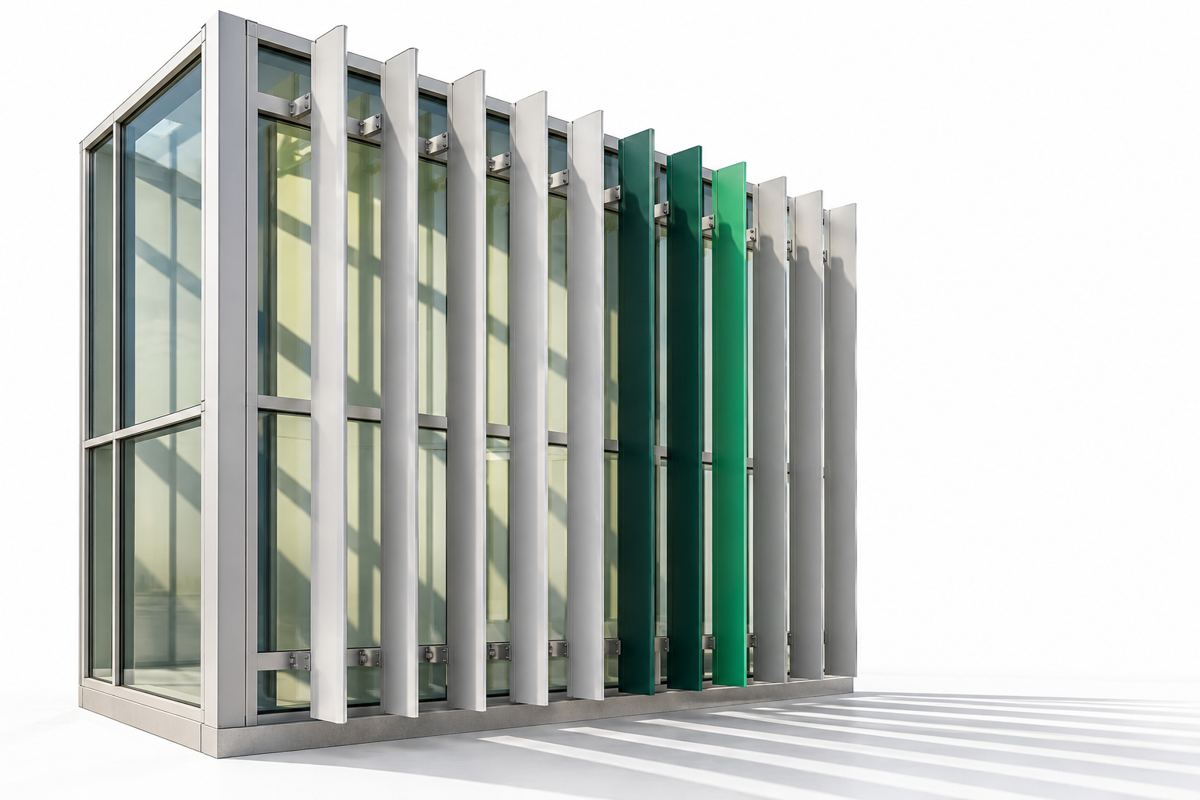
The image used in this article is generated with an AI tool and does not depict any real-time moment
Energy codes, glass-heavy skylines and rising cooling loads are pushing louvers from accent feature to core façade component. Three new aluminium profiles are arriving to meet that demand.
Look at newer commercial projects in Indian cities and a pattern is hard to miss: glazed façades now wear a second skin of fins, blades and screens. The same idea is spreading to residential balconies, gates and boundary walls. In most cases, the material behind it is aluminium.
Alstone India has added three profiles to its louvers range: Series 5000, Series 3600 and Series 2600. This article looks at why demand for aluminium louvers is shifting, what the new series offers, and what specifiers should ask any supplier before committing to a system.
Why louvers are moving up the specification list
Regulation is a large part of the answer. The Bureau of Energy Efficiency's Energy Conservation and Sustainable Building Code (ECSBC) 2024 succeeds ECBC 2017 and introduces three performance tiers: ECSBC Compliant, ECSBC Plus and Super ECSBC. It covers commercial and office buildings with a connected load of 100 kW or a contract demand of 120 kVA or more. Its predecessor already made passive design measures such as daylighting and shading mandatory, and an external louver is one of the most direct ways to cut solar gain before heat reaches the glass.
Aluminium suits the job for reasons this industry knows well. It is light enough to keep structural loads and fixing costs down, it does not rust, and it is fully recyclable at end of life. Those properties matter more as louvers move from small accent features to large-area cladding, where weight, corrosion and lifecycle cost often decide the specification.
To know the global production, demand and consumption forecasts of aluminium extrusions in the building & construction sector, explore our report "The World of Aluminium Extrusions to 2035"
What the new series brings
The launch comprises three vertical ribbed profiles, each pitched at a different design mood:
- Series 5000 comes in slate grey. The finish is cool and neutral, suited to contemporary commercial façades and clean-lined interiors.
- Series 3600 carries a timber-look finish in warm brown tones. It gives the feel of wood in a material that does not need re-oiling, sanding or termite treatment.
- Series 2600 is a deep charcoal. It reads as almost black from a distance and works as a high-contrast accent against light render, glass or stone.
Technical snapshot: Each series is [extruded / roll-formed: confirm] in [alloy and temper], with a wall thickness of [x mm] and a [coating system] finish. [Add fin width, depth and standard lengths.]
The new profiles sit alongside Alstone's existing louvers, which are organised into two categories: ventilated fin louvers for airflow and sun control, and fixed louvers that provide permanent ventilation, light control and privacy. The existing shade card runs to 15 colours and wood-grain finishes, from Pure White and Armani Grey to Nyana Teak, Tiger Wood and Rosewood.
Explore downstream aluminium products from our comprehensive list on AL Biz.
Where they fit
Alstone positions its louvers range for exterior and balcony cladding, canopies, roof cladding, fences and railings, gate panelling and interior highlighter walls. The range is lightweight, supplied ready to use, and water and termite proof. For fabricators and applicators, that keeps handling and site work simple, which matters on projects where louver area runs into hundreds of square metres.
Five questions to ask before specifying any aluminium louver
- What are the alloy, temper and wall thickness? These set stiffness and the maximum unsupported span.
- Which coating system is used, and what does the warranty cover? Ask for the test standard it was qualified against, and whether the warranty holds in coastal, high-UV or heavily polluted locations.
- How does the fixing handle thermal movement? Aluminium expands by about 23 micrometres per metre for every degree Celsius. A 3 m fin therefore changes length by close to 3 mm across a 40°C swing between a cool morning and a hot afternoon, so fixings must allow for it.
- What wind-load data is available? Louvers on tall façades behave like sails. Ask for calculated or tested values for your building height and wind zone rather than a generic statement.
- What documentation supports fire and sustainability claims? Aluminium itself is non-combustible, but a façade is judged as an assembly. Ask for reports on the finished product, and for recycled-content data if the project is chasing IGBC, GRIHA or LEED credits.
The bigger picture
Louvers used to be judged mainly on looks. Today they are also judged on what they do for solar gain, daylight and airflow, and on how long they last without attention. That favours aluminium. It also favours manufacturers who can offer a real range of profiles and finishes, consistent finish quality, and documentation that an architect can hand to a green-building consultant.
Alstone's Series 5000, 3600 and 2600 are the company's latest step in that direction. Alstone works through 16 offices, two manufacturing bases and a network of more than 500 channel partners across India.
Note: This article has been shared by Sameer Kumar from Alstone India and has been published by AL Circle with its original information without any modifications or edits to the core subject/data. As this is an exclusive coverage, republish or share will need prior permission.
Anshika Jain steps down from Golkonda Aluminium Extrusions
Next articleAlumil India designs innovative fenestration for NICMAR University’s precast campus in Pune
Grow with
AL Circle