Oceania’s aluminium and alumina industries are navigating a period of transition. Refinery closures, rising power prices, and shifting global markets have reshaped output across the region. Australia remains at the centre of this activity, continuing to supply much of the world’s bauxite, alumina, and primary aluminium.
Between 2023 and 2025, aging infrastructure, cost pressures, and softer market conditions have gradually weighed on production. Even so, producers are investing in modernisation, environmental improvements, and digital upgrades to make operations more efficient and resilient for the long term.
Daily aluminium output holds steady
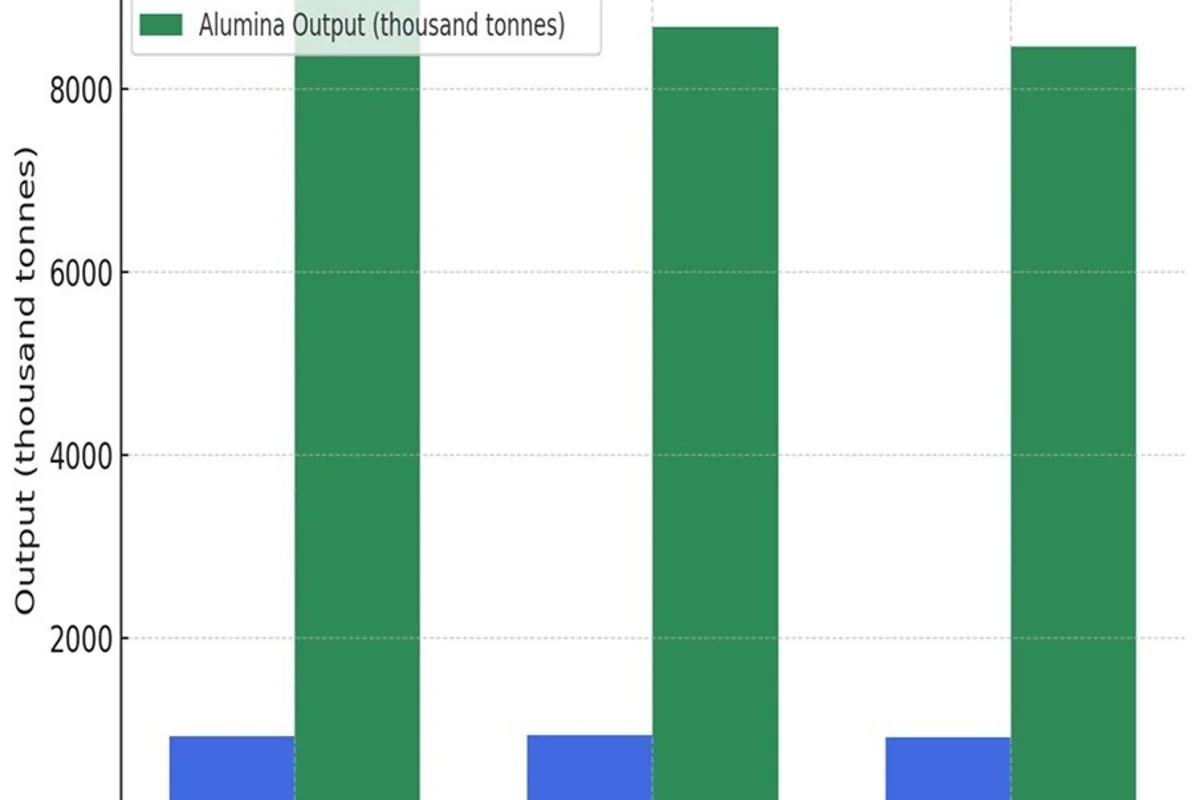
From January to June 2025, Oceania produced 923 thousand tonnes of aluminium, down 1.8 per cent from 940 thousand tonnes in the same period of 2024 and slightly below 929 thousand tonnes in 2023. Daily output stayed largely stable, averaging about 5.1 thousand tonnes per day.
Production peaked in March at 158 thousand tonnes, followed by May and January with 157 thousand tonnes each. The lowest level came in February, at 143 thousand tonnes, while April and June both recorded 154 thousand tonnes.
The 2024 period was marginally stronger, led by May at 162 thousand tonnes, followed by March and January with 161 and 160 thousand tonnes. In 2023, total aluminium output was 929 thousand tonnes, with January and May leading and February marking the lowest level at 144 thousand tonnes.
The small fluctuations were tied mainly to maintenance work, short-term supply interruptions, and changes in power prices. Heavy reliance on coal-fired energy has left smelters exposed to electricity cost swings and occasional supply disruptions. Still, these were temporary issues, not long-term production constraints.
Alumina output declines as refineries consolidate
Between January and June 2025, alumina production across Oceania totalled 8.47 million tonnes, down 2.4 per cent from 8.68 million tonnes a year earlier and 7.8 per cent below 9.19 million tonnes in 2023.
Output peaked in January at 1.52 million tonnes, followed by March with 1.45 million tonnes and May with 1.41 million tonnes. The lowest production came in February, at 1.35 million tonnes, while April and June stood at 1.40 and 1.34 million tonnes.
In 2024, alumina production reached a high of 1.61 million tonnes in January, remaining firm through the next few months before easing to 1.31 million tonnes in June. In 2023, the total reached 9.19 million tonnes, led by January’s 1.68 million tonnes, with May and April slightly lower.
Kwinana closure underscores market shifts
A large part of the decline stems from Alcoa’s closure of the Kwinana alumina refinery in Western Australia, coupled with rising energy costs and global oversupply.
The refinery, which once produced 2.2 million tonnes a year, started scaling down in early 2024 and will be shut completely by late 2025. It had been running at roughly 80 per cent capacity since 2023, hindered by aging equipment, growing maintenance costs, and declining efficiency compared with newer refineries abroad.
Falling bauxite quality from nearby mines added to the problem, increasing the energy and chemical intensity of production. In 2023, Kwinana reported pre-tax losses of about USD 130 million. The expansion of Chinese alumina capacity during the same period depressed global prices, further undermining profitability.
Most other Australian refineries face similar challenges. Their dependence on coal-fired power leaves them vulnerable to price volatility and environmental pressure, making cost control and energy transition key priorities for the years ahead.
After Kwinana’s closure, Alcoa has concentrated its production at the more advanced Pinjarra and Wagerup refineries. These plants now form the backbone of the company’s Australian operations, supported by new projects aimed at improving performance and sustainability.
The Pinjarra Refinery Expansion project will lift capacity by around five per cent, taking total output to 5.25 million tonnes a year. The expansion is tied to new bauxite mining areas in Myara North, Holyoake, and O’Neil, which are currently under environmental review.
To secure feedstock supply, Alcoa is also extending the Huntly and Willowdale mines, ensuring continuity of resources through 2045. In parallel, a USD 115 million residue filtration upgrade at Pinjarra is being installed to reduce water in refinery waste and improve processing efficiency.
Together, these initiatives reflect a strategic shift in Oceania’s refining sector — away from volume growth and toward reliability, sustainability, and cost efficiency.
Oceania’s role in the global aluminium chain
Despite recent declines, Oceania — led by Australia — remains a cornerstone of the world’s aluminium industry. The region holds vast bauxite reserves and operates some of the most significant alumina refineries globally. Facilities such as Pinjarra and Wagerup supply domestic smelters and international markets alike.
The output slowdown seen in recent years marks not a decline but a strategic realignment. With a stronger focus on sustainable mining, refinery upgrades, and energy efficiency, Oceania is positioning itself for a more balanced and competitive role in the global aluminium value chain.












_md.webp)
_md.webp)
_md.webp)







