The market dynamics of the aluminium industry in North America are gradually displaying a positive change, with a demand recovery in Q4 2023, as indicated by the preliminary estimates of the Aluminum Association. Even the beginning of 2024 has set a progressive tone, as the association’s index of net new orders of aluminium bill products hit 114.5 (baseline index of 100), the highest level since June 2022.
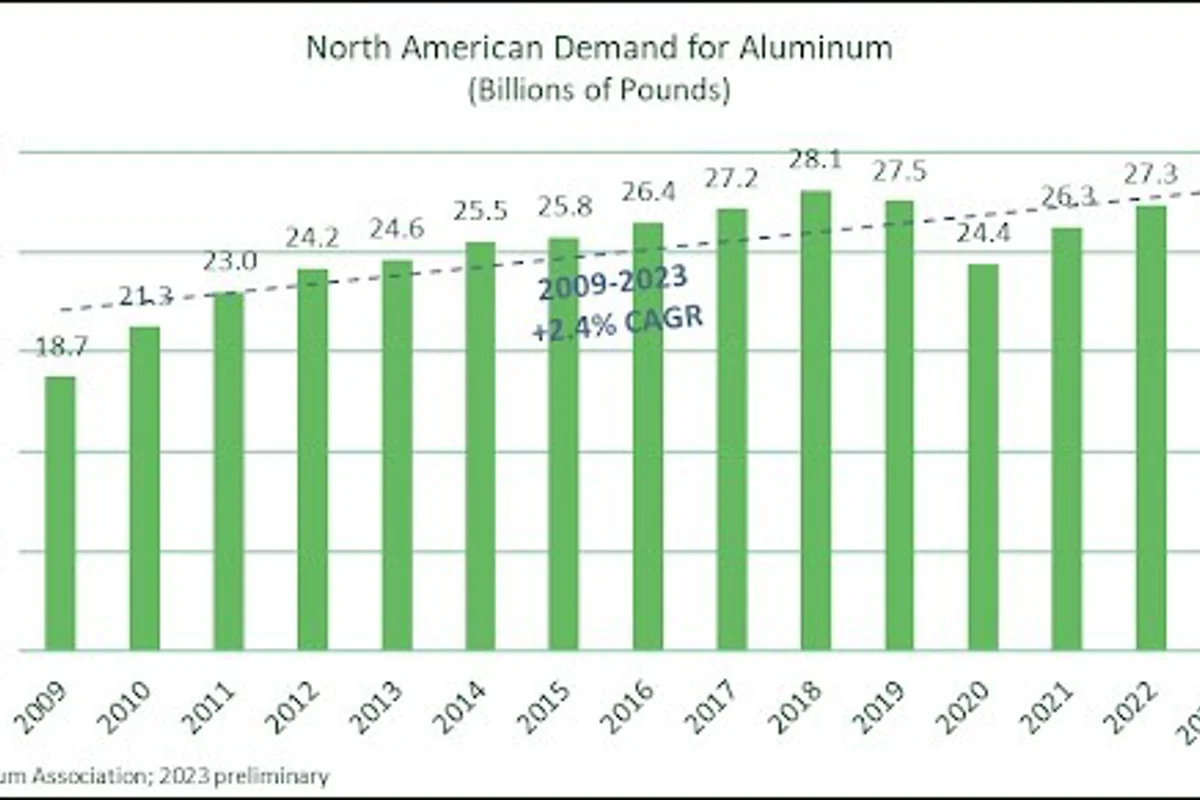
Until the third quarter of 2023, aluminium demand in North America was sluggish, contracting by 4.4 per cent year-on-year to about 20,908 million pounds. That led to a downfall in the full-year demand by about 3.9 per cent, totalling 26,271 million pounds, compared to 27,337 million tonnes a year ago. The recovery in Q4 slightly offset the annual fall.
Charles Johnson, president & CEO of the Aluminum Association, commented: “While North American demand declined slightly in 2023 following strong results in 2022, this latest data shows early signs of recovery.”
He added, “With historic U.S. aluminum manufacturing investment, steady domestic shipments and continued growth opportunities in many of our key markets, the trendlines for U.S. aluminum remain strong.”
Aluminum Association’s report also showed that North America’s domestic aluminium industry enjoyed a 2.4 per cent compound annual growth rate since 2009. In 2023, aluminium electrical wire and cable demand saw a 12.1 per cent Y-o-Y demand growth, driven by strong electrical infrastructure market.
Demand for semi-fabricated or mill products declined 9.2 per cent Y-o-Y in 2023, leading to a 26.3 per cent decline in the imports of aluminium ingot and mill products into North America through 2023. Due to weaker demand, exports from the US and Canada increased 25.6 per cent in the said year.
Detailed reflection on trade dynamics
In 2023, the United States imported 5.57 million tonnes of aluminium, which was year-on-year down by 11.59 per cent from 6.3 million tonnes, according to the US Census Bureau data. In December, the imports stood at 439,000 tonnes, which was also 16.86 per cent lower than 528,000 tonnes a year ago.
Of the total imports in 2023, aluminium crude metals and alloys import accounted for 68.40 per cent, amounting to 3.8 million tonnes – 8.43 per cent less than 4.15 million tonnes in 2022. The United States’ aluminium plates, sheets and bars import in 2023 was 1.08 million tonnes, accounting for 19.39 per cent of the total imports.
The United States aluminium imports in the entire year of 2023 displayed a downtrend due to poor demand. But the imports from Canada rose year-over-year by 1.87 per cent from 3.21 per cent to 3.27 per cent.
From January to December 2023, Canada exported 2.64 million tonnes of aluminium crude metals and alloys and 229,000 tonnes of aluminium plates, sheets and bars and 397,000 tonnes of recycled aluminium.
Besides weaker demand, additional 10 per cent tariff on imported aluminium could be another reason for the fall in imports. Most aluminum products imported into the U.S. are subject to a 10% tariff authorized by Section 232 of the Trade Expansion Act of 1962.
Aluminium production in the US
According to the US Geological Survey, the United States’ domestic production of primary aluminium totalled 750,000 tonnes in 2023 versus 861,000 tonnes a year earlier. That indicated a year-on-year plunge of 12.89 per cent.
In December 2023, the United States primary aluminium production was 64,000 tonnes, up by 3,000 tonnes or 4.9 per cent from 61,000 tonnes in November 2023. However, on a year-on-year basis, the output showed restraint, according to the USGS data.
The average daily output in full-year 2023 was 2,050 tonnes per day, down by 13.14 per cent from 2,360 tonnes.
In 2023, the total volume of aluminium recovered from scrap was 3.31 million tonnes, essentially unchanged from 3.39 million tonnes in 2022.
Weaker demand in the United States till the third quarter of 2023 was one of the valid reasons for decreased production of the metal. High energy prices also led some producers to cut their production capacity. In addition, the country’s focus shift to aluminium recycling was another key reason for the primary aluminium production fall.
In a very recent time (February 2024), the United States ruled out Russian aluminium and nickel from its new set of sanctions. According to a report on February 26, the United States declared sanctions on more than 500 people and entities in Russia and eliminated base metals, including aluminium and nickel. In early February, there was speculation that the United States might impose a fresh wave of sanctions on Russian aluminium and nickel, following which the prices of the two metals rose, assuming limited supply would occur in the wake of sanctions.
However, subsequently, the aluminium prices fell as the United States announced the exclusion of aluminium and nickel from its fresh sanctions list.














_md.webp)